Nasal Rasp Guide: How to Choose the Cut and the Grit
Oct
A nasal rasp is a hand file used in rhinoplasty to lower and smooth the nasal bones a fraction of a millimetre at a time. Surgeons use it after the hump comes off, to blend the dorsum so no step shows through thin skin, and on small humps that do not need an osteotome at all. Adas Instruments makes nasal rasps in high quality medical grade stainless steel, with tungsten carbide or diamond coated faces on the finishing patterns, most of them on an 18 cm body.
Our nasal rasp and saw range holds 15 instruments, and a working tray needs three or four of them. The choice comes down to two questions: which way the teeth cut, and how fine the face is. This guide takes them in that order.
Key takeaways
- A reverse cut rasp removes bone on the draw, toward the surgeon. It is the default in most teaching sets and the safer stroke on a hump.
- A cross cut face cuts both ways, at about half the rate of a single direction face.
- Diamond coated rasps remove bone by abrasion, a few microns per stroke, and are kept for the last pass under thin skin.
- Our steel rasps start at 22 dollars for the Aufricht. Tungsten carbide patterns start at 47 dollars.
What a Nasal Rasp Does in Rhinoplasty
The rasp has three jobs on the nose. The first is lowering a small hump, one too low to justify an osteotome. The second is smoothing the dorsum after the hump has come off, so the edges of the cut do not show. The third is tidying the side walls after the lateral osteotomies.
The second job matters most, and it shows up late. A profile can look straight on the table and still show a small ridge a year on, once thin skin has settled onto every edge left behind. A few careful passes with the right rasp is what prevents that.
Cut Direction: Forward, Reverse or Cross Cut
Look closely at a rasp face and the teeth all lean one way. That lean decides when the rasp removes bone.
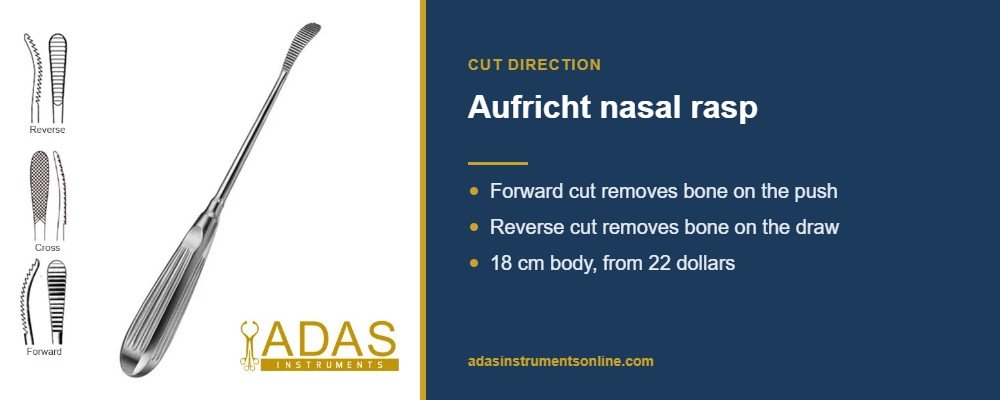
- Forward cut. The teeth lean back, so the rasp removes bone on the push, away from the surgeon.
- Reverse cut. The teeth lean forward, so it removes bone on the draw. The force runs back out of the nose, which is why most surgeons start here.
- Cross cut. Both sets of teeth in a diamond pattern. It cuts in either direction, at roughly half the rate.
The Aufricht nasal rasp comes in all three cuts on an 18 cm body, which makes it the easy way to try each one. The McIndoe is a backward cutting pattern built around the draw stroke. The Maltz is 7.5 mm wide and comes forward cut, reverse cut or double ended, with one of each on a single handle.
Steel Teeth, Tungsten Carbide or Diamond
The face is the second choice. Cut steel teeth remove bone fastest. Tungsten carbide teeth do the same job and hold their edge far longer, which matters on a rasp because you cannot regrind one the way you can an osteotome.
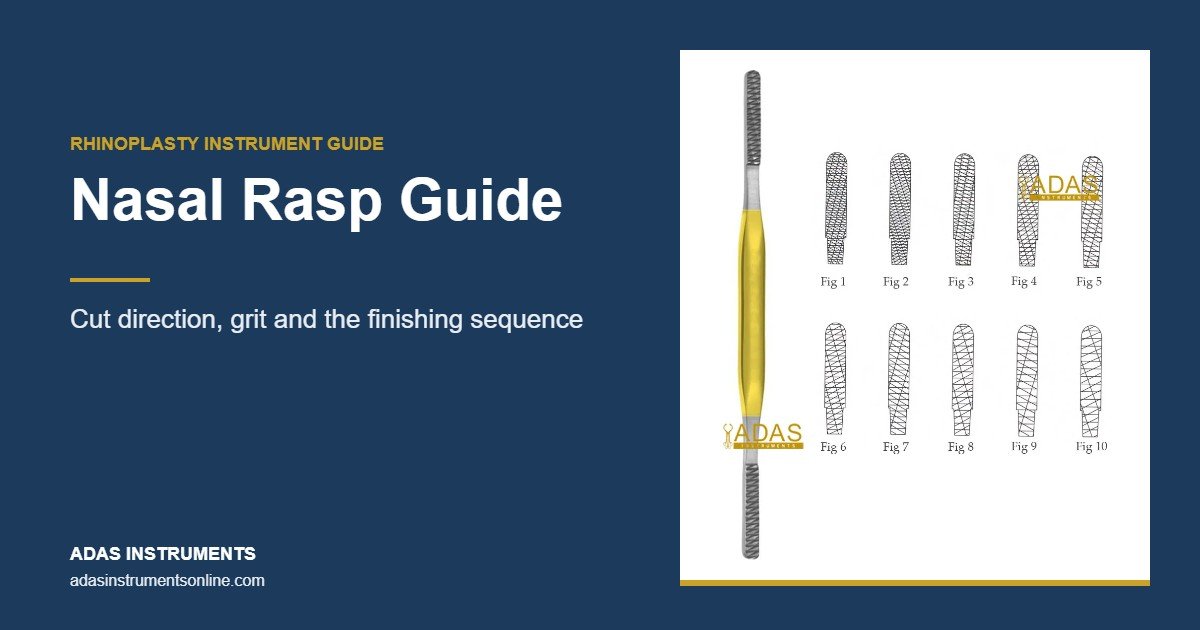
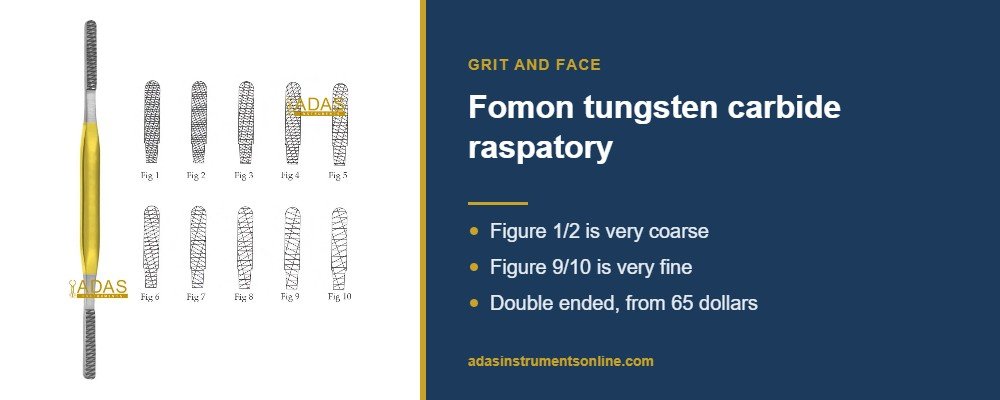
Our Fomon tungsten carbide raspatory names its grits in pairs. Figure 1/2 is very coarse and Figure 9/10 is very fine, with 3/4, 5/6 and 7/8 in between. The standard Fomon pairs a flat face with a convex one. The flat face is for the straight middle third of the dorsum, where it loads evenly across the bone.
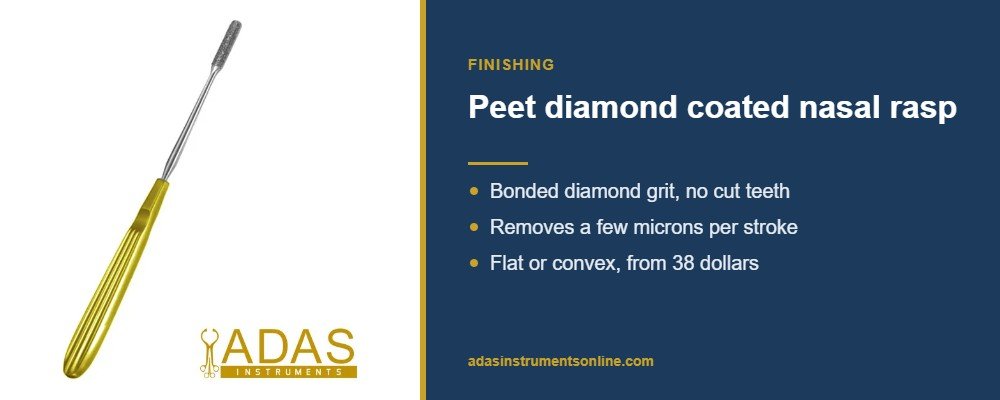
Diamond coated rasps work differently again. The Peet carries bonded diamond grit instead of cut teeth, so it removes bone by abrasion, a few microns per stroke. It leaves a surface closer to sanded than filed. That is the finish you want under thin skin.
Nasal Rasp Patterns and Prices
| Pattern | Cut | Face | From |
|---|---|---|---|
| Aufricht nasal rasp, 18 cm | Forward, reverse or cross cut | Steel teeth | $22 |
| Barsky nasal rasp, 18 cm | Reverse cut, straight | Steel teeth | $24 |
| Maltz nasal rasp, 18 cm | Forward, reverse or double ended | Steel teeth, 7.5 mm wide | $26 |
| McIndoe nasal rasp, 18 cm | Backward cut, straight | Steel teeth | $26 |
| Fomon rasp | Coarse or fine reverse cut | Steel, one flat end and one convex | $32 |
| Peet nasal rasp | Flat or convex, straight or curved | Diamond coated | $38 |
| McIndoe nasal rasp | Forward or reverse cut | Tungsten carbide | $48 |
| Fomon nasal raspatory | Figure 1/2 to Figure 9/10 | Tungsten carbide, double ended | $65 |
Shop nasal rasps direct from the maker
Every rasp in the table comes from the Adas Instruments workshop. Steel patterns from 22 dollars, diamond coated Peet rasps at 38 dollars, tungsten carbide from 47 dollars. Wholesale pricing for clinics and distributors, branded or plain.
The Finishing Sequence: Coarse to Fine
Rasping works like sanding a door. A coarse face sets the line, a medium one blends it, and a fine or diamond face finishes. Between grades, run a wet gloved finger along the dorsum. You will feel a step long before you can see one.
A tray needs at least two grades to do this properly. Many surgeons carry a reverse cut steel rasp for the work and a diamond rasp for the finish. Our 72 piece rhinoplasty set includes a diamond dust glabella rasp alongside the Cottle and Rubin osteotomes it follows.
The rasp comes after the cut, so the two are bought together. Our osteotome vs chisel guide covers the bone cuts that come first, and the essential rhinoplasty instruments guide lists the full tray. The NIH StatPearls review of rhinoplasty describes where rasping fits in the operation.
Cleaning a Nasal Rasp
Rasp teeth pack with bone dust, and dried dust is very hard to shift. Rinse the rasp in the theatre before it dries. Then clean it in an ultrasonic bath and brush across the teeth, not along them, so the bristles reach into each groove. After that it goes through normal autoclaving at up to 134 C, as set out in our autoclaving time guide.
A rasp that suddenly cuts unevenly is usually a clogged rasp. It feels like a technique problem. It is a cleaning one.
Frequently Asked Questions
What is a nasal rasp used for?
A nasal rasp lowers and smooths the nasal bones in rhinoplasty. It takes down small humps, blends the dorsum after a hump has been removed, and tidies the side walls after the lateral cuts, removing a fraction of a millimetre per stroke.
What is nasal rasping?
Nasal rasping is filing the bony bridge of the nose with a rasp instead of cutting it with an osteotome. It suits small bony humps and the final smoothing of the dorsum, and it is often done as one step within a larger rhinoplasty.
Does a rasp replace an osteotome in rhinoplasty?
No. They work as a pair. The osteotome makes the structural cuts and removes a large hump in one piece. The rasp refines what is left, and on a small hump it may be the only bone instrument the surgeon needs.
What is the difference between a forward and reverse cut rasp?
A forward cut rasp removes bone on the push, away from the surgeon. A reverse cut rasp removes bone on the draw, toward the surgeon, so the force runs out of the nose. Reverse cut is the default in most teaching sets.
How do you clean a nasal rasp?
Rinse it before the bone dust dries, then put it through an ultrasonic bath and brush across the teeth to clear each groove. Autoclave as normal afterwards. A rasp that starts cutting unevenly usually has packed teeth, not a worn face.
