
Cartilage Crushers and Morselizers in Rhinoplasty
Oct
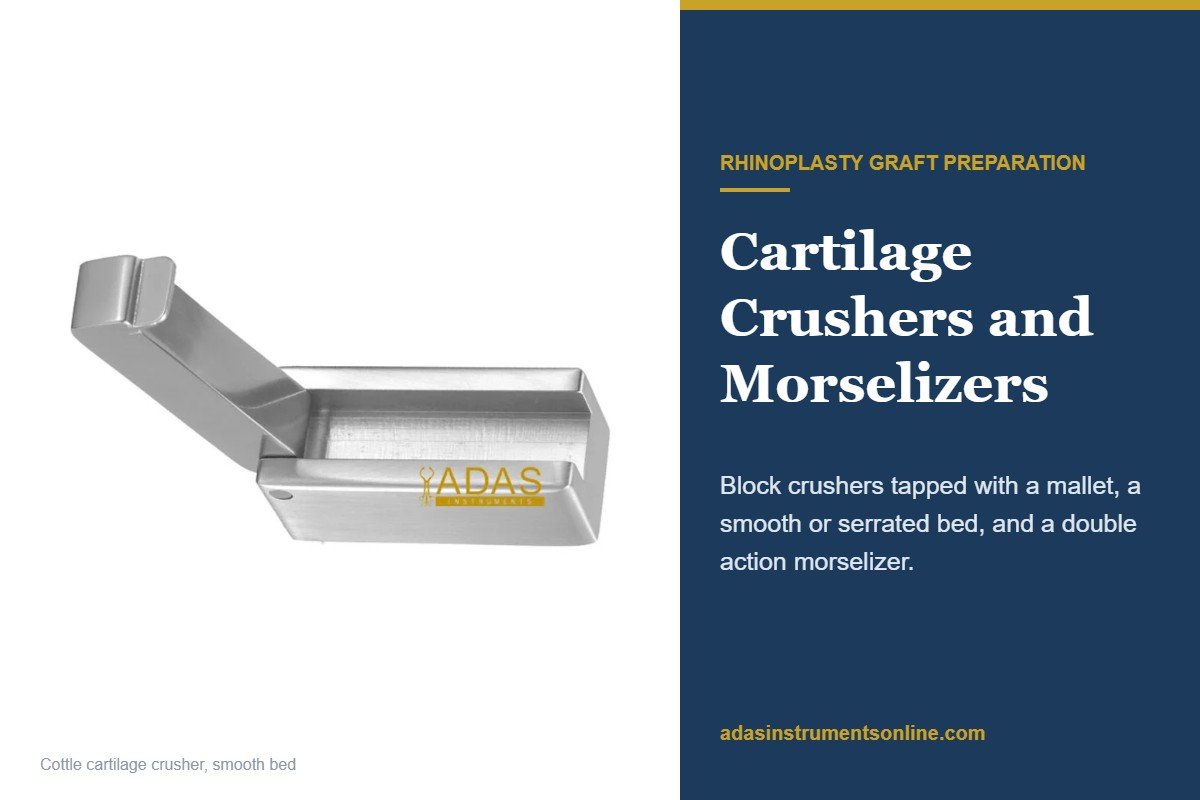
A cartilage crusher morselizer pair softens harvested cartilage before it becomes a graft. The crusher is a small steel block with a bed and a hinged lid: the surgeon lays septal or ear cartilage in the bed, closes the lid and taps it with a mallet until the graft loses its spring. A morselizer softens cartilage by scoring it between toothed jaws instead. Adas Instruments makes 2 block crushers and a double action morselizer for rhinoplasty, all in high quality medical grade stainless steel, listed with our nasal crushers and septum forceps.
Cartilage crushers and morselizers are the graft kitchen of rhinoplasty: they turn harvested septal or ear cartilage into exactly the consistency a graft site needs, from gently bruised to finely diced. As grafting techniques dominate modern structural and camouflage rhinoplasty, these two instruments have moved from optional to essential. This guide covers both instruments as we make them, and what each one does to a graft.
Key takeaways
- A block crusher is tapped with a mallet, not squeezed, so the force spreads across the whole graft.
- A smooth bed flattens cartilage to an even thickness; a serrated bed scores it so it bends one way.
- Thick septal and rib cartilage need the heavier Jost block, because a light tap does nothing to dense fibers.
- Only camouflage and onlay grafts should be softened. Spreader and strut grafts stay uncrushed.
The Crusher: Controlled Softening
A cartilage crusher is a block, not a press. The graft sits in a bed, a hinged lid closes over it, and the surgeon taps the lid with a mallet, so the force spreads evenly across the whole piece instead of pinching one edge. A few light taps leave cartilage bruised but whole, which is right for camouflage over the dorsum, where an uncrushed graft would show its edges through thin skin.
On the Cottle cartilage crusher the bed comes smooth or serrated. Smooth flattens to an even thickness; serrated scores the graft as it flattens, so it bends in a chosen direction.
The heavier Jost cartilage crusher, which catalogs also list as the Gubisch, is built for thick septal cartilage and rib, where a gentle tap achieves nothing.
The Morselizer: Texture Without Destruction
A morselizer’s jaws carry fine pyramid teeth that score and soften cartilage while preserving more of its viability than crushing. Morselized cartilage bends and drapes, used to break the memory of a warped graft or soften a spreader edge. Our Gorney septal morselizer is double action with tungsten carbide inserts, and it morselizes septal cartilage in place, without removing it. The distinction matters: crushing weakens by fracture, morselizing by controlled scoring.
Diced Cartilage and the Fine End
Diced cartilage grafts (with or without fascia wrap) need a different path: sharp blades on a firm board, cutting 0.5 to 1 mm cubes that pack into camouflage layers. A cartilage crusher morselizer set still earns its place preparing the source material before dicing.
Buying and Care Notes
Check that the lid meets the bed flat (hold them to the light), that the hinge has no side play, and that teeth on morselizer jaws are cut, not cast. Rinse immediately after use, because dried cartilage in tooth valleys is stubborn, then autoclave normally per our sterilization guide. They complete the graft chain alongside the Ballenger knife that harvests the material.
Cartilage Crusher Morselizer Options and Chamber Sizes
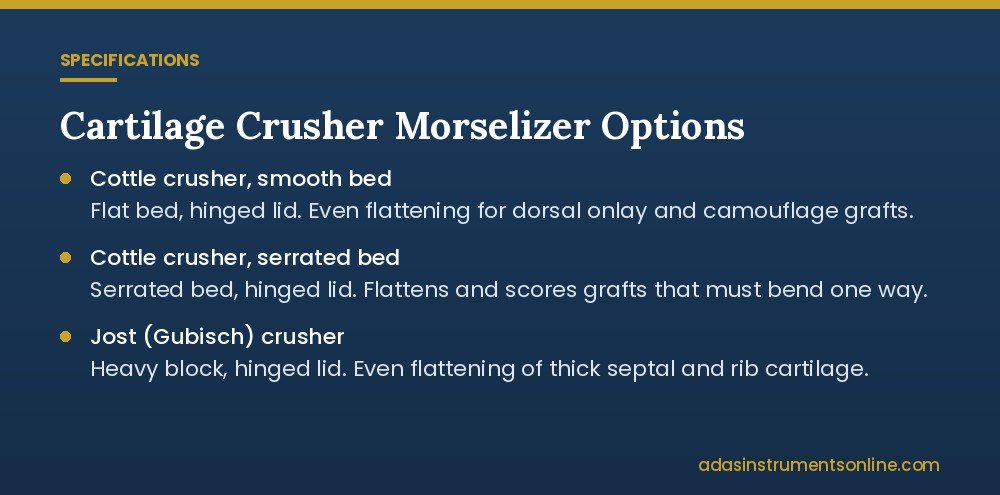
A cartilage crusher morselizer is chosen on the bed surface and on how much force the cartilage needs. The aim is a graft that keeps some structure, not cartilage paste.
| Instrument | Chamber or plate | Effect on graft | Usual application |
|---|---|---|---|
| Cottle crusher, smooth bed | Flat bed, hinged lid | Even flattening | Dorsal onlay and camouflage grafts |
| Cottle crusher, serrated bed | Serrated bed, hinged lid | Flattens and scores | Grafts that must bend one way |
| Jost (Gubisch) crusher | Heavy block, hinged lid | Even flattening of dense cartilage | Thick septal and rib cartilage |
| Gorney septal morselizer | Double action jaws, tungsten carbide inserts | Scored, not flattened | Septal cartilage softened in place |
| Blade and graft board | Flat cutting surface | Diced into 0.5 to 1 mm cubes | Diced cartilage in fascia |
Shop cartilage crushers direct from the maker
Adas Instruments makes the Cottle crusher with a smooth or serrated bed, the heavier Jost block for rib and thick septal cartilage, and the double action Gorney morselizer with tungsten carbide inserts. Each carries a 3 year replacement warranty against manufacturing defects. Wholesale pricing for clinics and distributors, branded or plain.
How Good Cartilage Gets Ruined
Graft preparation is where a technically good rhinoplasty can quietly lose its result at one year. A 2007 series of 462 patients in Archives of Facial Plastic Surgery found that how hard a graft is crushed affects how much of it lasts. Five errors do most of the damage.
- Over crushing. Heavy crushing destroys chondrocyte viability and the graft resorbs. Start light and reassess.
- Crushing structural grafts. Spreader and strut grafts need strength. Only camouflage and onlay grafts should be softened.
- Dirty plates. Dried cartilage and blood on the plates change the gap and the crush. Clean between grafts, not at the end.
- Wet chamber, slipping graft. Excess fluid lets the graft slide out of line. Blot the graft, keep it moist, do not flood it.
- Ignoring plate alignment. Plates that no longer meet in parallel crush one edge harder. Check them against the light.
Specifying Graft Preparation Instruments
When you order a cartilage crusher morselizer, the questions that matter are the bed surface, smooth or serrated, whether you work mostly with thin septal or thick rib cartilage, and how easily the lid and hinge can be brushed clean. Protein left in a hinge survives processing that the flat faces pass. Ours are made in high quality medical grade stainless steel and are listed with the rest of the nasal set in the rhinoplasty instruments range.
Laser marking with your clinic name, and a complete graft preparation kit built to a written list, are available on request.
Fitting Graft Preparation Into the Rhinoplasty Set
Graft preparation happens on a side table, and that table needs its own small set: a board, a fresh blade, fine plastic surgery scissors, toothed forceps and the crusher. Treating it as part of the main tray is how practices end up cutting grafts on a towel.
The upstream tools matter too. Cartilage has to be harvested before it is shaped, so the dissectors and elevators range and the septal instruments determine how much usable material reaches the board. Our essential rhinoplasty instruments guide sets out the full working list if you are equipping a new room.
Frequently Asked Questions
What is a cartilage crusher used for?
It flattens harvested septal or ear cartilage so the graft loses its spring but keeps enough structure for camouflage. Surgeons use it most over the dorsum, where thin skin would show the firm edge of an uncrushed graft.
What is the difference between crushing and morselizing cartilage?
Crushing flattens the graft between a bed and a lid, weakening it by fracture. Morselizing scores it with toothed jaws, softening it while it keeps more of its shape. The choice depends on how much structure the graft must keep.
Does crushing cartilage cause it to resorb?
Heavy crushing reduces cell viability and is linked with more resorption over time. Light crushing of camouflage and onlay grafts is widely used, while structural grafts such as spreaders and struts are left uncrushed.
Which cartilage crusher should I buy?
For everyday septal grafts, the Cottle block, with a smooth bed for even thickness or a serrated bed for grafts that must bend one way. For rib or thick septal cartilage, add the heavier Jost, because a light tap does little to dense fibers.
How do you clean a cartilage crusher properly?
Rinse it straight after use, open the lid and brush the bed, the lid face and the hinge under running water, then process it open so steam reaches every surface. Dried cartilage in a serrated bed is hard to shift later.
