


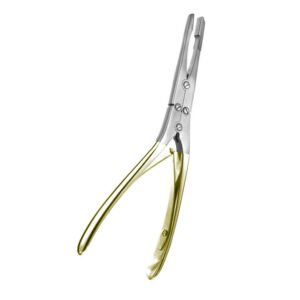
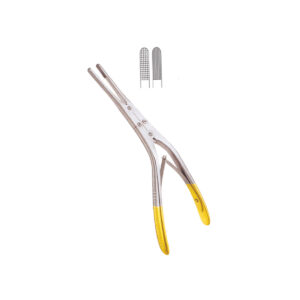
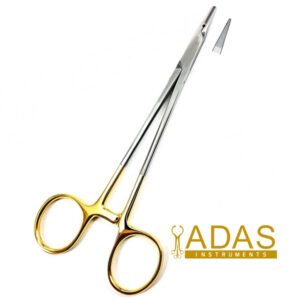
Gorney Septal Morselizer | Double Action, Tungsten Carbide
$ 75.00
The Gorney septal morselizer does not move a septum, it softens one. Double action jaws with tungsten carbide inserts crush a line of septal cartilage so it will bend and stay bent, which is what you want when the cartilage is straight enough to keep but too rigid to sit where it is put. Crushing it in place is the alternative to cutting a piece out.
Key Features
- Softens septal cartilage in place instead of removing it
- Double action, so the jaw force is multiplied twice over
- Tungsten carbide inserts in the crushing faces
- No ratchet. The jaws close under hand pressure alone
- Cut from high quality medical grade stainless steel and fully autoclavable
- Three year replacement warranty against manufacturing defects
- Item code AQ-10.58
5 in stock (can be backordered)

What a Gorney septal morselizer is
A deviated septum is not always a septum in the wrong place. Sometimes it is a septum in the right place that will not stay there, because the cartilage has a memory and springs back to the curve it has held for twenty years. You can cut the curved part out, which costs you cartilage you might want later, or you can take the spring out of it where it sits.
That is what a morselizer does. The jaws close on a line of cartilage and crush it just enough to break the fibers that are holding the curve, without cutting through and without removing anything. The cartilage is still there, still supporting the nose, and it now bends where it is told to.
The Gorney septal morselizer is the double action pattern, which matters more here than on most instruments. A single hinge gives you whatever your hand gives it; two hinges multiply it, and crushing cartilage takes real force applied evenly rather than a hard squeeze at one point. The crushing faces carry tungsten carbide inserts for the same reason the carbide forceps do: a crushing face that has polished smooth slides instead of biting.
It is listed as a septal morselizer, a septum morselizer forceps, a double action morselizer and as a cartilage morselizer, which Google uses as the plain alias of cartilage crusher. This is the handheld version of that job. The block crushers in this family do the same thing to a graft on a bench, where a block crusher is not squeezed, it is tapped with a mallet, which is how the force stays even across the whole graft.
One honest note about the URL. The web address of this page spells the instrument “morselize”. That is a typo from years ago and the address is frozen, because changing it would break every link and bookmark pointing at it. The instrument is a morselizer and the page now says so everywhere except in the address bar.
Key design features
Double action, and why it is not a luxury here
Two hinges rather than one. The mechanical advantage roughly doubles, which means the cartilage is crushed by the instrument rather than by the strength of the hand holding it. On a job that is about even pressure along a line, that is the difference between softening cartilage and splitting it.
Tungsten carbide crushing faces
Inserts brazed into the jaws, not a coating. A crushing face works by biting into a slippery surface and holding it still while the force builds, and a face that has polished smooth skids sideways instead. Carbide keeps the bite for the life of the instrument.
It crushes a LINE, not a point
The faces are long enough to take a strip of cartilage in one closure. A septum softened at three separate points has three weak spots and two stiff sections between them; softened along a line, it bends as one piece. That is the whole clinical argument for the pattern.
No ratchet, no lock, no coating
Hand pressure, released as soon as the jaws are opened. Nothing holds the instrument closed on tissue, which on a crushing instrument is a safety feature rather than a missing one.
What to order, and what we do not publish
One pattern, so this table is the specification and its limits.
| Specification | What we publish | Why |
|---|---|---|
| Action | Double action, two hinges | From our own product name and our own existing description |
| Crushing face | Tungsten carbide inserts | From our own product name |
| Crush width or jaw length | NOT published by us | There is NO attribute set on this product. Ask us before ordering if a figure has to be matched. It is on our list to measure |
| Overall length | NOT published by us | Same answer |
Where it is used
Septal work where the cartilage is worth keeping. The Gorney septal morselizer is reached for in all four of these.
| Procedure | What the morselizer does | Note |
|---|---|---|
| Septoplasty on a springy septum | Softens the cartilage so it stops returning to its old curve | The main use, and the alternative to resecting the curved part |
| Septorhinoplasty | Softens a line so the septum can be set and will hold | Used before the straightening forceps, not instead of them |
| Spreader graft preparation | Takes the spring out of a strip of cartilage | The block crushers do this better on a bench |
| Revision septal surgery | Softens cartilage that has been scarred and is now rigid | Where there is little cartilage left, softening beats cutting |
What it holds back, and what it must not do
Crushing is a one way operation and that is the point of the right hand column.
| The task | What this instrument does | What it must not do |
|---|---|---|
| Softening cartilage | Crushes a line so the cartilage bends and stays bent | It is NOT reversible. Cartilage that has been crushed too far does not firm up again, and judging that is the surgeon’s work, not the instrument |
| Keeping the septum intact | Nothing is cut and nothing is removed | It must not be closed until the jaws meet metal to metal on cartilage. That is not softening, it is cutting without a blade |
| Straightening the septum | It takes the spring out so straightening will hold | It does not move the septum. That is the Asch or the Cottle Walsham |
| Crushing a harvested graft | It will, in a pinch | A graft on a bench belongs in a block crusher, where the pressure is even across the whole piece |
How it compares with the rest of the family
Three instruments in this family crush cartilage and the difference is where the cartilage is when they do it.
| Instrument | Where the cartilage is | Action | Buy it when |
|---|---|---|---|
| Gorney septal morselizer, this page | Still in the nose | Double action, handheld, carbide faces | The septum has to bend in place and be kept |
| Cottle cartilage crusher | Harvested, on a bench | Block, tapped with a mallet, serrated or smooth bed | A graft has to be flattened or scored evenly |
| Jost cartilage crusher | Harvested, on a bench | Block, heavier, for tougher septal and rib cartilage | The cartilage is thick and the Cottle is working too hard |
| Asch septum straightening forceps | Still in the nose | Single action, a permanent protective gap | The septum has to MOVE rather than soften |
Materials and finish
Every Gorney septal morselizer we make is cut from high quality medical grade stainless steel. The steel itself is made to a German specification. We do not publish a grade number. The number on a certificate tells a surgeon nothing about whether two hinges still line up after two hundred autoclave cycles, because a double action joint that has worn out of line crushes harder on one side than the other, and the answer to that is in the making rather than in the alloy.
Both pivots are machined and fitted as a pair rather than drilled and pinned separately. On a double action instrument the two hinges have to share the load; one that is slightly tighter than the other takes more of it and wears faster, and the instrument ends up crushing unevenly along the face.
The carbide inserts are brazed into seats and finished flush with the steel around them. There is no sharp external edge anywhere on the outline.
Caring for it
Nothing abrasive on the crushing faces. The bite is the instrument and an abrasive pad takes it off.
Wash both joints open, because there are two of them and both hold blood. Warm water and a soft brush. Autoclave with the tray. Close the jaws empty every so often and look along the faces: they should meet along their whole length, and a pair that now touches at one end only is a double action joint that has gone out of line.
Ordering and wholesale
Every Gorney septal morselizer is made by Adas Instruments in our own workshop and sold direct, which is why the price sits where it does against the catalog houses. Order one for a single tray, or in quantity for a hospital list or a distributor line. We do OEM work under your own brand and your own item numbers. Send us a sample and we will hold a run to your pattern rather than ours. Stock items ship from our own workshop. Backorder items take 10 to 12 working days to make. Every instrument carries a three year replacement warranty against manufacturing defects. Production is controlled under an ISO 13485 quality management system.
Frequently asked questions
What does a septal morselizer do?
It crushes a line of septal cartilage so the cartilage will bend and stay bent, without cutting anything out. It is the alternative to resecting a curved section: the cartilage stays in place supporting the nose and loses the spring that was pulling it off line.
What is the difference between a morselizer and a cartilage crusher?
Mostly where the cartilage is. A morselizer is handheld and works on cartilage still in the nose. A crusher is a block that sits on a bench and flattens a harvested graft, and it is tapped with a mallet rather than squeezed. Google uses the two words as aliases and in practice the instruments are different shapes for different moments.
Why double action?
Because crushing cartilage takes real force applied evenly. Two hinges roughly double the mechanical advantage, so the pressure comes from the instrument rather than from how hard the surgeon can squeeze, and even pressure is what softens cartilage instead of splitting it.
What are the jaw dimensions?
We do not publish them, because our own record carries no attribute set for this product. Ask us before ordering if a crush width has to be matched, and it is on our list to measure.
Why does the web address say morselize?
Because it was typed that way years ago and web addresses do not get changed here: altering it would break every link and bookmark pointing at this page. The instrument is a morselizer and the page says so everywhere it can.
Related products and categories
For flattening a harvested graft on a bench instead, the Cottle cartilage crusher with a serrated or smooth bed, or the heavier Jost cartilage crusher. For moving the septum rather than softening it, the Asch septum straightening forceps.
The rest of this family sits under nasal cutting, crusher and septum forceps, and the instruments that lift and separate rather than crush are under dissectors and elevators.
| Weight | 0.1 kg |
|---|
Be the first to review “Gorney Septal Morselizer | Double Action, Tungsten Carbide”
Shipping & Delivery Policy
Processing Time: In-stock items are dispatched within 24-48 hours. For custom or out-of-stock items, production time is approximately 10-15 days.
Global Delivery Estimates
We partner with world-class couriers (DHL, FedEx) to ensure fast, tracked delivery.
- USA & Canada: 3-5 Business Days
- Europe & UK: 4-6 Business Days
- Rest of World: 5-7 Business Days
*We offer Air Cargo and Sea Freight options for bulk wholesale orders.
Customs & Duties
International buyers are responsible for any customs duties or taxes imposed by their country. Adas Instruments is not responsible for delays caused by customs clearance.
Lost Packages & Insurance
If your package is lost in transit, please contact us immediately. We offer full support and replacements for confirmed lost shipments. Note: You must report non-delivery within 3 weeks to be eligible for an insurance claim.
Related products
Reviews
There are no reviews yet.