


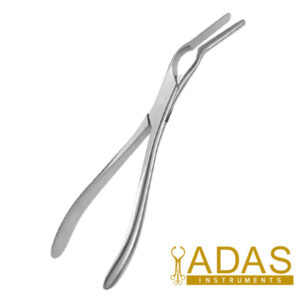
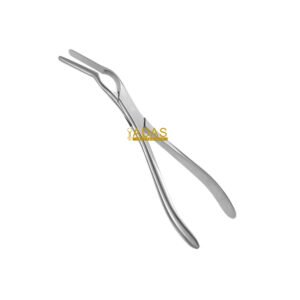
Asch Septum Straightening Forceps | Angled Blades with a Permanent Gap
$ 35.00
Asch septum straightening forceps move a deviated or fractured septum back to the middle of the nose, and the feature that matters is a gap the blades never close. Angled blades meet with a fixed space between them, so the cartilage is gripped and shifted while the mucoperichondrium on either side of it is not crushed. Ours are 35 dollars against 85 for the same pattern from a US catalog house.
Key Features
- Angled blades with a permanent gap that never closes
- Moves the septum without crushing the lining on either side of it
- For deviated septum correction and closed reduction of a nasal fracture
- One piece of steel and a joint, nothing plumbed in
- Cut from high quality medical grade stainless steel and fully autoclavable
- Three year replacement warranty against manufacturing defects
- Item code AQ-10.87
10 in stock (can be backordered)

What Asch septum straightening forceps are
Asch septum straightening forceps exist because of one problem. A septum has a layer of lining stuck to each side of it, and that lining is what keeps the cartilage alive. Crush it and you have moved the septum successfully and damaged the thing that was holding it together. The Asch is the instrument designed around that problem.
It solves it with the permanent gap between the blades, which is what keeps the mucoperichondrium from being crushed while the cartilage is moved. The blades are angled and they close onto each other, but they stop short: the gap is built in and no amount of squeezing closes it. Google’s own description of the pattern says the same thing, that the built in blade gap is designed to protect the mucoperichondrium from crushing injuries.
It is the second half of a pair of instruments that get confused with each other constantly. The Asch works on the SEPTUM. The Walsham takes the lateral nasal wall rather than the septum, which is why it comes left and right and is used as a pair. Search Console records seven separate searches asking which is which, and we rank position 1.0 for “asch forceps uses”, so the comparison is set out in full further down rather than left as a footnote.
Catalogs list it as an Asch forceps, as Asch septal forceps angled, and as an Asch nasal straightening forceps, and LowFruits puts “asch forceps” at 140 searches a month, which is the second highest figure anywhere in this part of our catalog. It is a well known instrument with a small, steady demand.
What this page will not tell you is the angle in degrees. Our own record carries no attributes for this product at all: the angled blade and the gap come from our own existing description and from the product name, and the 25 to 40 degree figure on rival listings is theirs, not ours.
Key design features
The permanent gap, which is the whole instrument
Angled blades that stop before they touch. The gap means the grip on the septum is a hold rather than a squeeze, and the lining passes between the blades instead of being flattened by them. Every other feature on the instrument exists to support that one.
The angle on the flat
The blades are bent on the flat rather than on the edge, so the handles sit outside the nostril while the working ends are inside it. That is what lets a surgeon see what the blades are doing. We do not publish the angle as a number, because our own record does not carry one.
No ratchet anywhere on it
Finger pressure only. A septum is moved and then checked and then moved again, and an instrument that locks at a pressure makes that a two step job instead of one continuous feel. There is nothing to release and nothing to set.
One piece of steel and a joint
No light, no suction, no coating, no insert. Nothing to flush, nothing to dry, nothing to wear through. The only moving part is the box joint and the only maintenance is washing it properly.
What to order, and what we do not publish
There is one version of this instrument, so the table is about the figures rather than the options.
| Specification | What we publish | Why |
|---|---|---|
| Blade shape | Angled, with a permanent gap | From our own product name and our own existing description |
| Blade angle in degrees | NOT published by us | Our record carries no attribute for this product. Rival listings say 25 to 40 degrees; that is their figure and we will not print it as ours |
| Overall length | NOT published by us | Rival listings say 9 inches. Our name and our record carry no length, so neither does this page. It is on our list to measure |
| Jaw size | NOT published by us | One rival quotes 44.0 by 7.0 mm. Same answer: ask us before ordering if a figure has to be matched |
Where it is used
Septal work, and the trauma list. The Asch septum straightening forceps is on most nasal trauma trays for the first row of this table.
| Procedure | What the Asch does | Note |
|---|---|---|
| Closed reduction of a nasal fracture | Moves the fractured septum back to the midline | The commonest use, and usually alongside a Walsham for the walls |
| Septoplasty | Repositions a deviated septum | The gap is the reason it is chosen over a plain forceps |
| Septorhinoplasty | Straightens the septum before the bones are addressed | Order of work, not order of importance |
| Revision septal surgery | Moves cartilage that has healed off the center line | Scarred lining is exactly where crushing it costs most |
What it holds back, and what it must not do
The gap is a protection and not a permission.
| The task | What this forceps does | What it must not do |
|---|---|---|
| Moving the septum | Grips and shifts cartilage with a gap that spares the lining | It is NOT a crusher. If the cartilage needs softening rather than moving, that is a morselizer |
| Protecting the mucoperichondrium | The permanent gap keeps the lining out of the squeeze | It is not a guarantee. A gap stops crushing; it does not stop tearing if the instrument is dragged |
| Holding a position | Holds under finger pressure while the result is checked | It does not lock. There is no ratchet |
| Working on the nasal walls | Nothing. This is a septum instrument | The lateral walls are the Walsham, which comes left and right for that reason |
How it compares with the rest of the family
Four instruments, and the honest way to choose between them is by which part of the nose is in trouble.
| Instrument | What it moves | The feature that decides it | Buy it when |
|---|---|---|---|
| Asch, this page | The septum | A permanent gap between the blades | The cartilage has to move and the lining has to survive it |
| Walsham | The lateral nasal wall | A concave neck, left and right | A fracture has pushed a wall inwards |
| Cottle Walsham | The septum and the bony base | The longer eponym pattern | The septal base rather than the cartilage alone |
| Rubin, tungsten carbide | The septum | Carbide inserts in the jaw | A list that runs this operation every day |
Materials and finish
Every Asch septum straightening forceps we make is cut from high quality medical grade stainless steel. The steel itself is made to a German specification. We do not publish a grade number. The number on a certificate tells a surgeon nothing about whether a built in gap is still the width it was forged at after two hundred autoclave cycles and a few hundred closures, and the answer to that is in the making rather than in the alloy.
The gap is set in the forging and then checked, and it is the one dimension on this instrument we will not let drift. A gap that has closed up over years of use is an Asch that has quietly turned into an ordinary forceps, and the surgeon holding it has no way of knowing.
There is no sharp external edge anywhere along either blade. The inside faces are the ones that meet cartilage and they are finished last.
Caring for it
Open the joint and wash it open. Then do the one check that is specific to this instrument: close the blades fully and look through the gap against the light. It should still be there. If the blades now meet, the instrument has lost the only feature it was bought for.
Warm water, a soft brush, autoclave with the tray, store flat. Nothing abrasive anywhere near the inside faces.
Ordering and wholesale
Every Asch septum straightening forceps is made by Adas Instruments in our own workshop and sold direct, which is why the price sits where it does against the catalog houses. Order one for a single tray, or in quantity for a hospital list or a distributor line. We do OEM work under your own brand and your own item numbers. Send us a sample and we will hold a run to your pattern rather than ours. Stock items ship from our own workshop. Backorder items take 10 to 12 working days to make. Every instrument carries a three year replacement warranty against manufacturing defects. Production is controlled under an ISO 13485 quality management system.
Frequently asked questions
What are Asch forceps used for?
Straightening a deviated or fractured nasal septum. The blades grip the cartilage with a fixed gap between them, so the septum can be moved without the lining on either side of it being crushed.
What are the key differences between Asch and Walsham forceps?
The Asch works on the SEPTUM and the Walsham works on the lateral WALL of the nose. The Asch has angled blades with a permanent gap for the lining; the Walsham has a concave inner neck and comes left handed and right handed so it can wrap each wall. They are usually on the same tray and they do different jobs.
Why do the blades not close completely?
Because they are not supposed to. The gap is the instrument. It is what lets the forceps hold cartilage firmly while the mucoperichondrium passes between the blades rather than under them.
What angle are the blades?
We do not publish an angle, because our own record does not carry one for this product. Rival listings quote 25 to 40 degrees. Ask us before ordering if a particular angle has to be matched, and it is on our list to measure.
Is it insulated or coated?
No. It is one piece of stainless steel and a box joint, with nothing plumbed in and no coating to wear through.
Related products and categories
For the lateral wall rather than the septum, the Walsham septum straightening forceps, which comes left and right. For the septal base, the Cottle Walsham septum straightening forceps. For the same work with carbide inserts, the Rubin septum straightening forceps.
The rest of this family sits under nasal cutting, crusher and septum forceps, and the wider set for the operation is under rhinoplasty instruments.
| Weight | 0.15 kg |
|---|
Be the first to review “Asch Septum Straightening Forceps | Angled Blades with a Permanent Gap”
Shipping & Delivery Policy
Processing Time: In-stock items are dispatched within 24-48 hours. For custom or out-of-stock items, production time is approximately 10-15 days.
Global Delivery Estimates
We partner with world-class couriers (DHL, FedEx) to ensure fast, tracked delivery.
- USA & Canada: 3-5 Business Days
- Europe & UK: 4-6 Business Days
- Rest of World: 5-7 Business Days
*We offer Air Cargo and Sea Freight options for bulk wholesale orders.
Customs & Duties
International buyers are responsible for any customs duties or taxes imposed by their country. Adas Instruments is not responsible for delays caused by customs clearance.
Lost Packages & Insurance
If your package is lost in transit, please contact us immediately. We offer full support and replacements for confirmed lost shipments. Note: You must report non-delivery within 3 weeks to be eligible for an insurance claim.
Related products
Reviews
There are no reviews yet.