
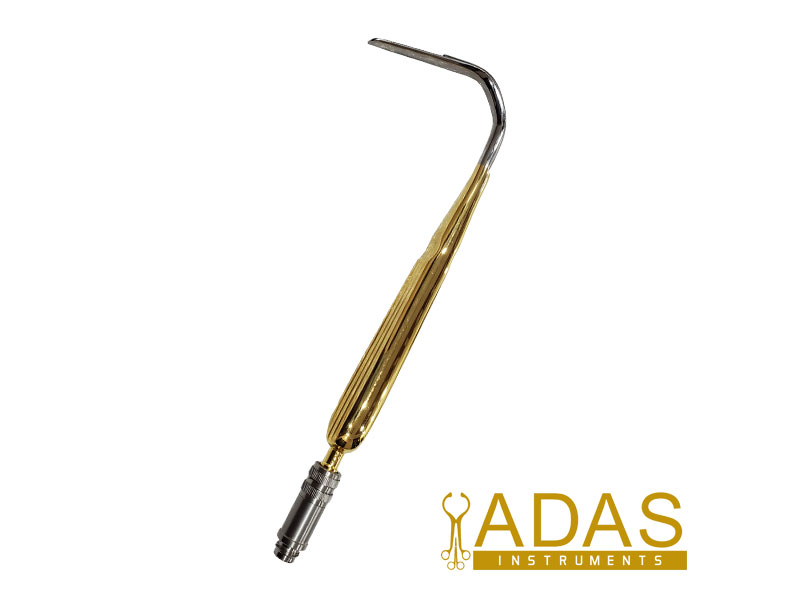
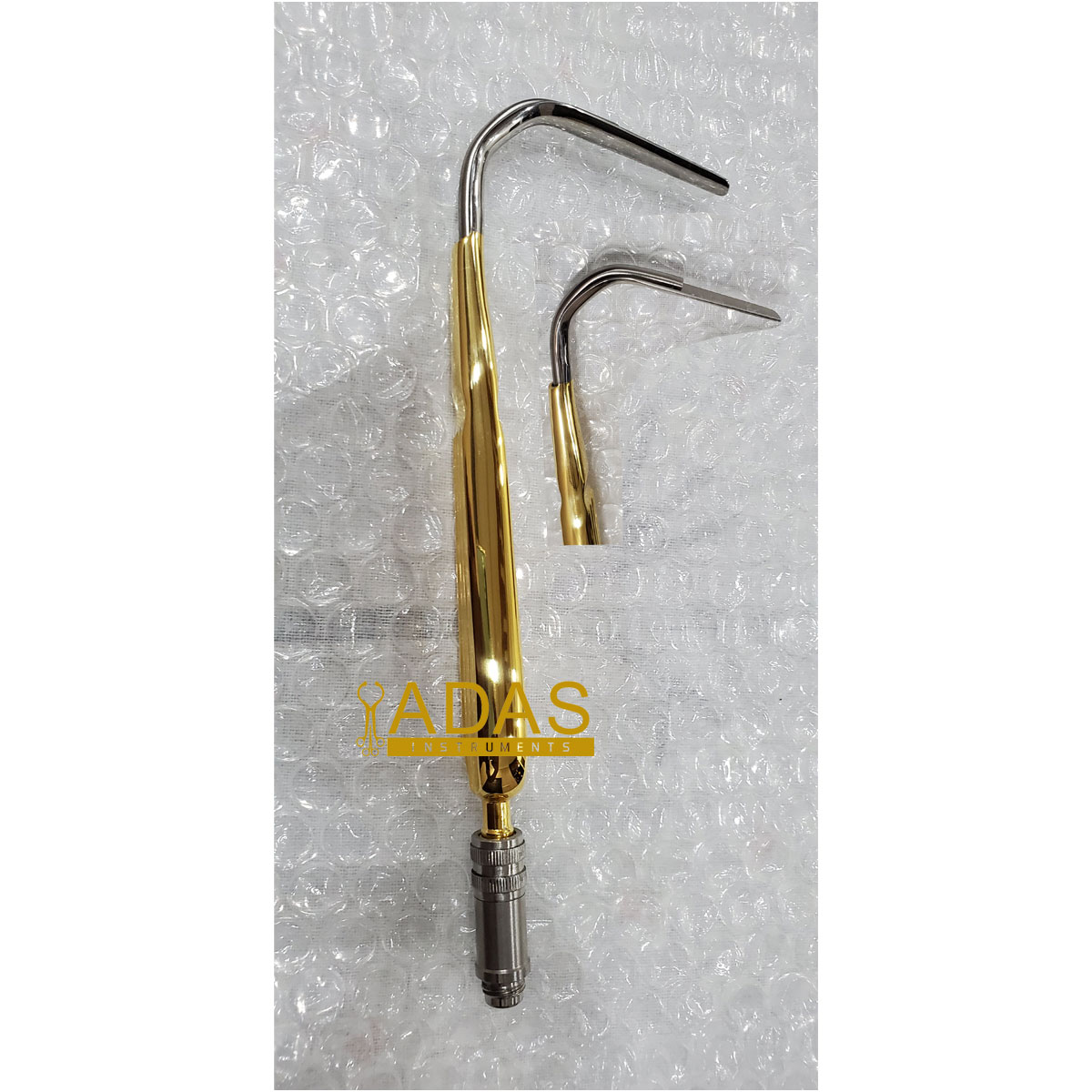
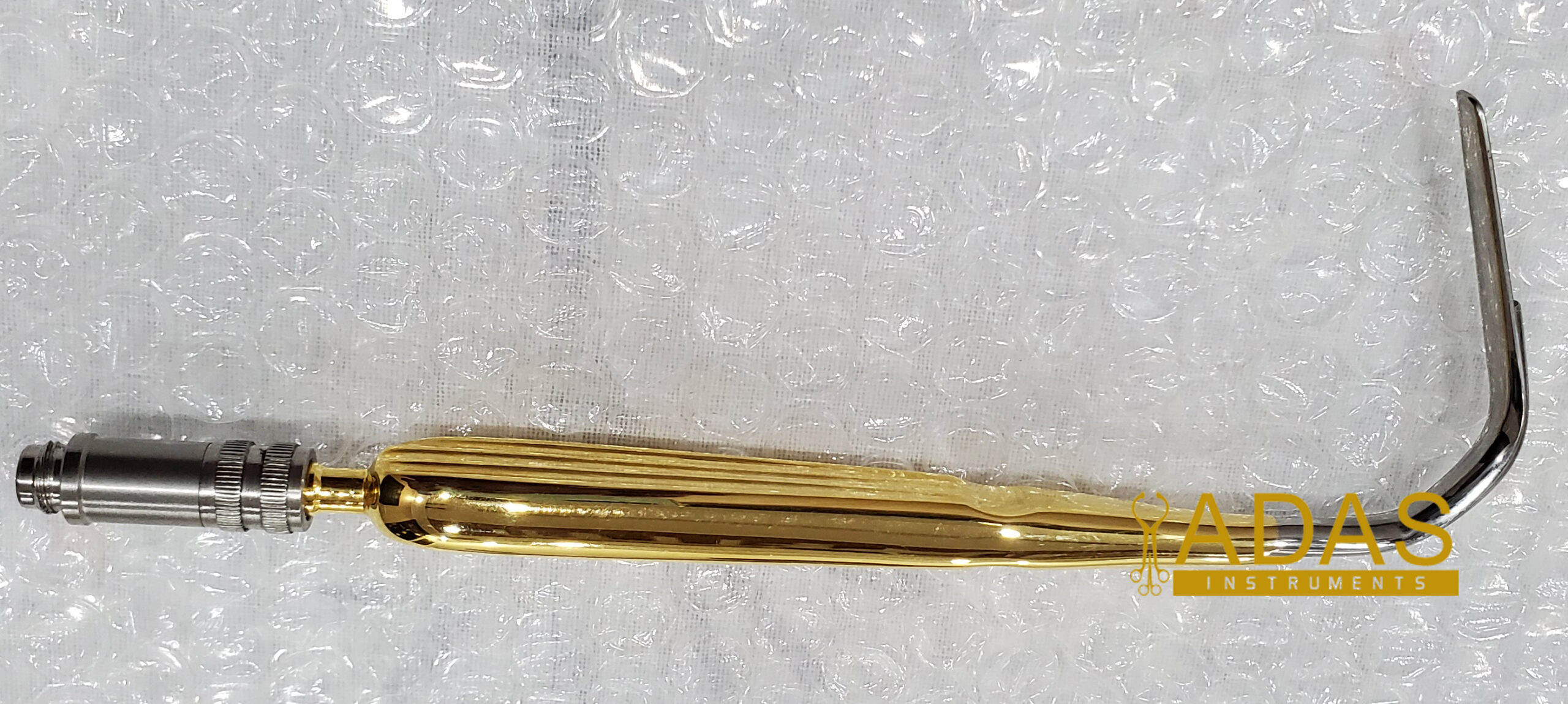
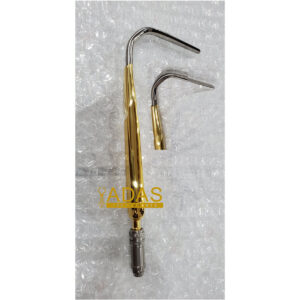
Aufricht Nasal Retractor Fiber Optic, Lighted Blade
$ 68.00
The aufricht nasal retractor fiber optic is the lighted version of the standard Aufricht pattern, with a light guide built into the blade so the illumination arrives where the blade is rather than over the surgeon’s shoulder. That matters in a nose, because the working space is a narrow tunnel and an overhead lamp is blocked by the very flap the retractor is holding. It does the same job as the plain Aufricht and is chosen when the field is deep, when the case is a revision, or when the dorsum has to be judged by eye.
Key Features
- A light guide built into the blade, so the light reaches the bottom of the tunnel
- The same blunt angled blade as the standard Aufricht, doing the same job
- For deep fields and revision work, where an overhead lamp is blocked by the flap
- Used on the nasal dorsum, the lateral cartilages and the internal framework
- Used in facial plastic surgery, rhinoplasty, revision rhinoplasty and ENT
- High quality medical grade stainless steel, autoclavable and made to be used again
- Three year replacement warranty against manufacturing defects
Available on backorder

What the aufricht nasal retractor fiber optic is
The aufricht nasal retractor fiber optic is the lighted version of the standard Aufricht pattern. It does the same job, lifting the nasal skin envelope off the framework, and it carries a light guide built into the blade so the illumination arrives where the blade is.
That is not a refinement in a nose. The working space is a narrow tunnel and the thing blocking the overhead lamp is the very flap the retractor is holding, so the deeper the exposure gets, the darker it gets. Light at the blade is light at the bottom of the tunnel.
It is chosen when the field is deep, when the case is a revision and the plane is harder to read, or when the dorsum has to be judged by eye rather than by feel.
Key design features of the fiber optic nasal retractor
Four features. Three of them are the plain Aufricht, and the fourth is the reason this page exists.
- Light guide in the blade. The channel runs inside the blade, so the light source does not add a second instrument to the field.
- Blunt blade. Unchanged from the plain pattern, because the far side of the flap is still mucosa.
- Downward angle. Over the rim and into the tunnel in one movement.
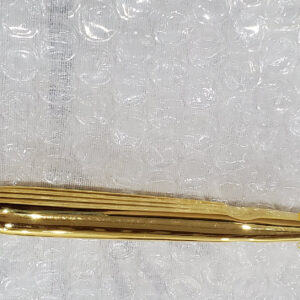
- Grooved handle. Holds in a wet glove, with a light cable attached.
Fiber optic nasal retractor, what ships and what does not
One pattern on this page, and the plain Aufricht beside it for comparison.
| Pattern | Blade | Light | What it is for | Item code |
|---|---|---|---|---|
| Aufricht nasal retractor fiber optic | Blunt, angled downward | Light guide built into the blade | Deep fields, revision work, judging the dorsum by eye | AP-39.24 |
| Aufricht nasal retractor | The same blade | None | Routine exposure in a shallow field, listed separately | see the plain pattern |
Our own record carries no length, no blade figure and no light source fitting, so none is stated here. A fiber optic nasal retractor has to match the light source already in the room, so tell us the fitting when you order and it will be made to suit rather than guessed at. No competitor figure is repeated on this page.
Where a lighted aufricht retractor earns its place
A lighted aufricht retractor is not needed for every case. The table says where it is.
| Specialty | What the aufricht nasal retractor fiber optic is used for |
|---|---|
| Revision rhinoplasty | Scar tissue makes the plane harder to read, and light at the blade is what makes it readable |
| Open rhinoplasty | The same exposure as the plain pattern, with the field lit from inside |
| Dorsal work | Judging the line of the dorsum by eye rather than by feel |
| Septoplasty | Deep septal exposure where an overhead lamp does not reach |
| ENT and rhinology | Any nasal procedure carried out through a narrow opening |
| Facial plastic surgery | Late stage work, when the flap has been lifted and the tunnel is at its deepest |
| Teaching and assisting | A lit field is a field a second person can actually see |
What the blade holds, and what it does not
The limits are the plain pattern limits, with one more that is specific to a lighted instrument.
| Structure | How the blade takes it |
|---|---|
| Nasal skin soft tissue envelope | The same hold as the plain Aufricht. Blunt, flat, even tension |
| Nasal dorsum soft tissues | Held clear, and lit while held |
| Upper and lower lateral cartilages | Exposed and visible, which is the whole point of the light |
| Septum | Reached once the envelope is lifted |
| Internal nasal framework | The deep structures an overhead lamp cannot reach |
| Nasal mucosa | NOT gripped. The blunt edge protects it, exactly as on the plain pattern |
| The light guide itself | NOT a lever. The guide is a channel in the blade, not a structural part to pry with |
How an illuminated nasal retractor compares with the alternatives
Four of the rows below are our own nasal retractors. The last two are the other ways of getting light into a nose, and an illuminated nasal retractor is chosen over both because it adds nothing to the field.
| Pattern | How it differs | When you reach for it instead |
|---|---|---|
| Aufricht nasal retractor | The same blade without the light guide | Routine work in a shallow field, where an overhead lamp reaches |
| Maliniac nasal retractor | A concave tapered blade, 9 mm by 45 mm on our pattern | Broad soft tissue exposure |
| Neivert nasal retractor | Double ended, a retractor and a guide | Vestibular work, and steadying a blade on a line |
| Cottle alar nasal retractor | A contoured blade for the nostril curve | Localized alar exposure |
| A headlight | Lights from the surgeon eye line, not from inside the tunnel | General work, and it is worn rather than held |
| A separate fiber optic light carrier | A second instrument in an already crowded field | When the retractor in use has no light channel |
Materials and finish
Made from high quality medical grade stainless steel, satin finished so the light this instrument carries is not thrown straight back at the surgeon off its own blade. The steel itself is made to a German specification. The light channel is finished inside as well as out, because a rough channel scatters light instead of delivering it.
Care and sterilization of a fiber optic rhinoplasty retractor
A fiber optic rhinoplasty retractor needs one step more than a plain one. Clean with a soft brush under running water, then rinse in deionized water and dry fully before autoclaving, and pay attention to the light channel and to the connector, because dried blood inside a channel dims the instrument permanently. Never kink the cable and never store anything resting across the blade. Check that the light still carries end to end before the instrument goes back into the set.
Ordering and wholesale
Adas Instruments makes this pattern to order and will match the connector to the light source you already use. We supply hospitals, surgical centers and distributors across the United States, Latin America, Europe and Asia, bulk and wholesale pricing is available, and instruments held on backorder ship in 10 to 12 working days. Every instrument carries a three year replacement warranty against manufacturing defects. Certifications: CE. Production is controlled under an ISO 13485 quality management system.
Frequently asked questions
What is a fiber optic nasal retractor used for?
The same exposure as a plain nasal retractor, with the field lit from the blade. It is used in open and revision rhinoplasty, in septoplasty and in ENT work, wherever the tunnel is deep enough that an overhead lamp is blocked by the flap being held.
What is the retractor used for?
Holding tissue out of the line of work so the surgeon can see and reach what is underneath. A retractor does not cut and does not grasp; it holds, and it comes out the moment the exposure is no longer needed.
Which instrument is a retractor?
Any instrument built to hold tissue aside rather than act on it. Handheld retractors such as this one need an assistant; self retaining retractors lock open on their own frame and free a hand. Every nasal retractor in this family is handheld.
Is the light guide part of the instrument or an attachment?
Part of the instrument. The channel is built into the blade, so there is no second item to hold and nothing extra taking up room in the nostril. Only the cable is separate, and it connects at the handle.
Do I need the fiber optic version?
Not for every case. If the work is shallow and the overhead lamp reaches the field, the plain Aufricht does the same job. Choose the lighted pattern for revisions, for deep dorsal work, and for any case where the answer to what you are looking at has to come from seeing it rather than feeling it.
Related products and categories
Buyers who order the aufricht nasal retractor fiber optic usually order alongside it the maliniac nasal retractor, the neivert nasal retractor and the cottle alar nasal retractor. The whole family sits in hooks and retractors, and this pattern is also listed under rhinoplasty instruments.
| Weight | 0.09 kg |
|---|
Be the first to review “Aufricht Nasal Retractor Fiber Optic, Lighted Blade”
Shipping & Delivery Policy
Processing Time: In-stock items are dispatched within 24-48 hours. For custom or out-of-stock items, production time is approximately 10-15 days.
Global Delivery Estimates
We partner with world-class couriers (DHL, FedEx) to ensure fast, tracked delivery.
- USA & Canada: 3-5 Business Days
- Europe & UK: 4-6 Business Days
- Rest of World: 5-7 Business Days
*We offer Air Cargo and Sea Freight options for bulk wholesale orders.
Customs & Duties
International buyers are responsible for any customs duties or taxes imposed by their country. Adas Instruments is not responsible for delays caused by customs clearance.
Lost Packages & Insurance
If your package is lost in transit, please contact us immediately. We offer full support and replacements for confirmed lost shipments. Note: You must report non-delivery within 3 weeks to be eligible for an insurance claim.
Related products

Reviews
There are no reviews yet.