
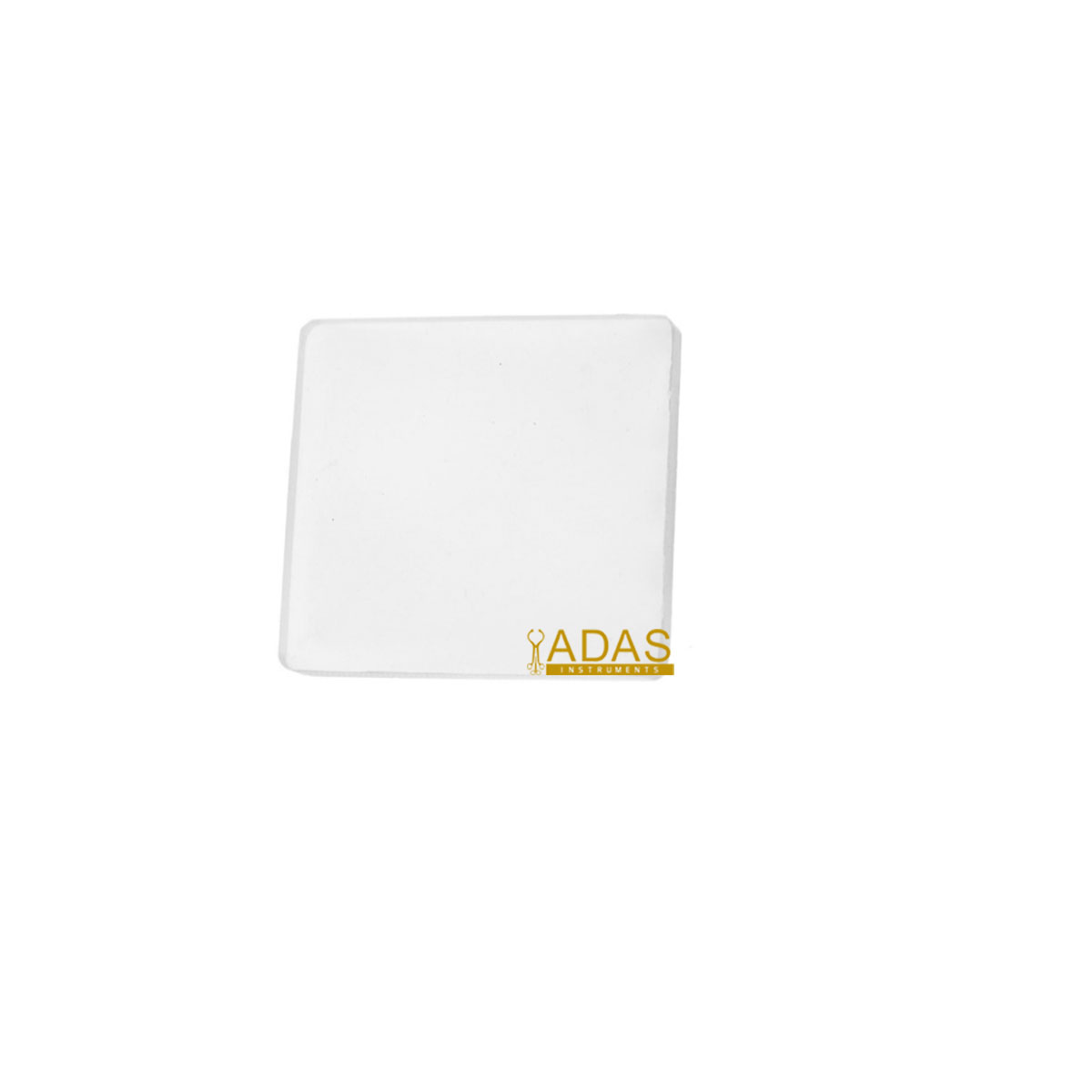
Cartilage Cutting Block | Teflon, Also Listed as a Cartilage Cutting Board
$ 13.50
A cartilage cutting block in Teflon, which Google and most surgeons also call a cartilage cutting board, is the flat work surface a graft is carved on. Cartilage is slippery and rubbery and it does not sit still on steel; it sits still on Teflon, and a blade drawn across it on Teflon does not skid or blunt itself on the surface underneath. That is the entire instrument and it costs 13.50 dollars.
Key Features
- Teflon work surface that holds a graft still while it is carved
- Also listed as a cartilage cutting board, which is what most buyers type
- Kinder to a blade edge than cutting on steel or glass
- Flat, plain and autoclavable, with nothing on it to clean around
- For carving septal, ear and rib cartilage grafts
- Three year replacement warranty against manufacturing defects
- Item code AQ-10.75
50 in stock (can be backordered)

What a Teflon cartilage cutting block is
Google calls this a cartilage cutting board and then tells you it is also a cartilage cutting block, in the same sentence. The numbers say the same thing: BOARD is searched 70 times a month and BLOCK 20. We sell it as a block, most buyers call it a board, and both words are on this page because that is what the thing is called rather than to get a term used.
Catalogs also list it as a Teflon cutting block and, where the graft is named, as a cartilage graft cutting board. Same flat piece of Teflon.
What it is for is the moment between harvesting a graft and putting it in. The graft has to be cut to length, split to thickness and shaped, and all of that happens on a trolley with a fresh blade. Google’s own explanation of why the surface matters is the honest one: cartilage is naturally slippery and rubbery, so a cutting board holds the graft firmly in place while the surgeon carves it.
Teflon does two things that steel does not. It grips a wet graft slightly instead of letting it slide, and it is soft enough that a blade drawn across it is not blunted by the surface. A scalpel used on a steel tray is a dull scalpel on the second pass.
We should say what ours is NOT, because the rival listings in this class are full of features of their own. Google describes rival boards with dimpled or textured surfaces and built in measurement channels or grids for slicing cartilage to a uniform thickness. OURS HAS NONE OF THAT. It is a plain flat Teflon block. If you want a measuring grid, the Sheen grid plate in this same category has one and it is a different instrument.
This page used to be 180 words, the shortest on our entire site, with one keyword on it and almost nothing said. That is why it has been rewritten rather than patched.
Key design features
Why Teflon, and not steel
It holds a wet graft rather than letting it slide, and it does not blunt a blade. Those are separate benefits and the second one is the one surgeons notice: carving three grafts on a steel tray costs you a blade, and carving them on Teflon does not.
Flat and plain, which is the whole specification
No dimples, no grid, no channels, no measurement marks. A flat surface. We say so clearly because the class is full of boards that have those features and ours does not, and buying one expecting a grid would be a bad surprise at any price.
Autoclavable, with nothing to clean around
No corners, no joints, no holes and no moving parts, so cleaning it is washing a flat surface. It is the easiest thing to reprocess in this whole category and that is worth something on a busy list.
It is a surface, not an instrument
Said plainly: it does nothing by itself. The work is done by the blade and the surgeon’s eye, and the block’s whole job is to not get in the way. The things that DO something to cartilage in this family are the crushers and the morselizer.
What to order, and what it is not
There is one version, so this table is the specification and the honest gaps.
| Specification | What we publish | Why |
|---|---|---|
| Material | Teflon | From our own product name. It is the only material claim on the page |
| Surface | Flat and plain | From our own record. NO dimpling, NO grid and NO measurement channels. Rival boards have them and ours does not |
| Dimensions | NOT published by us | There is no attribute set on this product. Ask us before ordering if the footprint has to fit a tray |
| Autoclave temperature | NOT published by us | Teflon has limits and we do not publish ours, so ask before putting it through an unusual cycle. It is on our list |
Where it is used
Every operation where cartilage is harvested and then shaped.
| Procedure | What the block does | Note |
|---|---|---|
| Septal graft carving | Holds the graft still while it is cut to length and thickness | The commonest use |
| Ear cartilage graft | Holds a curved conchal graft that will not sit flat on steel | Where the grip matters most |
| Rib cartilage carving | A surface for slicing costal cartilage into usable strips | Long, careful work and the hardest on a blade |
| Any graft going into a crusher afterwards | Carve it here first, then crush it | The order of work: carve to size, then soften |
What it holds back, and what it must not do
Short list, because there is not much to warn about.
| The task | What this block does | What it must not do |
|---|---|---|
| Holding a graft | A Teflon surface that grips a wet, slippery graft | It is NOT sterile out of the packet and it is not single use. It is a reusable instrument and it goes through the same cycle as the rest of the tray |
| Protecting the blade | Softer than steel, so the edge survives the pass | It must not be cut on with a saw or a chisel. A scalpel is what it is for |
| Measuring the graft | Nothing. There is no grid and no channel | If a graft has to be measured, use the Sheen grid plate, which has a grid, or a caliper |
| Crushing the graft | Nothing. It is a flat surface | Crushing is the crushers. A block crusher has a bed and a lid; this has neither |
How it compares with the rest of the family
Four things in this family touch a harvested graft and only one of them does nothing to it.
| Instrument | What it does to the graft | Has a grid | Buy it when |
|---|---|---|---|
| Cartilage cutting block, this page | Holds it while you carve | No | The graft has to be cut to size and shape |
| Sheen grid plate | Holds it and measures it | Yes | The graft has to be measured as well as carved |
| Cottle cartilage crusher | Flattens it, and scores it if the bed is serrated | No | The graft has to lie flat and lose its spring |
| Jost cartilage crusher | Flattens dense cartilage and rib | No | The cartilage is too thick for the Cottle |
Materials and finish
This is the one instrument in this family with no steel in it. Every Teflon cartilage cutting block we make is machined from solid PTFE, which is the material Teflon is the trade name for, in one piece. We do not publish a grade for it, and we do not print the steel sentence that sits on every other page in this category, because there is no steel here to say it about. What a buyer wants to know instead is whether a Teflon face is still flat and unscored after a few hundred scalpel passes, which is the only way this instrument ever wears out, and the answer to that is in the making rather than in the material.
The Teflon is one piece with no bonded layer and no backing plate, so there is nothing for a blade to find and lift. A board built as a Teflon skin on a steel core eventually gets cut through to the core, and from then on it is a steel cutting surface with a ragged edge around the damage.
The edges are radiused rather than square. It is a flat object held in a gloved hand and a square edge on Teflon is sharper than it looks.
Caring for it
Wash it flat under warm water with a soft brush. There are no holes, no joints and no corners, so there is nowhere for anything to hide, which makes this the simplest thing in the category to reprocess.
Autoclave with the tray. Do not use an abrasive pad: scratches in Teflon collect protein and a scratched face is harder to clean than a scored one. Look across the surface against the light every so often, and retire it when the cuts are deep enough that a blade catches in them rather than passing over, because a blade that catches skips, and a skipping blade in cartilage goes where it likes.
Ordering and wholesale
Every Teflon cartilage cutting block is made by Adas Instruments in our own workshop and sold direct, which is why the price sits where it does against the catalog houses. Order one for a single tray, or in quantity for a hospital list or a distributor line. We do OEM work under your own brand and your own item numbers. Send us a sample and we will hold a run to your pattern rather than ours. Stock items ship from our own workshop. Backorder items take 10 to 12 working days to make. Every instrument carries a three year replacement warranty against manufacturing defects. Production is controlled under an ISO 13485 quality management system.
Frequently asked questions
What is a cartilage cutting block used for?
Carving a harvested cartilage graft. It is the flat work surface a graft is cut to length, split to thickness and shaped on, before it goes into the nose. The Teflon holds the slippery graft still and spares the blade.
Is a cartilage cutting board the same thing?
Yes. Google uses both words in the same sentence, “a cartilage cutting board (also known as a cartilage cutting block)”, and board is actually the more searched of the two. Same instrument, two names.
Why Teflon rather than steel?
Two reasons. A wet graft grips slightly on Teflon instead of sliding, and a blade drawn across Teflon is not blunted by it. Carving several grafts on a steel tray costs you the blade.
Does it have a measuring grid?
No. Ours is a plain flat Teflon block with no dimpling, no grid and no measurement channels. Some boards in this class have them, and if you want a grid, the Sheen grid plate in this same category is the instrument with one.
What size is it?
We do not publish dimensions, because our own record carries no attribute for this product. Ask us before ordering if it has to fit a particular tray, and it is on our list to measure.
Related products and categories
For flattening the graft once it is carved, the Cottle cartilage crusher with a serrated or smooth bed, or the heavier Jost cartilage crusher for rib. For the mallet that taps either of them, the solid stainless steel nasal mallet.
The rest of this family sits under nasal cutting, crusher and septum forceps, and the wider set for the operation is under rhinoplasty instruments.
| Weight | 0.05 kg |
|---|
Be the first to review “Cartilage Cutting Block | Teflon, Also Listed as a Cartilage Cutting Board”
Shipping & Delivery Policy
Processing Time: In-stock items are dispatched within 24-48 hours. For custom or out-of-stock items, production time is approximately 10-15 days.
Global Delivery Estimates
We partner with world-class couriers (DHL, FedEx) to ensure fast, tracked delivery.
- USA & Canada: 3-5 Business Days
- Europe & UK: 4-6 Business Days
- Rest of World: 5-7 Business Days
*We offer Air Cargo and Sea Freight options for bulk wholesale orders.
Customs & Duties
International buyers are responsible for any customs duties or taxes imposed by their country. Adas Instruments is not responsible for delays caused by customs clearance.
Lost Packages & Insurance
If your package is lost in transit, please contact us immediately. We offer full support and replacements for confirmed lost shipments. Note: You must report non-delivery within 3 weeks to be eligible for an insurance claim.
Related products
Reviews
There are no reviews yet.