

Hose Adapter for 10 cc and 20 cc Syringes
Price range: $ 26.50 through $ 28.50
A hose adapter for liposuction is a connector that joins a syringe and its cannula to the suction machine tubing, so the machine can draw through them with an airtight seal. Ours has a wide end sized to the syringe and a barbed nozzle for the suction hose. It comes for 10 cc syringes at 26.50 dollars or for 20 cc syringes at 28.50 dollars, in blue anodized aluminum.
Key Features
- Wide end sized to the syringe
- Barbed nozzle for the suction hose
- Two sizes, for 10 cc and for 20 cc syringes
- Blue anodized aluminum with a knurled ring
- Reusable, steam sterilized between cases
- Three year replacement warranty against manufacturing defects
- Item code A-507.01-1

What a hose adapter is
A syringe and a suction machine are two ways of making the vacuum that draws fat through a cannula. This hose adapter lets them work together. It joins the syringe, with its cannula, to the machine tubing, so the machine supplies the suction and the syringe sits in the line. Nothing about the syringe or the cannula changes; the adapter only joins them to the hose, and comes off again when the syringe goes back to hand use.
Google AI Mode, read on 23 October 2026, describes liposuction hose adapters as the connectors that bridge cannulas, handles and syringes to vacuum tubing. Our earlier copy for this product says the same thing in its own words: an airtight junction between syringe, cannula and suction hose, made for machine assisted aspiration.
It is also searched for as a liposuction hose adapter or a suction hose adapter. On our site it sits with the other connecting pieces, between the handles that hold a cannula and the fittings that join a cannula straight to a hose.
Key design features
A wide end sized to the syringe
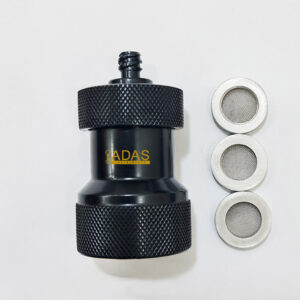
In our photograph one end of the adapter is a wide, short socket with a knurled ring around it. That end is sized to the syringe, which is why the listing offers two sizes, one for 10 cc syringes and one for 20 cc. Order the size that matches the syringes on your tray. The two sizes are not interchangeable, and a tray that runs both syringe sizes needs one of each. Fit the adapter to the syringe before the hose goes on, so the joint is made while both hands are free.
A barbed nozzle for the hose
The other end narrows into a ribbed, tapered nozzle. Suction tubing pushes over the ribs and they hold it under vacuum. Push the tubing on past the last rib rather than just onto the tip, because a short overlap is where a line under suction comes away.
A knurled ring
The ring around the wide end is knurled, a fine crosshatch cut into the metal. It gives the fingers a hold while the adapter is fitted to the syringe or taken off it, with wet gloves and the line under tension. The rest of the body is smooth and steps down to the nozzle. Turn the adapter by the ring, not by the nozzle, so the twist goes into the joint with the syringe and not into the hose.
Light anodized aluminum
The body is blue anodized aluminum. It adds very little weight to the syringe, which matters when the syringe is the thing in the hand, and the blue sets it apart from the gold threaded pieces on the same tray. There are two prices, 26.50 dollars for the 10 cc size and 28.50 dollars for the 20 cc size, and both sizes come in the same blue, so it pays to keep the two in separate places on the tray.
Which size to order
Two sizes, read off our own order form on 23 October 2026. The size follows the syringe, not the cannula, so the same adapter serves every cannula that fits that syringe. Both sizes end in the same kind of barbed nozzle for the suction hose.
| Size | Fits | Hose end | Price |
|---|---|---|---|
| For 10 cc syringes | A 10 cc syringe | Barbed nozzle | 26.50 dollars |
| For 20 cc syringes | A 20 cc syringe | Barbed nozzle | 28.50 dollars |
Where it is used
The first two columns come from the Google AI Mode answer read on 23 October 2026. They are its words about hose adapters in general. The last column is ours.
| Use | What the answer says | How this adapter fits it |
|---|---|---|
| Machine assisted aspiration | Hose adapters bridge cannulas and syringes to vacuum tubing | Syringe at the wide end, suction hose on the barb |
| Fat grafting | They support fat grafting set ups | The syringe in the line can be the one the fat is taken into |
| Hose barb connections | A tapered hose barb holds the tubing | Ribbed, tapered barb at the back |
| Choosing the part | Check whether you are adapting a cannula to a tube or a hose to a canister | This one joins a syringe to the hose |
What it is for, and what it is not for
Each connector in this family joins two particular things. The table sends the other jobs to the piece of ours that does them.
| Job | Use this adapter? | What to use instead |
|---|---|---|
| A 10 cc or 20 cc syringe on the suction hose | Yes | This is the job it is made for |
| A luer cannula straight onto the suction hose | No | Our female luer needle connector |
| A threaded cannula on the suction hose | No | Our adaptor handle with threaded connection |
| A 50 cc or 60 cc syringe | No | Not offered on this listing; ask us |
| A luer lock cannula on tumescent tubing | No | Our luer lock handle |
How it compares with the rest of the family
Five connecting pieces make up this family on our site. The ends are read off our own listing for each one, and the prices off each product’s order form.
| Piece | Front end | Back end | Body | Price |
|---|---|---|---|---|
| Luer lock handle | luer lock, takes a luer lock cannula | luer lock, takes tubing or a syringe | anodized aluminum, ribbed grip | 28 dollars, four colors |
| Adaptor handle, threaded | threaded, takes a threaded cannula | barbed nozzle for suction tubing | gold finish, knurled grip, thumb flat | 45 dollars |
| Adaptor, thread to luer lock | threaded, takes a threaded cannula | luer lock, takes a luer lock syringe | gold finish, knurled | 24 dollars |
| Hose adapter (this page) | wide socket sized for a 10 cc or a 20 cc syringe | barbed nozzle for suction tubing | anodized aluminum, knurled ring | 26.50 or 28.50 dollars |
| Female luer needle connector | female luer, takes a luer cannula or a needle | barbed nozzle for suction tubing | anodized aluminum, knurled | 25 dollars |
Materials and finish
Every hose adapter we make is anodized aluminum. Aluminum keeps it light on the syringe, and the anodizing gives it the blue color and a hard surface layer. We do not publish an alloy grade.
The color is part of the anodized surface rather than a coat of paint on top of it. Strong alkaline detergents can dull anodized aluminum over time, so a neutral instrument detergent is the safer choice. The knurled ring and the barb are worked into the same piece as the body.
Caring for it
Pull the hose off and take the adapter off the syringe as soon as the case ends. Flush water through it from the wide end to the barb, then push a brush through the nozzle bore. Wipe out the wide socket, where fat collects around the rim. Dry it, steam sterilize it on the normal instrument cycle, and store the two sizes apart so the 10 cc and 20 cc adapters do not get mixed on the tray. Check the barb before each case: a nozzle with a nicked rib will not hold the tubing tight, and it is cheaper to replace the adapter than to lose suction halfway through.
Ordering and wholesale
The hose adapter is made by Adas Instruments in our own workshop and sold direct, which is why the price sits where it does against the catalog houses. Order one for a single tray, or in quantity for a hospital list or a distributor line. We do OEM work under your own brand and your own item numbers. Send us a sample and we will hold a run to your pattern rather than ours. Stock items ship from our own workshop. Backorder items take 10 to 12 working days to make. Every instrument carries a three year replacement warranty against manufacturing defects. Production is controlled under an ISO 13485 quality management system.
Frequently asked questions
What is a hose adapter used for?
It joins a syringe and its cannula to the suction machine tubing. The wide end fits the syringe, the hose pushes onto the barbed nozzle, and the machine then draws through the syringe and the cannula with an airtight seal.
Which hose adapter size do I need?
Match it to the syringe. The listing has one size for 10 cc syringes at 26.50 dollars and one for 20 cc syringes at 28.50 dollars. The cannula does not decide the size; the syringe does, because the wide end has to seal on it.
Does the hose adapter fit a 60 cc syringe?
No. This listing is made for 10 cc and 20 cc syringes only. If your tray runs on larger syringes, write to us with the syringe you use and we will tell you whether we can make an adapter to fit it.
What types of equipment are used for liposuction?
Cannulas, the handles that hold them, syringes or a suction machine with its tubing and canister, and the connectors that join them. Our accessories category holds the connectors, handles and syringe hardware, and the cannulas sit in their own categories.
How do I clean a liposuction hose adapter?
Take it off the hose and the syringe, flush water through from the wide end to the barb, brush the nozzle bore, and wipe out the wide socket where fat collects. Dry it and steam sterilize it with your other instruments.
Related products and categories
Three more connecting pieces from the same family: female luer needle connector, luer lock handle and adaptor handle. The rest of the range is in liposuction accessories, and the cannulas they fit are under liposuction cannulas and accessories.
| Weight | 0.05 kg |
|---|---|
| Select Size | 10cc, 20cc |
Be the first to review “Hose Adapter for 10 cc and 20 cc Syringes”
Shipping & Delivery Policy
Processing Time: In-stock items are dispatched within 24-48 hours. For custom or out-of-stock items, production time is approximately 10-15 days.
Global Delivery Estimates
We partner with world-class couriers (DHL, FedEx) to ensure fast, tracked delivery.
- USA & Canada: 3-5 Business Days
- Europe & UK: 4-6 Business Days
- Rest of World: 5-7 Business Days
*We offer Air Cargo and Sea Freight options for bulk wholesale orders.
Customs & Duties
International buyers are responsible for any customs duties or taxes imposed by their country. Adas Instruments is not responsible for delays caused by customs clearance.
Lost Packages & Insurance
If your package is lost in transit, please contact us immediately. We offer full support and replacements for confirmed lost shipments. Note: You must report non-delivery within 3 weeks to be eligible for an insurance claim.
Related products


Reviews
There are no reviews yet.