
Spatula Tip Cannulas for Neck and Superficial Work
Nov
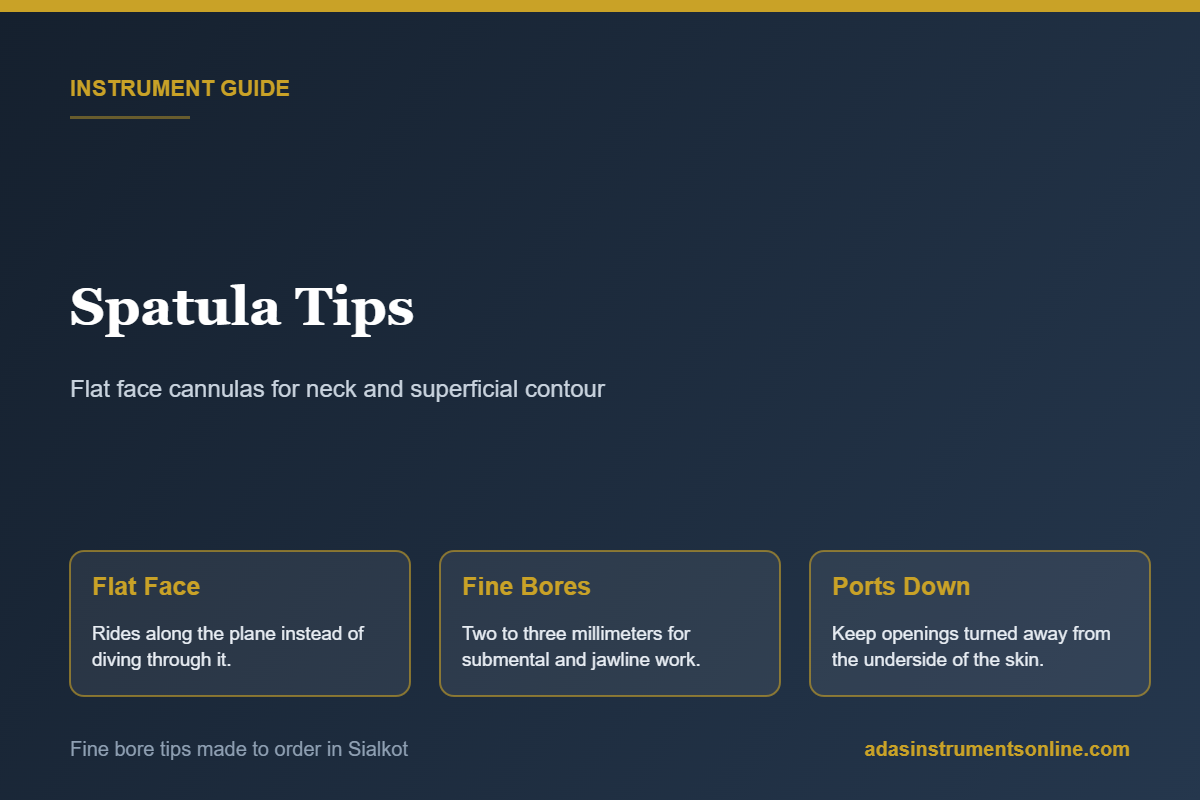
A spatula cannula is a liposuction cannula with a flattened, oval tip whose suction ports sit on one face, so it glides along a single plane just under the skin. Surgeons reach for it on the neck, the jawline and superficial body refinement. Adas Instruments makes the spatula cannula on a fixed handle in 1.5 mm to 6 mm bores and 15 cm to 45 cm lengths, standard or titanium nitride coated, as part of its aspiration cannula range.
The spatula cannula is the flat blade of the cannula rack: an oval, flattened tip whose openings face one way, built for the planes where liposuction works millimeters under visible skin. Necks, jawlines and HD etching all run on spatula control. Here is the pattern guide.
Key takeaways
- A spatula tip is flat, so it rides along one plane instead of grabbing tissue from every side.
- Turn the ports toward the deep layer and the dermis above stays untouched.
- Neck and jawline work runs at fine bores, roughly 2 to 3 mm, with long, flat, slow strokes.
- It is a finishing cannula: slower than a standard tip for bulk removal, better for the last smooth pass.
Why Flat Beats Round Near the Surface
A round cannula in a thin plane grabs from all sides, including the dermis above; the spatula’s flattened profile glides flat against the platysma or fascia while its single-sided ports aspirate only from the chosen side. Orientation becomes a control input: openings down protects skin, openings up (in expert hands) performs deliberate superficial work like dermal stimulation in HD technique.
The Home Zones
The neck first: submental contouring per the facial guide is spatula territory, hugging the platysma under paper-thin skin. Jawline transitions, gynecomastia edge feathering, and the superficial etching passes of HD lipo follow. Wherever contour irregularity would be immediately visible, the spatula’s directional control earns its slot.
Sizes and Technique Notes
Necks run 1.8 to 2.7 mm spatulas at 10 to 20 cm; body superficial work uses 3 to 3.7 mm. Strokes stay long and flat, orientation deliberate, and vacuum moderate, the whole point is control, not speed. Syringe suction pairs naturally in facial zones per the luer workflow in our fittings guide.
Buying and Care
Check the tip’s edge finish (a spatula edge must glide, never scrape), confirm hub type for your handles or syringes, and store flat-tip patterns where the blade face cannot bear weight. Standard lumen care applies unchanged.

Spatula Cannula Liposuction Tips at a Glance
Spatula cannula liposuction works because the tip is flattened rather than round. That flat face rides along a plane instead of diving through it, which is what makes it the usual choice for the neck, the jawline and other superficial areas.
| Feature | Typical value | Why it matters | What to check |
|---|---|---|---|
| Tip shape | Flattened spatula face | Stays in one plane | Face is even, edges rounded |
| Bore | 2 to 3 mm | Controlled removal rate | Finer for submental than for body |
| Port position | On the flat face | Directs suction away from dermis | Ports face down in use |
| Length | 10 to 20 cm | Neck, jawline, arms | Short enough to stay controllable |
| Plane | Superficial and intermediate | Refines contour | Never fully subdermal without care |
| Handle | Fixed or quick connect | Fine control at low force | No rotation of the flat face in use |
| Finish | Satin or matte | Low glare near the face | Uniform, no polish streaks |

Common Mistakes in Superficial Contouring
The neck is unforgiving because everything shows. Five errors cause most of the visible ones.
- Rotating the tip. A spatula only protects the dermis while the flat face is oriented correctly; turn it and the ports face upward.
- Using too large a bore. A 4 mm tip in the submental area removes faster than the skin can redrape and leaves a hollow.
- Working without a hand under the skin. The non dominant hand judges thickness continuously, and technique without it is guesswork.
- Chasing symmetry at the end. Late corrections in a thin area usually make asymmetry worse; stop earlier than feels finished.
- Skipping port protectors. Submental ports take many passes, and unprotected edges scar more visibly on the face and neck.
Specifying Spatula Tips for Facial and Superficial Work
Face width, port placement and shaft stiffness are the three variables worth naming on the order. Adas Instruments makes them in high quality medical grade stainless steel with custom lengths, matched hubs and OEM or white label marking, spatula tips are a routine made to order item. Production time on custom work is 10 to 15 working days, normally 15 working days depending on order size.
Facial contouring demand has grown alongside neck and jawline procedures generally, a trend visible in the statistics published by the American Society of Plastic Surgeons. Practices building a submental set usually order two or three fine bores together from the aspiration cannula range so the sizes step evenly.
Fitting Spatula Tips Into a Facial Contouring Tray
A spatula cannula liposuction tray is not simply a smaller body tray. Alongside the cannulas it needs fine retractors, a good light and delicate scissors, most of which come from the facelift and neck lift instrument range rather than from the liposuction shelf.
If the same case includes fat transfer to the jawline or the chin, the harvested fat goes through fine injection cannulas from the fat grafting and injection cannula range. Keeping harvest, contour and injection instruments on one tray saves a great deal of movement during a short case.
Shop spatula cannulas direct from the maker
Adas Instruments makes the spatula cannula on a fixed handle in 1.5 mm to 6 mm bores and 15 cm to 45 cm lengths, standard or titanium nitride coated, from 55 dollars, and a single port spatula cannula from 32 dollars. Plain or laser marked with your brand.
Frequently Asked Questions
What is a spatula cannula used for?
Superficial liposuction planes: neck and jawline contouring, edge feathering and HD etching, where the flat tip glides along fascia and aspirates from one chosen side only.
Why do spatula cannula openings face one direction?
Directional control: openings toward the deep plane protect the dermis above; the surgeon chooses what the cannula can touch by how the flat is turned.
What size cannula is used for neck liposuction?
Two to three millimeters is the usual working range for submental and jawline work, with some surgeons going to 1.8 mm for final refinement. Larger bores remove faster than thin skin can redrape and leave visible hollows.
Can a spatula cannula be used on the body?
Yes, particularly for superficial refinement over the flanks and the medial thigh where a round tip is easy to overtreat with. It is slower than a standard tip for debulking, so it is used as a finishing instrument.
How superficial is too superficial?
Anything that leaves the dermis feeling thin between your fingers has gone too far. Keep a hand on the skin throughout, keep the ports facing away from the surface and stop while a definite fat layer remains.
