
Freer Septum Chisel | Straight and Curved 4mm Tip | Rhinoplasty Tool
$ 28.00
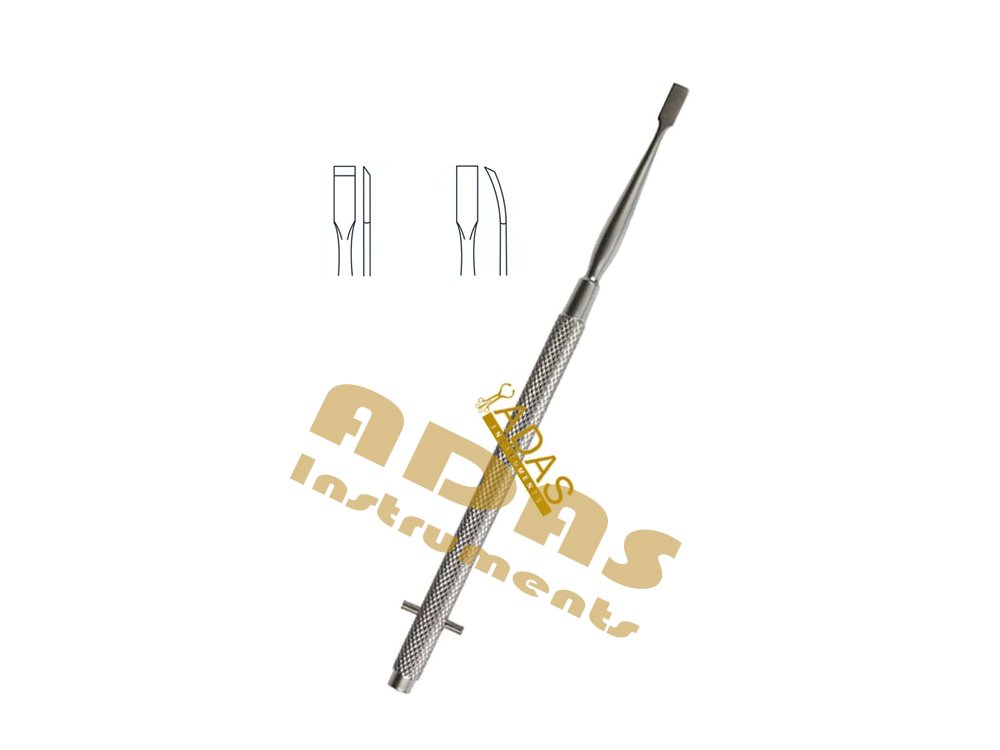
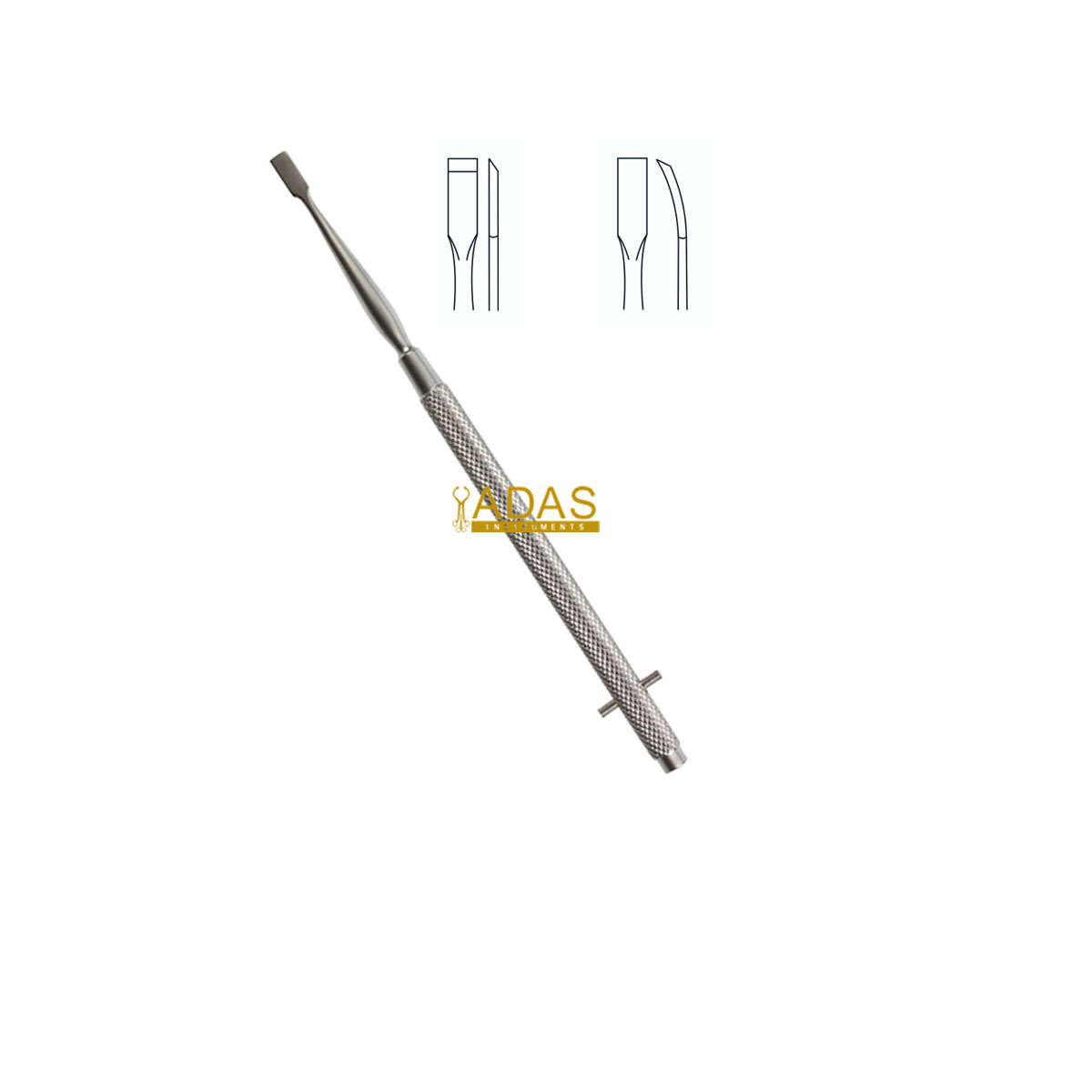
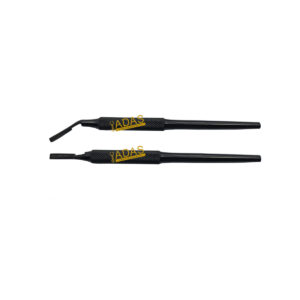
Freer septum chisel is a nasal bone chisel used in septoplasty, rhinoplasty and submucous resection to cut and reshape the bony part of the nasal septum. The 4mm blade is beveled on one face only, so the flat side can be laid against the tissue that is staying while the cut happens on the other side of the edge. It comes with a straight or a curved shank, and the curve is what lets a surgeon see over the instrument into the back of a deep nasal cavity instead of around it.
Key Features
- 4mm cutting blade, single bevel
- Straight tip or curved tip, ordered per instrument
- Curved shank clears the sightline over deep septal work
- Hexagonal handle with horizontal serrations
- Takes a mallet at the handle end for dense bone
- High quality medical grade stainless steel, fully autoclavable
- Three year replacement warranty against manufacturing defects
- Item code AM-02-19

What the Freer septum chisel is
The Freer septum chisel is a nasal bone chisel. It cuts and reshapes the bony part of the nasal septum, and it is used in septoplasty, in rhinoplasty and in submucous resection of the septum.
It is named after Otto T. Freer, the American otolaryngologist who worked out most of the delicate septal instruments still in use, and the design reflects that: the blade is 4mm across and beveled on one face only. A single bevel makes the blade directional. Lay the flat face against the mucosa or the cartilage that is staying, and the cut happens on the far side of the edge, which is what the word atraumatic means on an instrument like this.
It comes with a straight or a curved shank, ordered per instrument. Surgeons search for it as a septum chisel, a surgical chisel and a bone chisel, and it is worth saying which kind: this is a nasal bone chisel for the septum, not the dental chisel that shares the name.
Key design features of the single bevel nasal bone chisel
A 4mm blade beveled on one face
The bevel is ground on a single side, so the blade has a flat face and a cutting face. That lets a surgeon use the flat as a guard against tissue that is being kept while the edge works on the other side. A double beveled blade cuts in both directions and has to be held clear by hand, which is much harder inside a nasal cavity.
Straight shank or curved shank
The straight shank gives the most direct line of force and suits work near the nasal entrance. The curved shank steps the blade away from the handle so a surgeon can see over the instrument into the back of a deep cavity rather than around it. The two are the same chisel otherwise.
A hexagonal serrated handle
The handle is hexagonal with horizontal serrations, which does two things. The flats stop the chisel rotating between mallet taps, so the bevel stays facing the way it was set, and the serrations hold the grip when the hand is wet.
A flat end that takes a mallet
Septal bone near the vomer can be dense. The handle finishes in a flat face so a mallet lands square and moves the blade a known distance with each tap, instead of the surgeon leaning weight onto an instrument inside a nose.
Freer septum chisel, straight tip or curved tip
One blade width and two shank shapes. The width is fixed at 4mm because that is the span that cuts the septum without reaching the floor of the nose on one side or the roof on the other.
| Feature | This instrument |
|---|---|
| Blade width | 4mm |
| Bevel | Single bevel, one face flat |
| Shank options | Straight tip or curved tip, ordered per instrument |
| Handle | Hexagonal with horizontal serrations, flat mallet face at the end |
| Action | Divides bone or cartilage along a line |
| Supplied as | Single instrument, item code AM-02-19 |
If only one is going on the tray, the straight tip is the more generally useful. Surgeons who do a lot of posterior septal work usually add the curved.
Where the Freer septum chisel is used
These are the procedures this chisel is bought for. The word chisel is shared with dentistry and with the workshop, and neither of those is this instrument, so every row here is nasal.
| Procedure | What the chisel does there |
|---|---|
| Septoplasty | Divides the bony septum and cuts a deviated segment free |
| Submucous resection of the septum | Cuts the bony plate once the lining is lifted |
| Rhinoplasty, septal work | Squares off the bony septum before the dorsum is set |
| Septal graft harvest | Cuts a graft to shape after it has been freed |
| Revision septal surgery | Divides bone left thickened by earlier surgery |
In all of these the chisel follows an elevator. The mucoperiosteum is lifted off the bone first, and the chisel then divides bare bone or cartilage with the lining held out of the way.
What it cuts, and what it has to leave alone
A single beveled chisel is chosen for what it protects, not only for what it cuts. The flat face is a working surface in its own right.
| Tissue | What happens to it |
|---|---|
| Bony nasal septum | Cut and divided. This is the target |
| Septal cartilage | Divided cleanly along the line of the blade |
| Mucoperiosteum | Lifted clear first, then guarded by the flat face of the blade |
| Mucosa on the far side | Must stay whole. The single bevel cuts away from it |
| Nasal bones | Not this instrument. That is an osteotome |
The fourth row is the one that decides whether the operation goes well. Bone can be replaced. Septal mucosa torn through on both sides in the same place cannot, and that is what causes a perforation.
How it compares with the rest of the septum family
Five septum instruments sit next to each other here, and the pair most often confused are the two chisels. This is the honest comparison, including where a term could fairly belong to either of them.
| Instrument | Edge | Where it is the right choice |
|---|---|---|
| Freer septum chisel | Flat, 4mm, single bevel | A controlled clean cut through septal bone or cartilage |
| Ballenger Hajek septum chisel | Flat, mallet driven | Tough septal cartilage and thin bone that will not give |
| Freer septum gouge | Concave, 4mm or 6mm | Shaving bone in layers and lifting membrane |
| Killian septum gouge | 5mm concave trough | Lifting a strip of bone or cartilage out whole |
| Killian-Claus nasal septum gouge | 5mm V notch | Taking a bony ridge down without sliding off it |
Both this chisel and the Ballenger Hajek can honestly be called a septum chisel, which is why they are set out side by side rather than each claiming the phrase. The Freer is the lighter, more controlled cut. The Ballenger Hajek is the one for cartilage that will not give.
Freer septum chisel materials and finish
The chisel is ground from high quality medical grade stainless steel, hardened through the blade so a single bevel keeps its angle through resharpening, and left softer along the shank so a badly landed tap does not set a bend. The steel itself is made to a German specification.
The finish is satin rather than mirror bright. Under a headlamp a polished blade reflects the light back up the nostril, and satin scatters it instead. Satin also makes bone dust and dried blood obvious when the instrument is inspected between cases.
Caring for a Freer septum chisel
Rinse the blade under cool running water as soon as the case finishes. Bone dust left to dry along a bevel has to be brushed off later, and a soft nylon brush at the sink takes seconds.
Ultrasonic clean in a neutral pH enzymatic solution, rinse in deionized water, then dry fully before pouching. Tap water dried on steel is the ordinary cause of pitting.
Autoclave at 134 degrees Celsius. Store with the edge guarded and not touching other instruments. On a single beveled chisel the corner of the bevel is the first thing to dull and it almost always dulls against another blade in a tray.
Ordering a Freer septum chisel, and wholesale
The Freer septum chisel is supplied as a single instrument, item code AM-02-19, 4mm blade, in a straight tip or a curved tip. Both shanks are made in our own workshop to the same handle pattern, so a set can be built with instruments that feel the same in the hand.
Wholesale and distributor pricing is available on quantity, and larger orders can be laser marked with a hospital or practice reference at no separate tooling charge. Send the shank shapes, the quantity and the marking text and we will quote all of it together.
Item code AM-02-19. Every instrument carries a three year replacement warranty against manufacturing defects. Stock items ship from our own workshop. Backorder items take 10 to 12 working days to make. Production is controlled under an ISO 13485 quality management system.
Frequently asked questions
What is a Freer septum chisel used for
It cuts and reshapes the bony part of the nasal septum during septoplasty, rhinoplasty and submucous resection. The 4mm blade is beveled on one face only, so the flat side can be laid against tissue that is staying while the edge cuts on the other side.
What is a surgical chisel
A surgical chisel is a flat bladed instrument driven by a mallet to divide bone or cartilage along a line. It differs from a gouge, which has a trough and scoops, and from an osteotome, which is heavier and beveled on both faces for cutting through larger bone.
What is the difference between a chisel and an osteotome
A chisel is usually beveled on one side only and is used to cut a surface or divide a thin plate. An osteotome is beveled on both sides and is used to split through bone in a straight line. In nasal surgery the chisel works on the septum and the osteotome works on the nasal bones themselves.
Is the Freer septum chisel straight or curved
Both are made. The straight tip is the general purpose instrument and the curved tip steps the blade away from the handle so the surgeon can see over it into the back of a deep nasal cavity. They are ordered per instrument, not as a pair.
Which chisel is used on the nasal septum rather than on teeth
This one. A dental chisel is a short instrument for bone around a tooth socket and is used in the mouth. A nasal septum chisel like this is longer, narrower and shaped to reach the septum through a nostril. They share the word chisel and nothing else.
Related products and categories
Browse the full range of osteotomes, chisels and gouges, or see the wider set of rhinoplasty instruments this instrument belongs to.
| Weight | 0.09 kg |
|---|---|
| Tip options | Curved Tip, Straight Tip |
Be the first to review “Freer Septum Chisel | Straight and Curved 4mm Tip | Rhinoplasty Tool”
Shipping & Delivery Policy
Processing Time: In-stock items are dispatched within 24-48 hours. For custom or out-of-stock items, production time is approximately 10-15 days.
Global Delivery Estimates
We partner with world-class couriers (DHL, FedEx) to ensure fast, tracked delivery.
- USA & Canada: 3-5 Business Days
- Europe & UK: 4-6 Business Days
- Rest of World: 5-7 Business Days
*We offer Air Cargo and Sea Freight options for bulk wholesale orders.
Customs & Duties
International buyers are responsible for any customs duties or taxes imposed by their country. Adas Instruments is not responsible for delays caused by customs clearance.
Lost Packages & Insurance
If your package is lost in transit, please contact us immediately. We offer full support and replacements for confirmed lost shipments. Note: You must report non-delivery within 3 weeks to be eligible for an insurance claim.
Related products
Reviews
There are no reviews yet.