

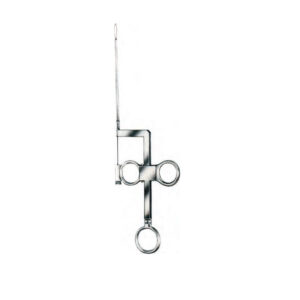
Tessier Spreading Forceps, 17 cm Bone Spreader
$ 46.00
A Tessier spreading forceps, listed in some catalogs as a Tessier bone spreader, is a 17 cm hand instrument that opens a cut already made in bone. The tips go into the osteotomy line and hold the two edges apart while a graft is seated or a segment is moved, which is craniofacial, midface and orbital work rather than anything a general tray covers. It is not the instrument most people land on when they search the word spreader: a rib spreader cranks a chest open and is the size of a forearm, and this is a hand instrument working in millimeters.
Key Features
- Opens and holds a gap in bone already cut, rather than making the cut
- 17 cm, which is 6.7 in, a facial instrument length rather than a chest one
- Also listed as a Tessier bone spreader and as a bone spreader instrument
- Cleft correction, cranial vault remodeling, Le Fort osteotomies, orbital work
- Not a rib spreader, a sternum retractor or a dental ridge spreader
- Made from high quality medical grade stainless steel and fully autoclavable
- No tip width, opening figure or serration pattern is published, because our own record does not carry them
- Three year replacement warranty against manufacturing defects
- Item code ADM-802.18
Available on backorder

What a Tessier spreading forceps is
It is a forceps that pushes instead of pinching. Every other forceps on a facial tray closes on something; this one goes into a gap and widens it, which is why catalogs keep reaching for a second word and landing on spreader.
The order of work explains it better than a drawing. First somebody cuts: a spreader opens a gap somebody else has already made, so the saw or the osteotome does its work before this does. Then the two edges have to come apart far enough to put something between them, and stay apart while it is put there. One pair of hands cannot do both. That second job is this instrument, and it is the only job it has.
Paul Tessier is the reason for the name. He sorted facial clefts into the numbered scheme still in use, and those clefts are what this pattern was shaped to work in.
Then there is what the search engine does with the word. Type spreader and you get a chest: a rib spreader cranks a chest open and is the size of a forearm, and this is a hand instrument working in millimeters. Add bone and a lawn fertilizer, a toe separator and a dental implant tool arrive before anything facial, by about five to one on our own measurement. This page is the facial one, and our own record for this pattern carries a length and an item code and nothing else, so anything beyond that is not ours to state.
Key design features
It opens a gap, it does not make one
A saw or an osteotome leaves a line a fraction of a millimeter wide, and nothing goes into a line that thin. The spreader turns it into a space and holds the space open while a graft, a plate or a piece of the patient’s own skull is fitted. On uncut bone it is just a lever, and a lever on a cranial vault breaks it somewhere nobody chose.
A facial instrument length, which is the figure we have
17 cm, which is 6.7 in. It is the only dimension on our record, and it is the one that tells a buyer most: 17 cm reaches the midface from an intraoral or a coronal approach with the hand still out of the view. The chest instruments that share the word are far bigger than that, which is the whole difference.
What our record does not carry, said plainly
Four questions a surgeon would reasonably ask about a spreader have no answer in our own data: how wide are the tips, how far do they open, what is the tip profile, and which way does the handle work.
Google’s summary answers all four. We are not repeating it, for a reason worth stating: the answer engine naming this instrument is quoting our own page back at us, which makes it an echo and not a source. Its mechanism paragraph is our own old sentence coming home. Ask us and we will measure it.
Named for the man who classified what it works on
Tessier numbered the craniofacial clefts 0 to 14 around the orbit, and that scheme is still how the deformity this instrument helps correct is described. Most eponyms on a tray are just whoever got to the pattern first. This one carries information.
Which instrument the step needs
This instrument is one job in a sequence, and ordering it alone is usually a mistake. Four jobs on facial bone, four instruments, and this page is the second row.
| The job | What it needs | Ours |
|---|---|---|
| Cut the bone | An osteotome and a mallet, or a saw | Tessier graft calva osteotome, $33 |
| Open the cut and hold it open | A spreader, which is this instrument | This page, $46 |
| Separate a sagittal split | A separator that fits the split line | Smith sagittal split separators, $34 |
| Move the whole maxilla | A mobilizer or a disimpaction forceps | Tessier disimpaction forceps, $80 |
Where it is used
Four procedures, all four taken from Google’s own summary of this instrument. The common thread is that the bone is cut first and something has to go into the gap afterward.
| Procedure | What the gap is for |
|---|---|
| Craniofacial cleft correction | Widening the osteotomy across a numbered Tessier cleft so the segments meet in a new position |
| Cranial vault remodeling | Mobilizing vault segments once a fused suture has been cut out in craniosynostosis |
| Le Fort midface osteotomy | Opening the midface cut far enough to seat a graft or a plate |
| Orbital reconstruction | Holding thin segments apart around the socket, where there is no room to work |
What it is not, and what it must not be used for
Three of the four rows below came out of Google’s own People Also Ask boxes rather than out of our heads: we read three boxes and eight of the twelve questions were about a different instrument.
| Not this | Why it matters |
|---|---|
| A rib or sternum spreader | A thoracic retractor with a rack and a crank, built to hold a chest open. Different scale, different force, different operation |
| A bone cutter or osteotome | Those part the bone. This one has nothing to cut with and will crush an edge if asked to |
| A dental ridge spreader | Implant dentistry widens an alveolar ridge with an osteotome set. Same idea, a tenth of the size, a different instrument |
| A soft tissue retractor | The tips are made to sit in a cut edge of bone. On tissue they load one spot, which is how a flap gets damaged |
How it compares with the rest of the family
Four instruments off our own list that get confused with each other, at the prices we charge. The difference is what each one grips.
| Instrument | What it holds | Price |
|---|---|---|
| Tessier spreading forceps, this page | The two edges of a cut, held apart | $46 |
| Tessier disimpaction forceps | The whole maxilla, to move it as one piece | $80 |
| Smith sagittal split separators | The two halves of a sagittal split in the mandible | $34 |
| Smith ramus separator | The same split, one pattern rather than a pair | $55 |
Materials and finish
Made from high quality medical grade stainless steel. The steel itself is made to a German specification. We publish no grade number, and we are not going to tell you this instrument is forged: our record does not say so, and the word is easy to print and impossible for a buyer to check.
The finish is the same story. Instruments of this pattern are usually supplied satin rather than mirror, and Google’s summary says so with the word generally in front of it. Generally is not our instrument: we hold no finish attribute on ADM-802.18, and we will tell you what is in your hand if you ask before you order.
Without hedging: one piece of steel with a joint in it, it takes an autoclave cycle, and it carries the three year replacement warranty.
Caring for it
Clean it before anything dries on it. Bone dust and blood set hard in a joint, and on an instrument that works by opening, the joint seizes first. Rinse cool, brush the joint with the tips open, then run it through the washer and the autoclave with the rest of the facial set.
Check the joint rather than the tips at the end of every cycle. It should move evenly through its travel with no catch, because a catch means something is in the joint, and that is how a spreader slips in a cut.
Do not use it to pry. It is the one failure the warranty does not cover, because it is a use the instrument was not shaped for rather than a defect in it.
Ordering and wholesale
The Tessier spreading forceps is made by Adas Instruments in our own workshop and sold direct, which is why the price sits where it does against the catalog houses. Order one for a single tray, or in quantity for a hospital list or a distributor line. We do OEM work under your own brand and your own item numbers. Send us a sample and we will hold a run to your pattern rather than ours. Stock items ship from our own workshop. Backorder items take 10 to 12 working days to make. Every instrument carries a three year replacement warranty against manufacturing defects. Production is controlled under an ISO 13485 quality management system.
Frequently asked questions
What is a Tessier spreading forceps used for?
It opens a cut already made in bone and holds it open: widening an osteotomy across a craniofacial cleft, mobilizing vault segments after a craniosynostosis release, opening a Le Fort midface cut to seat a graft, and holding small segments apart around the orbit. It does not make the cut.
Is a bone spreader the same thing as a rib spreader?
No. A rib spreader is a thoracic retractor with a rack and a crank that holds a chest open; this is a 17 cm hand instrument working in a gap measured in millimeters. The confusion is real enough that Google’s own question boxes for bone spreader are full of rib spreader questions, which is why it is answered here.
What is the difference between a bone spreader and an osteotome?
The osteotome parts the bone; the spreader opens what the osteotome made. They are used minutes apart on the same site and do not swap either way: a spreader has no cutting edge, and an osteotome cannot hold a gap open while both hands are busy. Ours is the Tessier graft calva osteotome.
How long is the Tessier spreading forceps?
17 cm, which is 6.7 in. That is the one dimension our record carries, and it is the figure Google’s summary gives as well. We publish no tip width and no maximum opening, because we have not measured them on this item and we would rather say so than copy a number off somebody else’s catalog.
Is the Tessier spreading forceps the same as a Tessier bone spreader?
Yes. Google’s answer opens by calling them Tessier Bone Spreaders, the KLS Martin listing calls the pattern a Tessier spreader forceps, and ours says spreading forceps. One instrument, three labels, and the search data says spreader is the word most people type.
Related products and categories
The three it works beside: the Tessier graft calva osteotome makes the cut, the Smith sagittal split separators do the same job lower down in the mandible, and the Tessier disimpaction forceps takes the whole maxilla once the cuts are finished.
The rest of the family sits in maxillofacial instruments, inside ENT instruments.
| Weight | 0.12 kg |
|---|
Be the first to review “Tessier Spreading Forceps, 17 cm Bone Spreader”
Shipping & Delivery Policy
Processing Time: In-stock items are dispatched within 24-48 hours. For custom or out-of-stock items, production time is approximately 10-15 days.
Global Delivery Estimates
We partner with world-class couriers (DHL, FedEx) to ensure fast, tracked delivery.
- USA & Canada: 3-5 Business Days
- Europe & UK: 4-6 Business Days
- Rest of World: 5-7 Business Days
*We offer Air Cargo and Sea Freight options for bulk wholesale orders.
Customs & Duties
International buyers are responsible for any customs duties or taxes imposed by their country. Adas Instruments is not responsible for delays caused by customs clearance.
Lost Packages & Insurance
If your package is lost in transit, please contact us immediately. We offer full support and replacements for confirmed lost shipments. Note: You must report non-delivery within 3 weeks to be eligible for an insurance claim.
Related products


Reviews
There are no reviews yet.