
How Long Do Surgical Instruments Last? Lifespan and Replacement Guide
Oct
How long do surgical instruments last? Longer than most clinics expect, and shorter than they should. A well made forceps can outlive the surgeon who first used it, while a new needle holder can be finished in a year. The difference is rarely the surgery. It is what happens to the instrument between cases.
Surgical instrument lifespan is the length of time an instrument stays reliable and safe in service before wear, corrosion or damage takes it out of use. For high quality medical grade stainless steel instruments that is often ten years or more, and it depends far more on cleaning, handling and storage than on surgical use. Adas Instruments covers every instrument with a 3 year replacement against manufacturing defects, and the habits below are what carry instruments well past that. You can browse our plastic surgery instruments by family.
Key takeaways
- Instruments with no moving parts last longest. Ratchets, box locks and cutting edges are where instruments wear out first.
- Dried blood, saline soaks and wet packs end more instruments than surgery does.
- Retire an instrument at the first reliable failure sign. Hoping it holds for one more case is how failures happen mid procedure.
- Tag each set with an in-service date so replacement can be planned instead of rushed.
Lifespan by Instrument Family
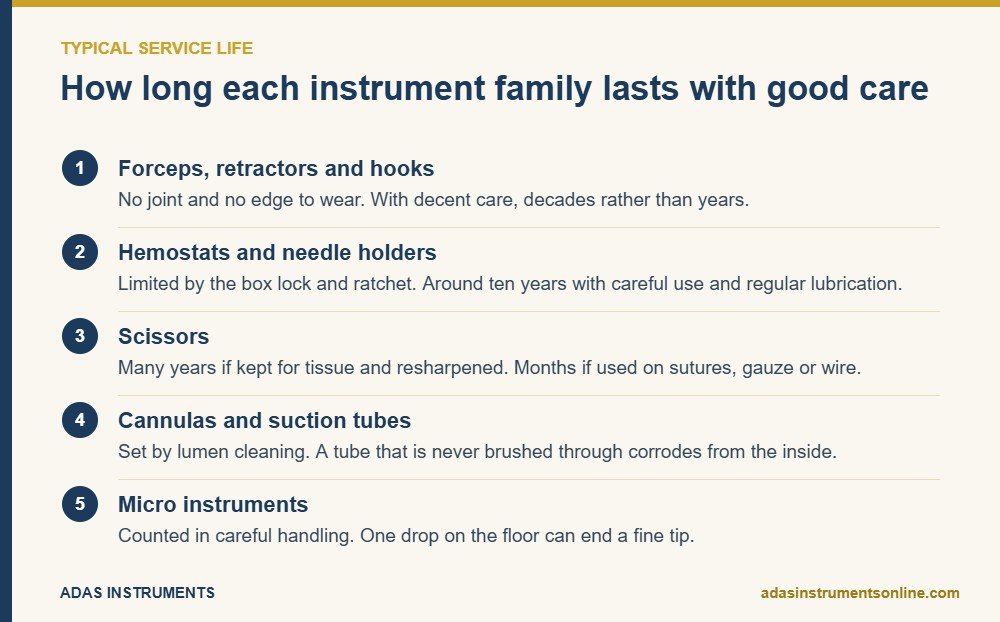
The simpler the instrument, the longer it lasts. Forceps, retractors and hooks have no joint to wear and no edge to dull, so with decent care they stay in service for decades rather than years.
Hemostats and needle holders live and die by their box locks and ratchets. With careful use and regular lubrication ten years is a fair expectation. Heavy use shortens that, and needle holders with tungsten carbide jaw inserts keep their grip far longer than plain jaws, which our guide to needle holder types explains.
Scissors depend on how their edges are treated. Kept for tissue and sharpened professionally when they start to drag, a good pair runs for many years. Used to cut sutures, gauze or wire, the same pair can be ruined within months. Our scissor sharpening guide covers the service side.
Micro instruments are the exception. Their tips are so fine that one drop on the floor can end them, so their lifespan is counted in careful handling rather than in years.
Signs an Instrument Should Be Retired
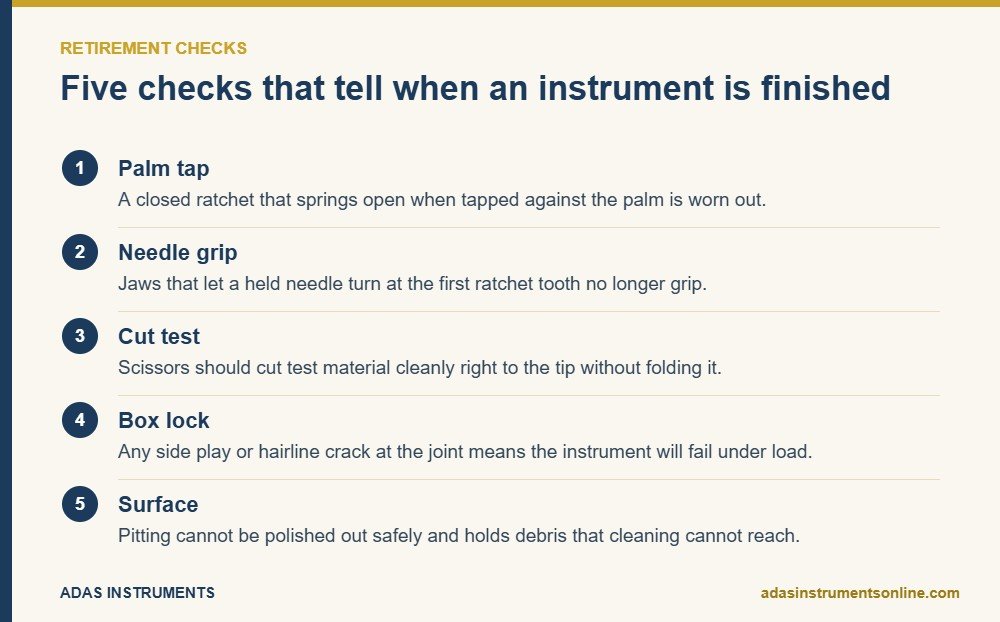
Check every instrument at every reprocessing cycle, not just when someone complains. An instrument comes out of service when it fails any of these checks:
- The ratchet springs open when the closed instrument is tapped against the palm.
- The jaws slip on a needle held at the first ratchet tooth.
- Scissor tips fold instead of cutting test material cleanly to the very tip.
- The box lock has side play or shows a hairline crack.
- Teeth or serrations no longer meet when the jaws are closed.
- Pitting appears on the surface, the end stage of corrosion described in our rust removal guide.
What Shortens Instrument Life
In order of the damage they do:
Chlorides. Saline soaks, dried blood and bleach attack the protective layer on stainless steel and lead to pitting. Rinsing at the point of use, before anything dries, is the single most effective habit.
Rough handling. Instruments thrown into a basin, tangled together in an ultrasonic bath or packed loose in a tray chip their tips and bend their jaws. Our sterilization tray guide shows how to keep them apart.
The wrong job. Tissue scissors cutting sutures, hemostats used as pliers, needle holders closed on needles too large for the jaw.
Dry joints. Box locks and ratchets that are never lubricated wear against themselves, and friction is where many rust spots start.
Wet storage. A pack that never fully dried keeps the instruments in a small humid chamber until it is opened.
None of these is surgery. A clinic that fixes them can expect its instruments to last noticeably longer, and that costs nothing.
Repair or Replace
Some wear can be put right. Scissors can be resharpened several times over their life, stiff joints can be cleaned and lubricated, and slightly misaligned jaws can be reset by a specialist. On well made steel that work pays for itself many times over.
Other damage is terminal. A cracked box lock will fail, usually under load. Pitting cannot be polished out without weakening the metal, and a pit holds debris that cleaning cannot reach. Carbide inserts worn smooth, tips broken off micro instruments and jaws bent out of true are all reasons to replace rather than repair. For tungsten carbide instruments, our tungsten carbide guide explains what can and cannot be serviced.
Refreshing an aging tray?
Adas Instruments makes pattern matched replacements in high quality medical grade stainless steel, singly or as complete sets, with a 3 year replacement against manufacturing defects.
Planning Replacements
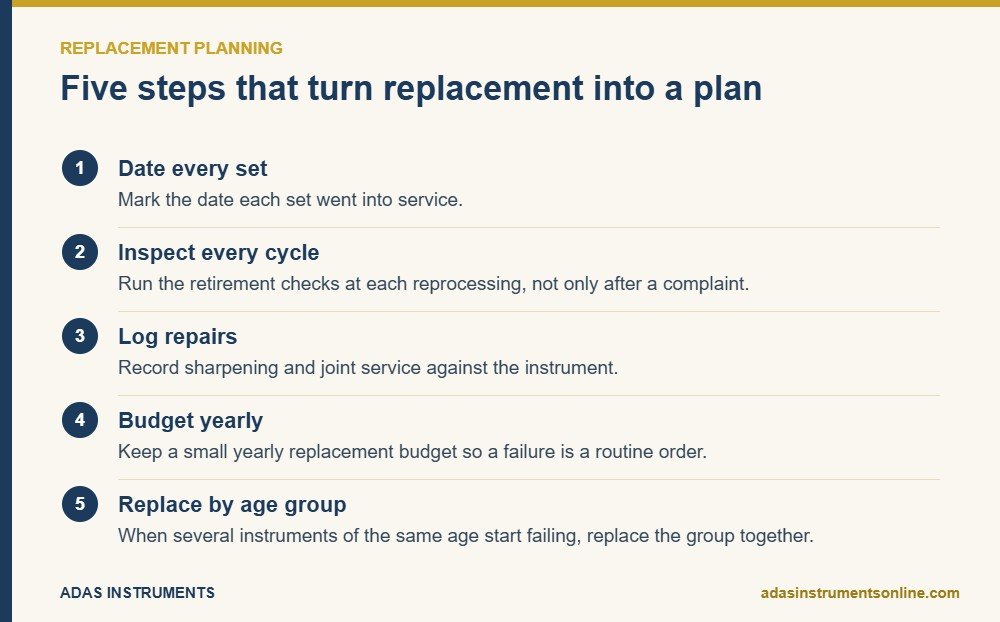
Treat instruments as assets with a life, not as consumables to be replaced when they break. Mark every set with the date it went into service. Record each repair against the instrument. Keep a small yearly budget for replacements so a failed instrument is a routine order rather than an emergency.
When the same check starts failing across several instruments of the same age, replace that group together rather than one piece at a time. Standardizing on the same patterns across sets helps, because a replacement then drops straight into any tray. The reprocessing standards most departments follow are published by AAMI.
Frequently Asked Questions
How long do surgical instruments last?
Well made stainless steel instruments often serve ten years or more. Simple forceps and retractors last longest, while ratcheted and cutting instruments wear sooner. Cleaning, handling and storage habits matter far more than how often the instrument is used in surgery.
How many sterilization cycles can a surgical instrument survive?
Steam sterilization on its own does little harm to good stainless steel, and instruments routinely go through thousands of cycles. The practical limit comes from mechanical wear, handling damage and corrosion from poor cleaning, not from the autoclave itself.
When should a surgical instrument be replaced?
At the first reliable failure sign: a ratchet that springs open, jaws that slip on a needle, scissor tips that fold, side play or cracks at the box lock, or pitting on the surface. Replace it before the next case, not after it fails.
Is it worth repairing old surgical instruments?
Sharpening, cleaning and joint service are worth doing on well made steel, often several times. Cracked box locks, pitting and broken tips are terminal, and replacing the instrument is cheaper than the failure they are heading toward.
Do tungsten carbide instruments last longer?
Their jaws and cutting edges do. Tungsten carbide inserts are much harder than steel, so needle holder jaws keep their grip and scissor edges stay sharp for longer. The rest of the instrument still needs the same cleaning and care as plain steel.
