
Titanium vs Stainless Steel Surgical Instruments: Solid or Coated
Oct
Titanium surgical instruments sound like a straight upgrade on steel. They are not, and the word covers two very different products. One is an instrument machined from solid titanium alloy. The other is a stainless steel instrument with a thin titanium coating on the surface. Buyers pay for one and sometimes receive the other, so it is worth knowing which is which before the order goes in.
Titanium surgical instruments are instruments made either from a titanium alloy, most often grade 5 Ti-6Al-4V, or from stainless steel finished with a titanium nitride coating a few microns thick. The first is about 40 percent lighter than steel; the second weighs exactly what steel weighs. Adas Instruments makes the coated kind: high quality medical grade stainless steel with a black titanium nitride layer applied by PVD, autoclave safe at 134 C, across parts of our plastic surgery instrument range.
Key takeaways
- Solid titanium is lighter and nonmagnetic, but it is softer than hardened stainless steel and does not hold a cutting edge as well.
- Titanium coated instruments are stainless steel underneath. The coating cuts glare and adds surface hardness, but the weight and magnetism stay the same.
- Anything that cuts should be hardened steel or carbide, whatever color it is.
- Ask the supplier one question: solid alloy or coating? A magnet answers it in two seconds.

Solid Titanium and Titanium Coated Are Not the Same Thing
A solid titanium instrument is cut from titanium alloy bar or forged from it. Every property that makes titanium interesting, the low weight, the lack of magnetism, the stable oxide, runs all the way through the metal.
A titanium coated instrument starts life as a normal hardened stainless steel instrument. After polishing it goes into a vacuum chamber, where a layer of titanium nitride a few thousandths of a millimeter thick is deposited on the surface. The coating changes how the instrument looks and how its surface behaves. It does not change what the instrument is made of.
The quickest way to tell them apart is a magnet. Hardened 420 stainless steel is strongly magnetic, and a coating does not change that. Solid titanium does not react to a magnet at all.
What Solid Titanium Does Well
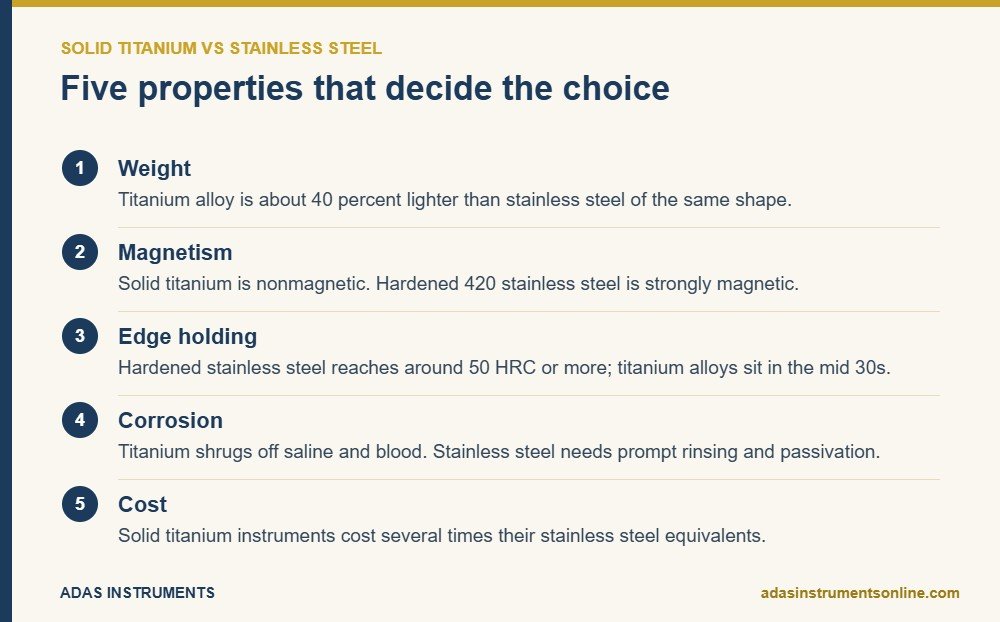
Weight is the headline. Titanium alloy has a density of about 4.4 grams per cubic centimeter against roughly 7.8 for stainless steel, so a micro needle holder or forceps of the same shape weighs a little over half as much. Over a four hour microsurgical case, held in a precision grip the whole time, that difference shows up in the surgeon’s hand.
It is also nonmagnetic, which matters near imaging equipment and at micro scale, where a magnetized instrument can drag a fine needle. And its natural oxide layer is very stable, so it shrugs off the chloride exposure from saline and blood that pits neglected stainless steel.
Where Stainless Steel Still Wins
Hardness decides the cutting work. Martensitic stainless steel is hardened to around 50 HRC or more, while common titanium alloys sit in the mid 30s. A harder blade takes a finer edge and keeps it longer, which is why scissors, osteotomes and knives stay in steel or take carbide inserts. Our tungsten carbide guide covers the inserts.
Steel is also stiffer. A long retractor or a heavy clamp in titanium flexes more than the same shape in steel, so it needs a thicker section to do the same job, which eats into the weight saving.
Then there is cost. Solid titanium instruments cost several times their steel equivalents, partly for the material and partly because titanium is slow and difficult to machine. Across a full tray, that is real money spent on instruments that gain nothing from being light.
What a Titanium Coating Adds to Steel
The coating is about the surface. A black titanium nitride finish is matt, so it does not throw a headlight or microscope beam back into the surgeon’s eyes. It is also much harder than the steel beneath, which helps the surface resist scratching from contact with other instruments.
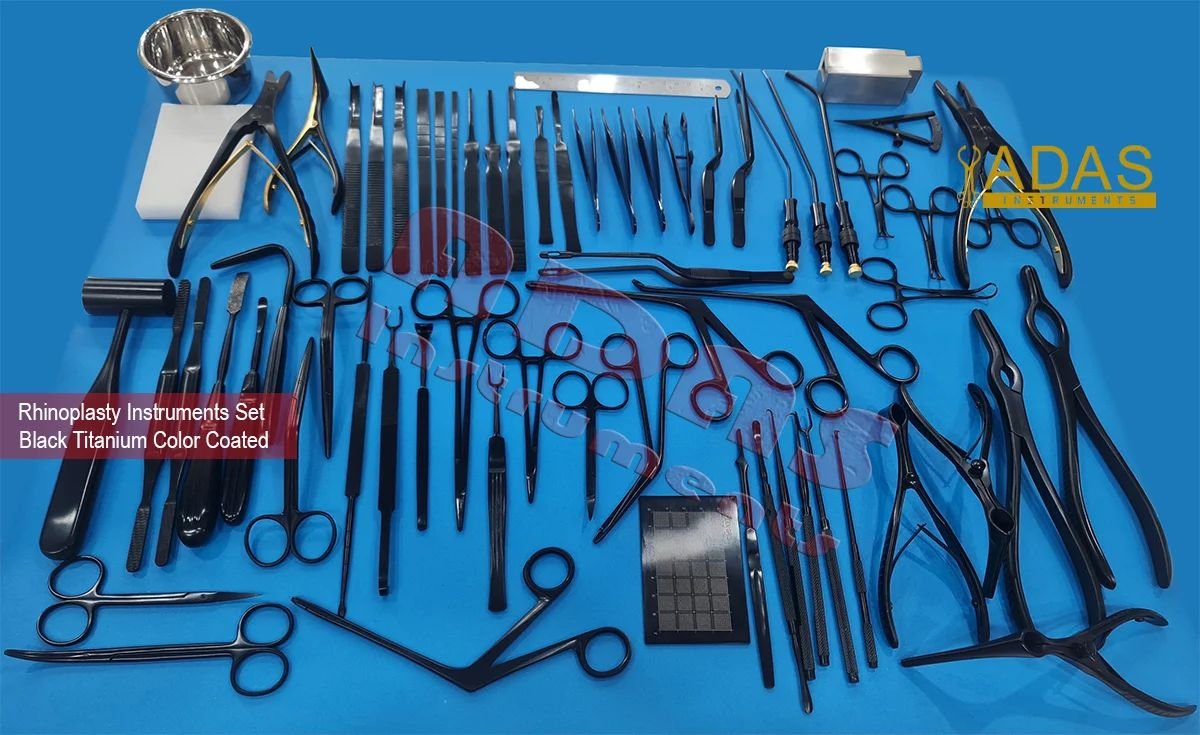
That is why our coated range sits where glare is the problem: the Gorney facelift scissors in five lengths from 14.5 cm to 23 cm, the set of three Freeman Gorney rhytidectomy scissors in 18, 20 and 23 cm, and a complete 72 piece black rhinoplasty instrument set. In each case the blades and jaws are hardened steel doing the work, and the coating keeps the field readable under bright light.
Black titanium coated instruments, direct from the maker
Adas Instruments makes facelift scissors, scissor sets and a 72 piece rhinoplasty set in matt black titanium nitride over high quality medical grade stainless steel. Single pieces, sets and private label for distributors.
Shop plastic surgery instruments or see the black scissor set
Which Material for Which Job
The useful question is how long each instrument stays in the hand. A retractor that is placed and held by an assistant gains nothing from being light. A jeweler forceps used continuously for three hours under a microscope gains a lot.
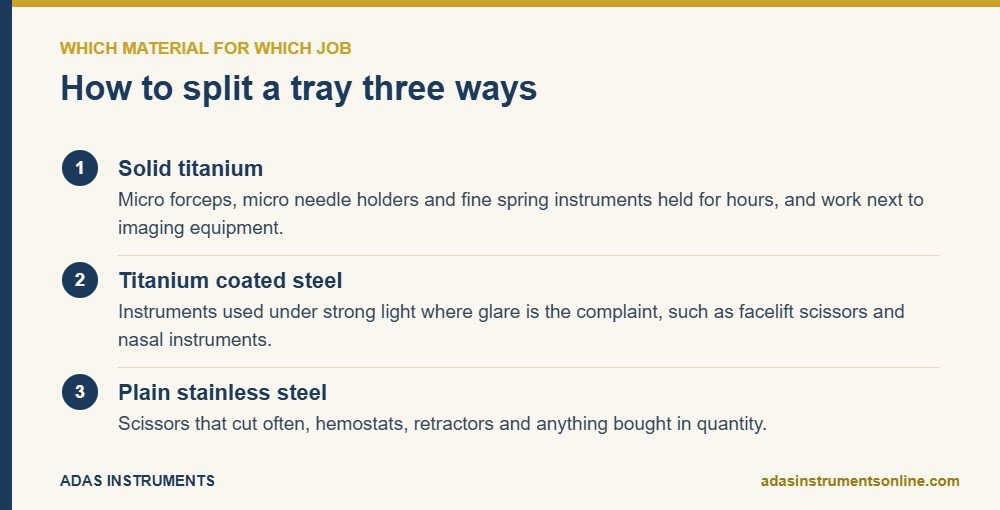
So solid titanium earns its price in micro forceps, micro needle holders and fine spring instruments used for hours at a time, and in work next to imaging equipment. Coated steel suits instruments used under strong light where glare is the complaint, such as facelift scissors and nasal instruments. Plain satin stainless steel stays the sensible choice for everything else: scissors that cut often, hemostats, retractors and anything bought in quantity.
Caring for Coated and Solid Titanium
Both go through the same steam cycle as the rest of the tray, as set out in our autoclave temperature and time guide. A coating is not a license for rough handling. It can wear through at the tips and jaws after years of use, and once it does, the steel underneath needs the same care as any other steel instrument, as described in our rust removal guide.
Keep solid titanium and steel apart in the ultrasonic bath where you can, and do not leave them touching in a wet tray. Prolonged wet contact between dissimilar metals is a common cause of staining that gets blamed on the sterilizer.
Frequently Asked Questions
Are titanium surgical instruments better than stainless steel?
Better for weight, magnetism and corrosion, worse for edge holding, stiffness and cost. Solid titanium suits micro forceps and needle holders used for hours. Hardened stainless steel remains the better choice for scissors, retractors and anything that cuts repeatedly.
Are titanium coated instruments really titanium?
No. They are stainless steel instruments with a thin titanium nitride layer on the surface. The coating reduces glare and hardens the surface, but the instrument keeps the weight and magnetism of steel. A magnet will tell you which you have.
Do titanium instruments rust?
Solid titanium does not rust in the way steel does, because its oxide layer is very stable. Titanium coated steel resists staining well while the coating is intact, but where the coating wears through, the steel beneath needs normal care.
Why are surgical scissors not made of titanium?
Titanium alloys are softer than hardened stainless steel, so they take a less fine edge and dull faster. That is why cutting instruments stay in steel, often with tungsten carbide inserts, even when the finish is black titanium.
Can titanium coated instruments be autoclaved?
Yes. A titanium nitride coating is applied at temperatures well above any sterilization cycle, so it is unaffected by steam at 134 C. Clean and dry them the same way as the rest of the tray.
