


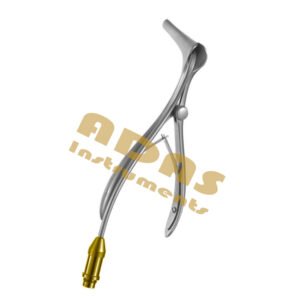
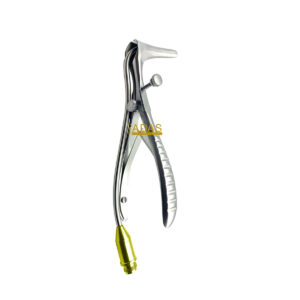
Fiber Optic Killian Nasal Speculum | Lighted, 35 to 90 mm Blades
$ 55.00
The fiber optic Killian nasal speculum is the same locking long bladed speculum as our plain Killian, with a light guide running down it so the light arrives at the blade tip instead of at the nostril rim. A headlight lights the entrance to a nose; this lights the bottom of it. Blades 35 to 90 mm, regular or thin, and the set screw still holds it open.
Key Features
- Fiber optic light guide puts cold light at the blade tip
- Set screw locks the blades open, so it is self retaining
- Blade lengths 35 mm, 50 mm, 75 mm and 90 mm
- Regular blades or thin blades
- For deep septal and sinus work where a headlight does not reach
- Cut from high quality medical grade stainless steel and fully autoclavable
- Three year replacement warranty against manufacturing defects
- Item code ADR-454.350

What a fiber optic Killian nasal speculum is for
Light in a nose is a geometry problem. A headlight sits above the surgeon’s eye and throws light along their line of sight, which works until the corridor is 75 mm deep and the speculum blades themselves are in the way. Then the bottom of the field is in the shadow of the instrument holding it open.
A fiber optic Killian nasal speculum solves that by carrying the light down the blade. Google’s own description is the clear one: the light guide delivers shadowless, cold light directly to the tip. Cold matters because the tip is against mucosa for the length of the operation, and shadowless matters because the shadow being removed is the one the speculum was casting.
Everything else is the plain Killian. It is a lighted Killian nasal speculum, the same long bladed self retaining pattern. Here is that mechanism: a set screw holds the blades open at the width you set, so the hand that opened the speculum can let go and do something else, which is the whole difference between a self retaining speculum and one you hold. Blades 35, 50, 75 and 90 mm on our own record, regular or thin.
It is listed as a fiber optic Killian nasal speculum, as a lighted Killian nasal speculum, as a Killian speculum with fiber optics and as a thin blade nasal speculum. One instrument, four ways of writing it down.
One thing we do not publish, and it is the question a buyer of this product will ask first. We do not state which light post this takes or which cable it fits. Rival listings say a universal post clips into standard cables from Storz, Olympus and Wolf; that is their statement about their instrument. Ours says nothing, so ask us with your light source before you order, and it is on our own list to put right.
Key design features
The light goes where the blades go
The guide runs the length of the blade and finishes at the tip. On a 75 or 90 mm blade that is the difference between seeing the posterior septum and guessing at it, and it is why the lighted version exists at all. On a 35 mm blade the gain is much smaller, which is worth knowing before you pay for it.
Cold light, against mucosa, for an hour
Fiber optic light is cold at the delivery end because the lamp is somewhere else. The blade tip sits against mucosa for as long as the operation lasts, and that is the whole reason this is a fiber guide and not a bulb.
It still locks
The set screw is unchanged. Open the blades, turn the screw, let go. Adding a light does not cost you the hand the lock gave back, which is the point of putting the light on this pattern rather than on the Thudichum.
What we do not claim
No light source, no cable and no adaptor is included or specified, because our record does not carry one. No post diameter either. If your operating room runs one brand of stack, send us the name with the order and we will tell you before we ship rather than after.
Which blade to order, and the question to ask us first
Four of these five rows are decisions you make. The fifth is the gap in our own record.
| Choice | Options | How to decide |
|---|---|---|
| Blade length | 75 mm or 90 mm | Where the light actually earns its money |
| Blade length | 50 mm | Standard adult work, and the light still helps |
| Blade length | 35 mm | The gain from lighting a short blade is small. Buy the plain Killian instead |
| Blade type | Thin or regular | Thin leaves room for the working instrument |
| Light post and cable | NOT published by us | Rivals name Storz, Olympus and Wolf compatibility. We do not publish ours. Send us your light source with the order |
Where it is used
Everywhere the plain Killian is used, and it is worth the money in the deeper half of that list.
| Procedure | What the light adds | Blade |
|---|---|---|
| Submucous resection | Lights the posterior septum, which the blades were shadowing | 75 or 90 mm |
| Sinus surgery | Puts light at the far end of a corridor a headlight cannot follow | 75 mm, thin |
| Septoplasty | Removes the shadow of the speculum from the working field | 50 or 75 mm |
| Revision work | Scarred tissue reads differently under direct light than under reflected | 50 to 90 mm |
| Anterior examination | Very little. The front of a nose is already lit | 35 mm |
What it lights, and what it must not do
Two of these are about the lock and two are about the light.
| The task | What this speculum does | What it must not do |
|---|---|---|
| Lighting the field | Cold light at the blade tip, not at the nostril rim | It is NOT a light source. It carries light from a cable you already own, and we do not supply the cable |
| Holding itself open | The set screw, exactly as on the plain Killian | It must not be locked wider than the tissue will take, and a lit field makes that easier to miss because everything looks fine |
| Surviving the autoclave | The guide is built to go through the same cycle as the steel | It must not be kinked, clamped in a tray clip or stood on. A fiber guide fails by losing light gradually, not by breaking visibly |
| Fitting your stack | Nothing we will promise in writing | Our record does not name a post or a cable. Ask first. It is on our owed list |
How it compares with the other four specula
It is the plain Killian plus a light, and the table says when that is worth it.
| Speculum | Holds itself open | Light | Buy it when |
|---|---|---|---|
| Fiber optic Killian, this page | Yes, set screw | Guide to the blade tip | The corridor is 75 mm deep and the bottom of it is dark |
| Killian | Yes, set screw | None | Same instrument, and a headlight is reaching |
| Cottle | Yes, thumb screw | None | Septal and rhinoplasty work under the Cottle name |
| Hartmann | No, spring tension | None | Examination with short cone blades |
| Thudichum | No, you hold it | None | Anterior rhinoscopy, and the hand stays free |
Materials and finish
Every fiber optic Killian nasal speculum we make is cut from high quality medical grade stainless steel. The steel itself is made to a German specification. We do not publish a grade number. A certificate says nothing about whether a light guide still carries the same light after two hundred autoclave cycles, because a guide dims slowly and nobody notices until a field that used to be lit is not. The answer to that is in the making rather than in the alloy.
The guide is seated into the blade rather than bonded along the outside of it, so the steel takes the handling and the fibers only have to carry light. A guide glued to the outside of a blade is the first thing a tray clip finds.
The screw and thread are cut and lapped as a pair, the blades are ground as a matched pair, and the post end is finished so a cable seats square instead of at an angle. No sharp external edge anywhere on the outline.
Caring for it
Never kink the guide and never clamp it. A fiber bundle does not announce that it has been crushed; it just gets dimmer, and by the time anybody notices nobody remembers what did it.
Warm water, a soft brush along the blades and into the thread, nothing abrasive on the post face. Autoclave with the tray and lay it flat. Hold the post to a window every so often and look at the tip: the light should be even across the whole face, and a dark patch is broken fibers.
Ordering and wholesale
Every fiber optic Killian nasal speculum is made by Adas Instruments in our own workshop and sold direct, which is why the price sits where it does against the catalog houses. Order one for a single tray, or in quantity for a hospital list or a distributor line. We do OEM work under your own brand and your own item numbers. Send us a sample and we will hold a run to your pattern rather than ours. Stock items ship from our own workshop. Backorder items take 10 to 12 working days to make. Every instrument carries a three year replacement warranty against manufacturing defects. Production is controlled under an ISO 13485 quality management system.
Frequently asked questions
What is a fiber optic nasal speculum for?
Lighting the inside of a nose from the blade tip rather than from above the surgeon’s eye. A headlight lights the entrance; on a 75 mm corridor the speculum itself casts a shadow over the part you are working on, and a light guide removes it.
What light cable does it fit?
We do not publish that, and it is the one thing a buyer of this product most needs to know. Rival listings say a universal post takes standard cables from Storz, Olympus and Wolf. That is their instrument. Send us your light source with the inquiry and we will confirm before we ship. It is on our list to put right.
Is it self retaining like the plain Killian?
Yes, the set screw is unchanged. Adding the light does not cost you the free hand, which is why the light goes on this pattern and not on the Thudichum.
Which blade length is worth lighting?
75 or 90 mm. That is where the blades shadow the field and the light pays for itself. On a 35 mm blade the front of the nose is already lit and the plain Killian is the better buy.
Is a lighted speculum the same as an endoscope?
No, and the two get confused. This holds the nostril open and lights it; you look down it with your own eyes. An endoscope carries the image back as well as the light and is a different instrument with a camera behind it.
Related products and categories
For the same speculum without the light, the plain Killian nasal speculum. For the same locking mechanism under the Cottle name, the Cottle nasal speculum. For short cone blades and examination rather than surgery, the Hartmann nasal speculum.
The rest of this family sits under nasal speculum and polypus instruments, and the wider set for the operation is under rhinoplasty instruments.
| Weight | 0.1 kg |
|---|---|
| Blade Type | Regular Blades, Thin Blades |
| Tip options | 35mm, 50mm, 75mm, 90mm |
Be the first to review “Fiber Optic Killian Nasal Speculum | Lighted, 35 to 90 mm Blades”
Shipping & Delivery Policy
Processing Time: In-stock items are dispatched within 24-48 hours. For custom or out-of-stock items, production time is approximately 10-15 days.
Global Delivery Estimates
We partner with world-class couriers (DHL, FedEx) to ensure fast, tracked delivery.
- USA & Canada: 3-5 Business Days
- Europe & UK: 4-6 Business Days
- Rest of World: 5-7 Business Days
*We offer Air Cargo and Sea Freight options for bulk wholesale orders.
Customs & Duties
International buyers are responsible for any customs duties or taxes imposed by their country. Adas Instruments is not responsible for delays caused by customs clearance.
Lost Packages & Insurance
If your package is lost in transit, please contact us immediately. We offer full support and replacements for confirmed lost shipments. Note: You must report non-delivery within 3 weeks to be eligible for an insurance claim.
Related products

Reviews
There are no reviews yet.