
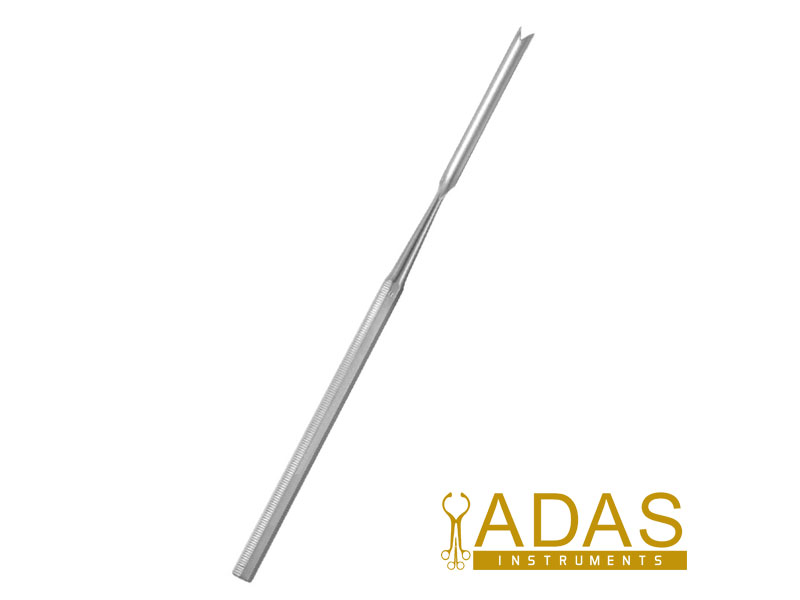
Ballenger Hajek Septum Chisel
$ 22.00
Ballenger Hajek septum chisel, listed by surgeons as simply the Ballenger or the Hajek septum chisel, is used in septoplasty, rhinoplasty and nasal reconstruction to cut the bone and the deeper cartilage of the nasal septum. It is a chisel rather than an elevator, so the work is done by a mallet tapping the end of the handle while the surgeon holds the line, which is why the handle is hexagonal and cross serrated rather than round. That makes it the chisel that stays on the septoplasty tray: septal cartilage is often too tough to take with a knife and too thin to risk a heavier osteotome on.
Key Features
- Septum chisel for bone and deep cartilage of the nasal septum
- Hexagonal handle, horizontally serrated, holds its line under a mallet
- Flat handle end shaped to receive mallet taps
- Single instrument, no ratchet and no moving parts to wear
- Sits between a knife and a nasal osteotome in weight
- High quality medical grade stainless steel, fully autoclavable
- Three year replacement warranty against manufacturing defects
- Item code AM-05.04
Available on backorder

What the Ballenger Hajek septum chisel is
The Ballenger Hajek septum chisel is used to cut the bone and the deeper cartilage of the nasal septum, in septoplasty, in cosmetic rhinoplasty and in nasal reconstruction. Surgeons and catalogues shorten the name in both directions, so the same instrument turns up as the Ballenger septum chisel and as the Hajek septum chisel.
It is a chisel rather than an elevator, and that changes how it is used. The cut is made by a mallet tapping the end of the handle while the surgeon holds the line, so the whole instrument is built around staying where it was aimed between taps. That is why the handle is hexagonal and cross serrated rather than round, and why the shaft is solid with no joint in it anywhere.
It sits in the range between a knife and a nasal osteotome. Septal cartilage is often too tough to take cleanly with a blade and too thin to put a heavier osteotome near, and that gap is where this chisel stays on the septoplasty tray.
Key design features of the mallet driven septum chisel
A hexagonal serrated handle that holds its line
The flats of a hexagonal handle stop the chisel rolling in the hand, and horizontal serrations across those flats stop it sliding forward when the grip is wet. Between mallet taps the instrument has to stay pointed exactly where it was, and a round polished handle is the commonest reason it does not.
A flat handle end made to be struck
The far end is a true flat face, so a mallet lands square and transfers the whole tap into the blade. A domed or tapered end sends part of every tap sideways, which is felt as the blade wandering off the line.
One piece, no joints
There is no hinge, no screw and no box lock. An instrument struck with a mallet many times a year lasts longer when there is nothing in it to work loose, and there is also no joint for tissue or cleaning solution to sit in.
Built for cartilage as well as bone
The deeper cartilage of the septum is the material this pattern is normally reached for. It is tougher than it looks and it deflects a knife; a chisel driven by a mallet divides it in one controlled movement instead of sawing at it.
What is supplied, and what is not claimed
This instrument is supplied as one pattern with no size options. The table below also states plainly what is not on file for it, because a specification we cannot verify from our own records does not belong on a product page.
| Feature | This instrument |
|---|---|
| Pattern | Ballenger Hajek septum chisel, one pattern, no size options |
| Also listed as | Ballenger septum chisel, Hajek septum chisel |
| Handle | Hexagonal with horizontal serrations, flat mallet face at the end |
| Construction | Single piece, no joints or moving parts |
| Blade profile and length | NOT ON FILE in our product data, so not stated here |
| Supplied as | Single instrument, item code AM-05.04 |
Blade profile and overall length are not recorded in our product data for this item, so they are not stated here. Several suppliers describe this pattern with a V profile edge; our own records do not confirm that for the instrument we grind, so this page does not claim it. If you need the exact edge geometry before ordering, ask us and we will measure one.
Where the Ballenger Hajek septum chisel is used
These are the procedures this chisel is bought for. The word chisel is shared with dentistry and with the workshop, so every row here says what part of the nose it is for.
| Procedure | What the chisel does there |
|---|---|
| Septoplasty | Divides the bony septum and the deeper cartilage |
| Cosmetic rhinoplasty | Cuts the septal framework back to plane |
| Nasal reconstruction | Divides thickened or misshapen septal bone |
| Submucous resection of the septum | Cuts the bony plate once the lining is lifted |
| Revision septal surgery | Takes on cartilage stiffened by earlier surgery |
In each of these the mucoperiosteum is lifted with an elevator first, and the chisel is then driven against bare bone or exposed cartilage with the lining held clear.
What it cuts, and what it has to leave alone
A septum chisel is judged by what survives the cut as much as by what it divides. The lining on both sides of the septum has to come through intact.
| Tissue | What happens to it |
|---|---|
| Bony nasal septum | Divided. This is the target |
| Deep septal cartilage | Cut in one controlled movement rather than sawn |
| Mucoperiosteum | Lifted clear with an elevator before the chisel is used |
| Mucosa on the far side | Must stay whole. A tear on both sides in one place is what perforates |
| Nasal bones | Not this instrument. That is an osteotome |
That fourth row is the whole reason for lifting the lining before the chisel is used. A tear through the mucosa on both sides in the same place is what becomes a septal perforation.
How it compares with the rest of the septum family
Five septum instruments sit beside each other in this range. This chisel and the Freer are both honestly described as a septum chisel, so the table sets the two out together rather than letting either one claim the phrase on its own.
| Instrument | Edge | Where it is the right choice |
|---|---|---|
| Ballenger Hajek septum chisel | Flat, mallet driven | Tough septal cartilage and thin bone that will not give |
| Freer septum chisel | Flat, 4mm, single bevel | The lighter controlled cut, used most often |
| Freer septum gouge | Concave, 4mm or 6mm | Shaving bone in layers and lifting membrane |
| Killian septum gouge | 5mm concave trough | Lifting a strip of bone or cartilage out whole |
| Killian-Claus nasal septum gouge | 5mm V notch | Taking a bony ridge down without sliding off it |
The practical split is weight and purpose. The Freer is the lighter, more controlled cut and it is the one used most of the time. This chisel is the one reached for when cartilage or bone will not give to it.
Ballenger Hajek septum chisel materials and finish
The chisel is ground from high quality medical grade stainless steel, hardened through the blade so the edge holds under mallet work, and left a little softer along the shaft so a tap that lands off square bends nothing permanently. The steel itself is made to a German specification.
The finish is satin rather than mirror bright. A polished blade under a headlamp throws light back up the nostril at the surgeon; satin scatters it. Satin also shows bone dust and dried blood plainly, which is what is wanted when an instrument is checked before it goes back in.
Caring for a Ballenger Hajek septum chisel
Rinse the blade under cool running water as soon as the case is over, before anything dries along the edge. A soft nylon brush at the sink takes seconds and saves a much longer clean.
Ultrasonic clean in a neutral pH enzymatic solution, rinse in deionized water, then dry fully before pouching. Tap water dried on steel is the ordinary cause of pitting on an instrument that is otherwise well kept.
Autoclave at 134 degrees Celsius. Store with the edge guarded and clear of other instruments. On a chisel the edge is the instrument, and it blunts against other blades in a tray far more often than it blunts in use.
Ordering a Ballenger Hajek septum chisel, and wholesale
The Ballenger Hajek septum chisel is supplied as a single instrument, item code AM-05.04. It is ground and finished in our own workshop, so it can be ordered to match the handle pattern and finish of the rest of the septum instruments on a tray.
Wholesale and distributor pricing is available on quantity, and larger orders can carry a laser marked hospital or practice reference at no separate tooling charge. Tell us the quantity and the marking text and we will quote both.
Item code AM-05.04. Every instrument carries a three year replacement warranty against manufacturing defects. Stock items ship from our own workshop. Backorder items take 10 to 12 working days to make. Production is controlled under an ISO 13485 quality management system.
Frequently asked questions
What is a Ballenger Hajek septum chisel used for
It cuts the bone and the deeper cartilage of the nasal septum during septoplasty, cosmetic rhinoplasty and nasal reconstruction. It is driven by a mallet against the flat end of the handle rather than pushed by hand.
Is the Ballenger the same as the Hajek septum chisel
Yes. The same instrument is listed as the Ballenger Hajek, as the Ballenger septum chisel and as the Hajek septum chisel, and people search for all three. If you have been quoted any of those names, this is the instrument.
What is a surgical chisel
A flat bladed instrument driven by a mallet to divide bone or cartilage along a line. It differs from a gouge, which has a trough and scoops bone away, and from an osteotome, which is heavier and beveled on both faces.
What are three types of chisels used in surgery
In the nose the three that matter are the chisel, which divides along a line, the gouge, which scoops with a concave blade, and the osteotome, which is heavier and splits the nasal bones themselves. Outside the nose the word also covers dental chisels and bone chisels for orthopedic work, which are different instruments entirely.
What is the difference between a chisel and an osteotome
A chisel is normally beveled on one face and is used to cut a surface or divide a thin plate. An osteotome is beveled on both faces and is used to split through bone in a line. In nasal surgery the chisel works on the septum and the osteotome works on the nasal bones.
Related products and categories
Browse the full range of osteotomes, chisels and gouges, or see the wider set of rhinoplasty instruments this instrument belongs to.
| Weight | 0.09 kg |
|---|
Be the first to review “Ballenger Hajek Septum Chisel”
Shipping & Delivery Policy
Processing Time: In-stock items are dispatched within 24-48 hours. For custom or out-of-stock items, production time is approximately 10-15 days.
Global Delivery Estimates
We partner with world-class couriers (DHL, FedEx) to ensure fast, tracked delivery.
- USA & Canada: 3-5 Business Days
- Europe & UK: 4-6 Business Days
- Rest of World: 5-7 Business Days
*We offer Air Cargo and Sea Freight options for bulk wholesale orders.
Customs & Duties
International buyers are responsible for any customs duties or taxes imposed by their country. Adas Instruments is not responsible for delays caused by customs clearance.
Lost Packages & Insurance
If your package is lost in transit, please contact us immediately. We offer full support and replacements for confirmed lost shipments. Note: You must report non-delivery within 3 weeks to be eligible for an insurance claim.
Related products
Reviews
There are no reviews yet.