
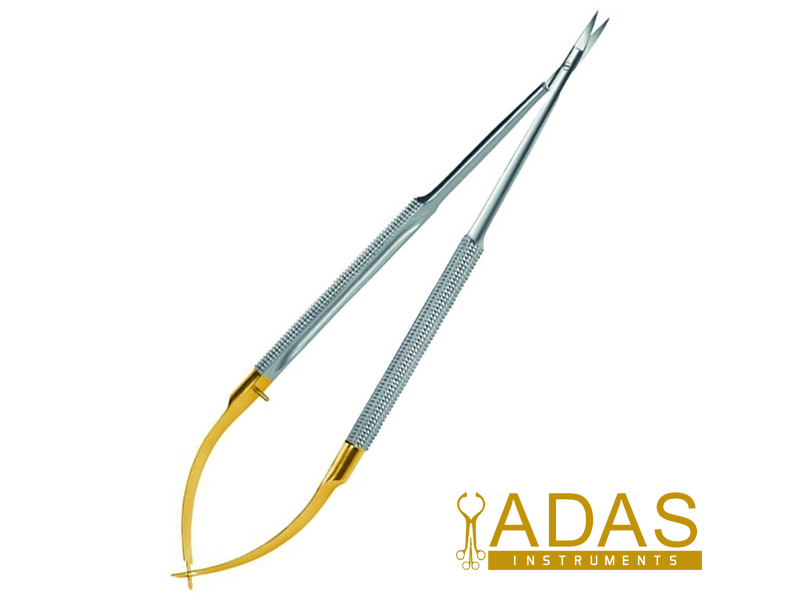
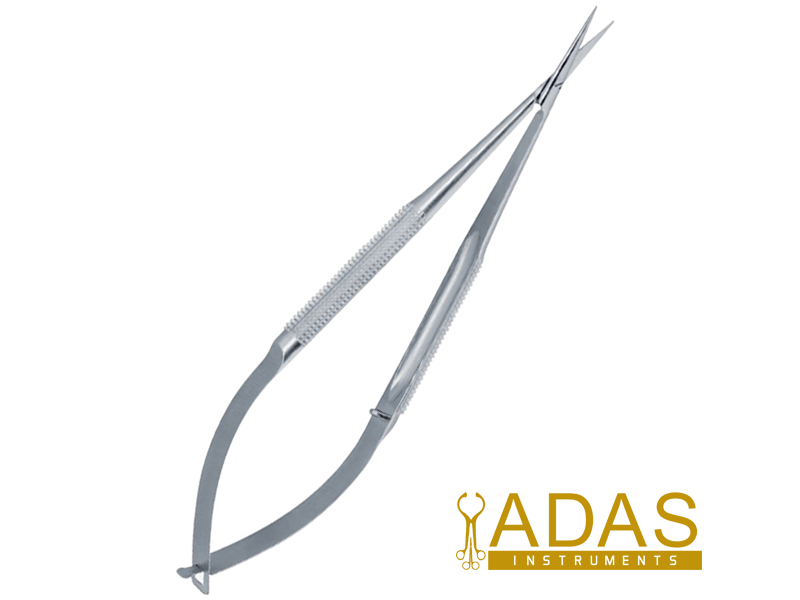

Castroviejo Scissors, Micro Ophthalmic and Microsurgical Scissors
Price range: $ 16.50 through $ 26.50
Spring handled Castroviejo micro scissors in 12 cm, 15 cm and 18 cm, with curved or straight blades in 10 mm and 14 mm. Held like a pen and closed with light finger pressure, for cutting under the microscope.
- Standard or tungsten carbide blades
- Satin non glare finish for microscope work
- Fully autoclavable at 134 C
- Manufactured by Adas Instruments, Sialkot
- OEM and private label available

What are Castroviejo scissors used for?
Castroviejo scissors are spring handled micro scissors designed for cutting under magnification, where the target is a vessel wall, a nerve sheath or a 9-0 suture rather than bulk tissue. The flat spring handle is held like a pen and closes with light finger pressure, so the tips move a fraction of a millimetre at a time and the hand never has to change grip. Adas Instruments manufactures them in 12 cm, 15 cm and 18 cm, with curved or straight blades in 10 mm and 14 mm, in standard steel or tungsten carbide.
Why the spring handle changes the work
- Pen grip, not ring grip. Ring handles need the fingers to open and close. A spring handle returns on its own, so the hand stays still and the tips stay in the field of the microscope.
- Fine, graded closure. Light pressure gives a small movement. This is what allows a controlled cut on a vessel wall instead of a snap.
- Tips you can see past. The blades on these Castroviejo scissors are slim enough that they do not hide the cut at high magnification.
- Two blade lengths. The 10 mm blade is for the finest work, the 14 mm blade covers more ground per cut when dissecting.
- Carbide option. Tungsten carbide holds its edge far longer where the instrument is used in every list.
Clinical applications
These are the procedures our customers buy Castroviejo micro scissors for.
| Specialty | What it is used for | Usual blade |
|---|---|---|
| Ophthalmic surgery | Corneal and conjunctival work, capsulotomy, fine ophthalmic suture | Curved 10 mm |
| Microvascular surgery | Preparing vessel ends before anastomosis, trimming adventitia | Straight 10 mm |
| Neurosurgery | Opening arachnoid, dissecting around small perforating vessels | Curved 14 mm |
| Hand and free flap surgery | Dissection around digital vessels and nerves under the microscope | Curved 10 mm |
| ENT and skull base | Fine dissection in confined fields | Curved 14 mm |
| Research and laboratory | Training and experimental microsurgery | Straight 10 mm |
Size and blade chart
| Overall length | Imperial | Blade options | Best suited to |
|---|---|---|---|
| 12 cm | 4 3/4 in | Curved or straight, 10 mm or 14 mm | Anterior segment eye surgery, superficial micro work |
| 15 cm | 6 in | Curved or straight, 10 mm or 14 mm | The general microsurgery length, most ordered |
| 18 cm | 7 in | Curved or straight, 10 mm or 14 mm | Deep fields, neurosurgery, skull base |
Curved Castroviejo scissors are the usual first purchase because the blades follow tissue and stay visible under the microscope. Straight Castroviejo scissors give a squarer cut and are preferred for trimming suture and vessel ends. Choose the 10 mm blade for the finest cutting and the 14 mm blade when you are dissecting a longer plane. Most microsurgery trays end up carrying one of each.
Technical specifications
| Specification | Detail |
|---|---|
| Instrument | Castroviejo scissors, spring handle micro pattern |
| Lengths | 12 cm, 15 cm and 18 cm |
| Blade options | Curved 10 mm, curved 14 mm, straight 10 mm, straight 14 mm |
| Blade types | Standard or tungsten carbide |
| Handle | Flat spring handle, round or flat body |
| Material | German surgical stainless steel, AISI 420 grade |
| Finish | Satin, non glare for microscope work |
| Sterilisation | Fully autoclavable, 134 C for 3 minutes |
| Reusable | Yes, supplied non sterile |
| Origin | Manufactured by Adas Instruments, Sialkot, Pakistan |
| OEM and private label | Available, laser marking on request |
Care and sterilisation
Micro tips are the most fragile part of any instrument tray. Handle them accordingly.
- Fit a tip guard the moment the instrument leaves the field.
- Never scrub the tips with a brush. Ultrasonic cleaning only, with a neutral pH detergent.
- Rinse in deionised water to avoid mineral spotting on the blades.
- Inspect tip alignment under magnification, not with the naked eye. A misalignment you cannot see is enough to stop the scissors cutting.
- Check the spring returns fully. A tired spring is the usual reason a pair is retired.
- Autoclave at 134 C for 3 minutes in a protective tray, never loose.
Frequently asked questions
What is the difference between Castroviejo scissors and Westcott scissors?
Both are spring handled micro scissors. Westcott scissors have a shorter, more sharply angled blade and are used almost entirely in ophthalmology. Castroviejo scissors have a longer body and are used across microvascular, neuro and hand surgery as well as the eye.
Should I order curved or straight blades?
Curved for dissection, because the blades follow tissue and the tips stay visible. Straight for trimming suture ends and squaring off a vessel.
Is the tungsten carbide version worth the difference?
If the instrument is used in most lists, yes. Carbide holds its edge several times longer than standard steel. For occasional use the standard blade is the better value.
Can Castroviejo scissors cut 10-0 nylon?
Yes. The 10 mm blade in either curved or straight form is the size normally used for fine ophthalmic and microvascular suture.
Do you supply microsurgery sets rather than single instruments?
We do. Tell us the procedure and we will quote a matched set, including private label marking if you need it.
Related instruments
Browse the full plastic surgery scissors range, or the wider plastic surgery instruments catalogue.
- Castroviejo Micro Needle Holder, the matching spring handled needle holder for the same tray.
- Stevens Tenotomy Scissors, for fine dissection that does not need a microscope.
- Iris Scissors Sharp, the ring handled fine cutting scissor used alongside these in eye work.
Related instruments and categories
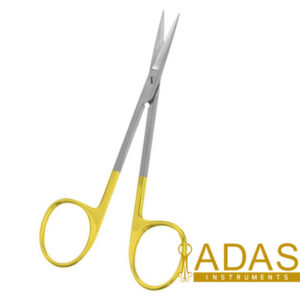
Iris Scissors Razor Edge, Micro Dissection, 9 cm to 11.5 cm, Standard or is listed alongside it and links back here, so the two can be ordered together.
| Weight | 0.06 kg |
|---|---|
| Blade Type | Standard, Tungsten Carbide |
| Select Size | 15cm / 6", 18cm / 7", 12cm / 4.75" |
| Select Scissors Blades | Curved 10mm Blade, Curved 14mm Blade, Straight 10mm Blade, Straight 14MM Blade |
Be the first to review “Castroviejo Scissors, Micro Ophthalmic and Microsurgical Scissors”
Shipping & Delivery Policy
Processing Time: In-stock items are dispatched within 24-48 hours. For custom or out-of-stock items, production time is approximately 10-15 days.
Global Delivery Estimates
We partner with world-class couriers (DHL, FedEx) to ensure fast, tracked delivery.
- USA & Canada: 3-5 Business Days
- Europe & UK: 4-6 Business Days
- Rest of World: 5-7 Business Days
*We offer Air Cargo and Sea Freight options for bulk wholesale orders.
Customs & Duties
International buyers are responsible for any customs duties or taxes imposed by their country. Adas Instruments is not responsible for delays caused by customs clearance.
Lost Packages & Insurance
If your package is lost in transit, please contact us immediately. We offer full support and replacements for confirmed lost shipments. Note: You must report non-delivery within 3 weeks to be eligible for an insurance claim.
Related products


Reviews
There are no reviews yet.