Periosteal Elevator: Types, Uses and How to Choose One
Sep
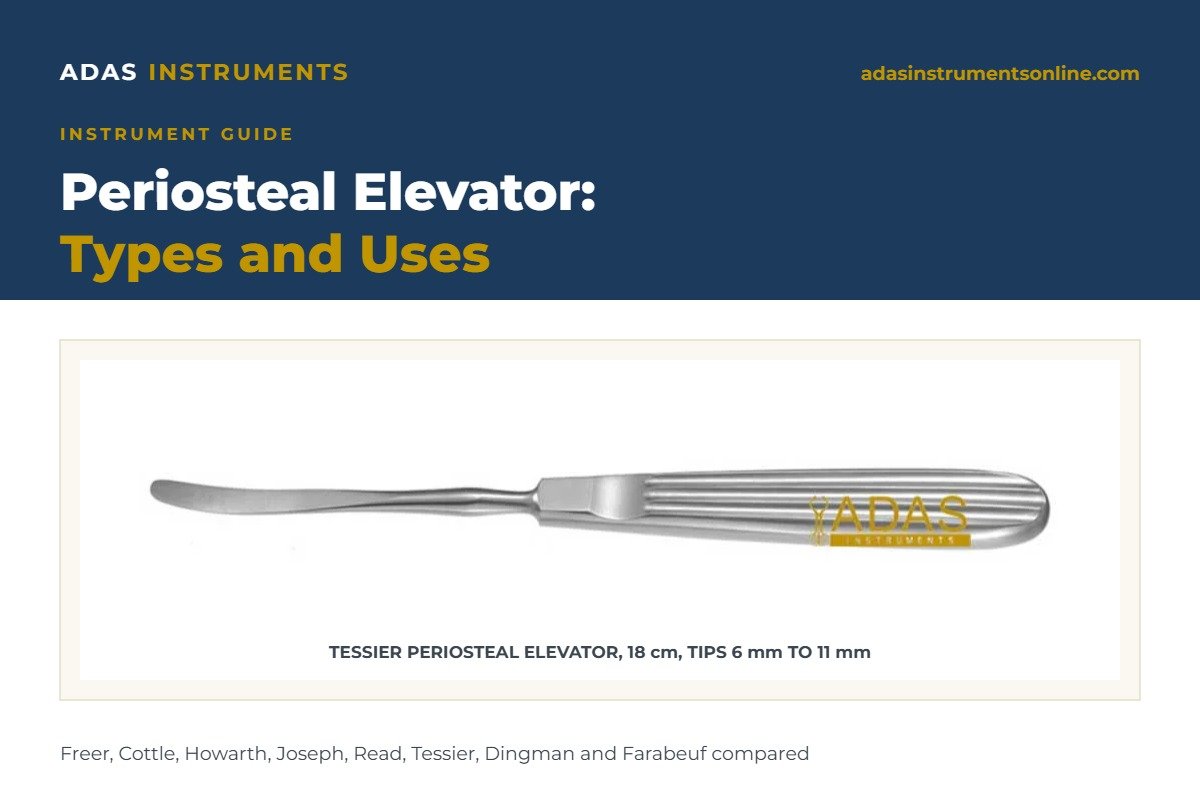
A periosteal elevator is a hand instrument that lifts the periosteum, the thin tough membrane on the outside of a bone, off the bone in one sheet so the bone underneath can be worked on. Surgeons use it in septoplasty and rhinoplasty, in facial fracture work, in hand surgery and in orthopedics. Adas Instruments makes the common patterns in its dissectors and elevators range, from an 18 cm Freer to a 22 cm Dingman, in high quality medical grade stainless steel.
Key takeaways
- The tip decides the job. A 2 mm Read tip suits fine bone work, and an 11 mm Tessier clears the cheekbone in a few passes.
- For the nose most trays carry two: a Freer to start the flap and a Cottle to lift it the rest of the way.
- The periosteum should come off whole. It carries the cells the bone heals from.
- Look at the tip before every case. A nicked edge tears the membrane instead of lifting it.
What a periosteal elevator does
Periosteum does not come away if you pull it. It shears off when it is pushed at a low angle by an edge that is rounded but not dull. That is what the working end is ground for: sharp enough to get under the membrane, blunt enough not to cut through it.
Why it matters is healing. The inner layer of the periosteum holds the cells that lay down new bone, as the StatPearls chapter on periosteum sets out. Lift it whole and it goes back down and does its job. Tear it and the bone under the hole heals slower. So a surgeon picks an elevator for the membrane first and the bone second.
Types of periosteal elevators
These are the Adas Instruments patterns. Every size is one we ship, and the price is the single unit price on this site.
| Pattern | What sets it apart | Size | Main use | From |
|---|---|---|---|---|
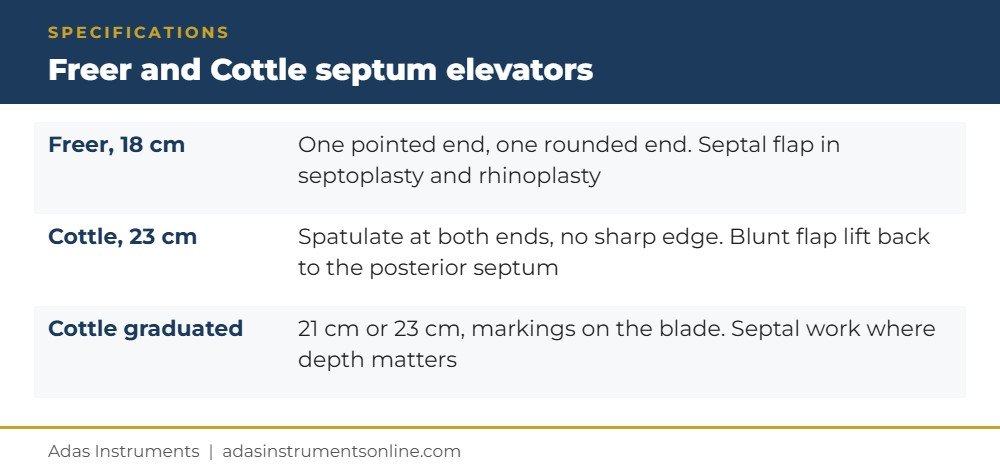
| Freer | One pointed end, one rounded end | 18 cm | Septal flap in septoplasty and rhinoplasty | 18.50 dollars |
| Cottle | Spatulate at both ends, no sharp edge | 23 cm | Blunt flap lift back to the posterior septum | 22 dollars |
| Cottle graduated | Markings on the blade | 21 cm or 23 cm | Septal work where depth matters | 23 dollars |
| Howarth | Stiffer periosteal blade, double ended | 21 cm | Mucoperiosteum over bone, revision cases | 26 dollars |
| Joseph | Slightly curved blade | 2 to 5 mm tip | Nasal dorsum in rhinoplasty | 28 dollars |
| Read | Fine blade, single or double ended | 2 to 5 mm tip | Orthopedic and maxillofacial bone | 23 dollars |
| Tessier | Curved tips | 18 cm, 6 to 11 mm tip | Orbital rim and malar surface | 28 dollars |
| Dingman zygomatic | Curved shaft | 22 cm, 5.5 mm tip | Lifting a depressed zygomatic arch | 32 dollars |
| Farabeuf | Straight or curved blade, heavier build | One build | Fracture repair and larger bone | 22 dollars |
Lay them side by side and one thing stands out. The nasal patterns are long and slim, because the work is deep in a narrow space. The bone patterns are shorter and wider, because the bone is right there and the job is to clear it quickly.
The nasal elevators
The Freer septum elevator does two moves with one handle. One end is ground to a point for the first cut through the perichondrium. The other is rounded to lift the flap clear. Ours is 18 cm, and it is the pattern most residents meet first.
The Cottle septum elevator has no sharp edge at all. Both ends are spatulate, so the flap is separated by pressure and never cut, and the 23 cm shaft reaches the back of the septum. That is why the two sit together: the Freer opens the plane, the Cottle carries it. The graduated Cottle adds markings for when you want to know how deep you are.
Over bone you want something stiffer. The 21 cm Howarth septum elevator has the heavier blade for mucoperiosteum and scarred revision noses. The Joseph periosteal elevator has a slight curve that keeps the edge flat on the dorsum. Our rhinoplasty instruments guide shows where each one sits on a full tray.
Shop periosteal elevators direct from the maker
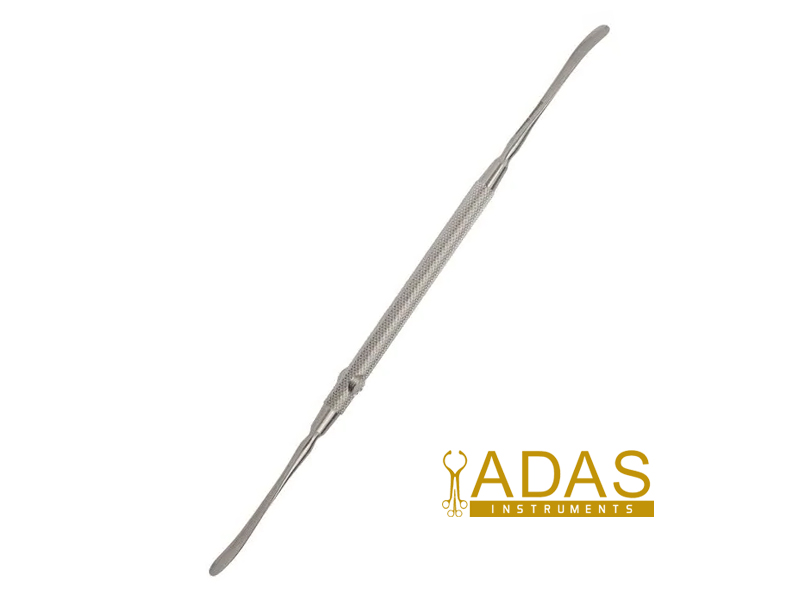
Every elevator in this guide is made by us, from the 18 cm Freer at 18.50 dollars to the 22 cm Dingman zygomatic. Tips from 2 mm to 11 mm. Wholesale pricing for clinics and distributors.
Bone work beyond the nose
Away from the nose the question is tip width. The Read periosteal elevator has a fine blade in 2 mm to 5 mm for orthopedic and maxillofacial exposure. It also comes double ended if you want two widths on one handle. For the small bones of the hand, the Kleinert Kutz elevator is finer still.
The Tessier periosteal elevator goes the other way: 18 cm with curved tips from 6 mm to 11 mm, for the orbital rim and the malar surface. The Dingman zygomatic elevator is a different job again. Its 22 cm curved shaft and 5.5 mm tip go in behind a depressed zygomatic arch and lever it back into line.
People often ask what a Farabeuf periosteal elevator is used for. Short answer: larger bone. The Farabeuf elevator strips periosteum in fracture repair and amputation, and it is made to take real force. It is the wrong tool near a nose, and a Freer is the wrong tool near a femur.
How to choose a periosteal elevator
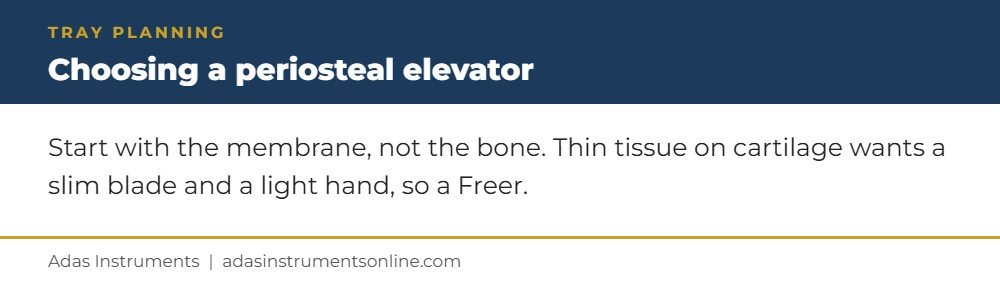
Start with the membrane, not the bone. Thin tissue on cartilage wants a slim blade and a light hand, so a Freer. Tissue stuck to bone wants a stiffer blade, so a Howarth or a Joseph. Then match the tip to the surface: fine for small bone, 5 mm for the dorsum, 11 mm for the cheekbone.
Buy two, not one. A light elevator and a stiff one cover almost every nose. A narrow and a wide Read or Tessier cover most small bone work. One elevator doing both jobs is how flaps get torn.
Elevator or dissector? Our catalogue files them together. An elevator lifts a membrane off a hard surface. A dissector opens a plane between two soft layers, like a breast pocket.
Care and inspection
Rinse the elevator in cool water straight after use so blood does not dry in the grind. Brush it with a neutral pH enzymatic detergent, dry it and steam autoclave at 134 degrees Celsius. Our autoclaving temperature guide has the cycle times.
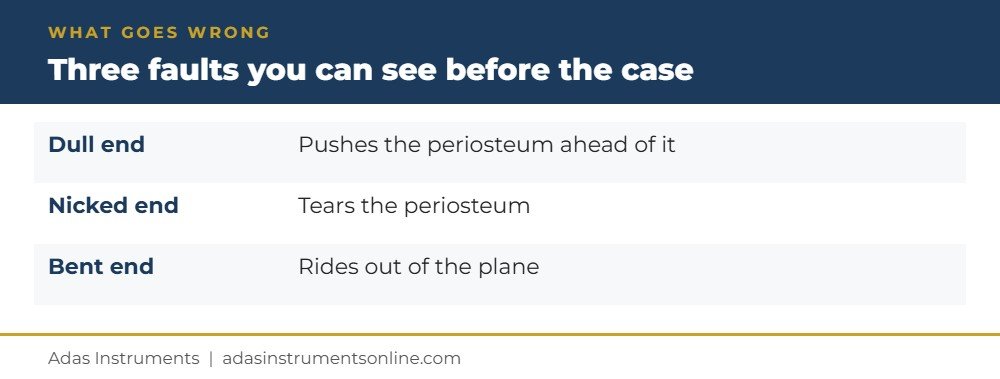
Then hold the tip to the light. A dull end pushes the periosteum ahead of it. A nicked end tears it. A bent end rides out of the plane. You can see every one of these before the case, and none of them can be fixed on the tray.
Frequently Asked Questions
What is a periosteal elevator used for?
It lifts the periosteum, the membrane that covers bone, off the bone surface in one piece. That exposes the bone for cutting, rasping, plating or repositioning, while keeping the membrane whole so it can be laid back down and help the bone heal.
What is a Farabeuf periosteal elevator used for?
It strips periosteum from larger bone in orthopedic and general surgery, such as fracture repair and amputation. It is made to take force on big surfaces, so it is not used for fine nasal or hand work.
What is the difference between a Freer and a Cottle elevator?
The Freer has one pointed end to start the incision through the perichondrium and one rounded end to lift the flap. The Cottle is spatulate at both ends with no sharp edge, so it lifts by pressure only. Most septoplasty trays carry both.
Why should the periosteum come off in one piece?
Its inner layer holds the cells that form new bone and much of the local blood supply. A membrane lifted whole can be laid back down to support healing. A torn one leaves bare bone that heals more slowly.
Which periosteal elevator tip width should I choose?
Match it to the surface. Use 2 mm to 3 mm for fine bone work, 4 mm to 5 mm for the nasal dorsum, and 6 mm to 11 mm for the cheekbone, orbital rim and other wide surfaces of the facial skeleton.
