
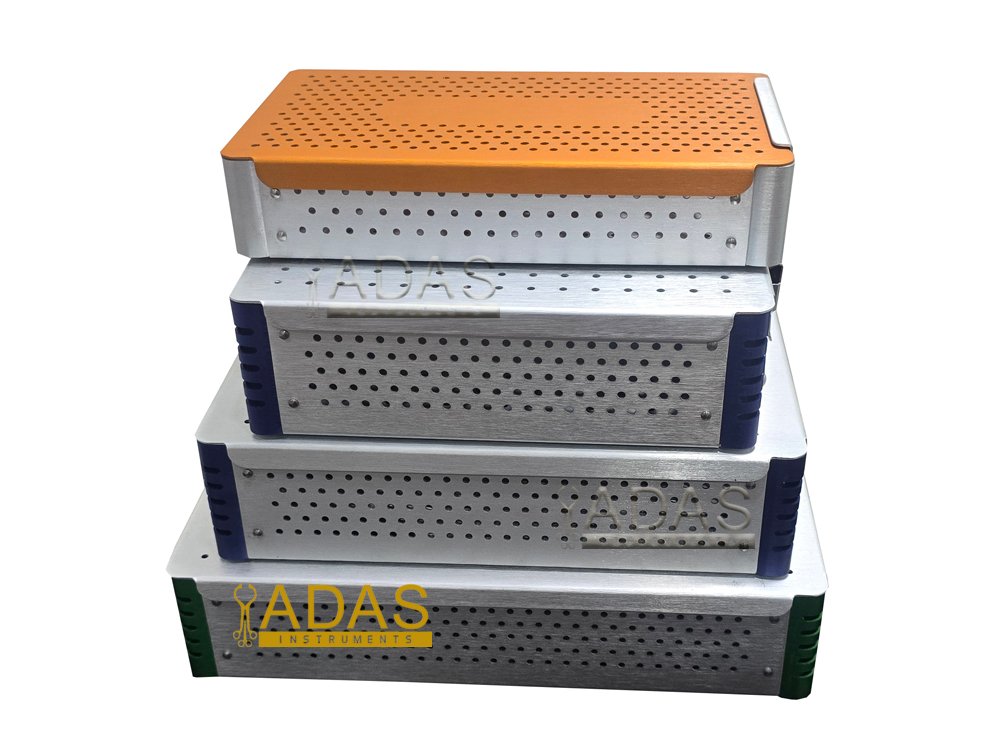
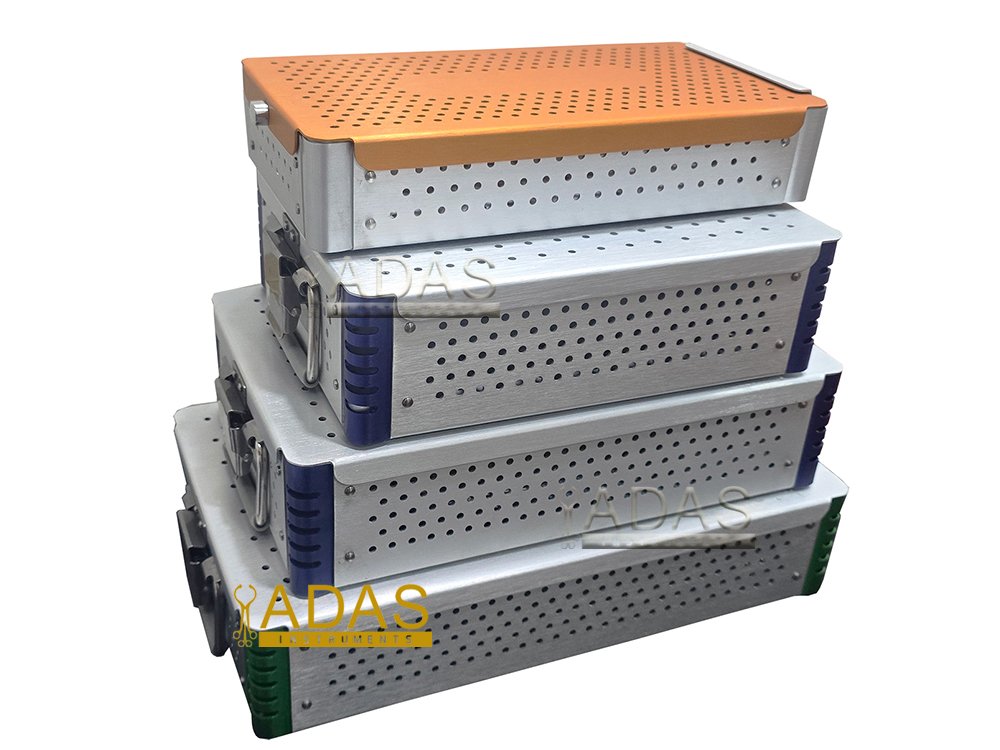
Anodized Aluminum Sterilization Box, Perforated Lid, Four Sizes
Price range: $ 75.00 through $ 110.00
An aluminum sterilization box is the lightweight instrument case: the same job as a steel box at a fraction of the weight, which is why the material gets used for a large instrument set somebody has to carry full. Ours are anodized, which is the finish that lets aluminum take a steam cycle instead of pitting in it, and the lid is perforated so steam and air move through the box rather than around it. Four sizes, 10 x 7 x 1.5 inches to 12 x 8 x 3, and it is a container rather than a sterilizer: the cycle happens around the box.
Key Features
- Anodized aluminum, so it takes a steam cycle and still weighs a third of steel
- Four sizes: 10 x 7 x 1.5, 10 x 8 x 3, 11 x 6 x 2 and 12 x 8 x 3 inches
- Perforated lid, so air and steam pass through rather than around
- Shallow depths, 1.5 to 3 inches, for sets laid out in one layer
- Autoclavable and reusable, and the whole tray is reachable with the lid off
- Listed in the trade as an autoclave container and an instrument tray
- Three year replacement warranty against manufacturing defects
- Item code AH-50-15

What an aluminum sterilization box is
There is one reason to buy an aluminum sterilization box instead of a steel one and it is weight. Aluminum is roughly a third the density of stainless steel, so a 12 by 8 inch box full of instruments is something a person carries in one hand rather than something they put on a trolley.
The lid is perforated and that is the second thing to know, because steam has to reach every surface and then drain off it, so a perforated lid is the difference between an instrument that comes out dry and one that comes out wet. Google’s own selection notes say the same, that perforated lids improve moisture drainage, steam circulation and drying speed.
Now the part most pages in this trade leave out. Aluminum and a steam autoclave are not automatically compatible. Bare aluminum pits, stains and dulls under high temperature steam, and the treatment that prevents it is anodizing, which turns the surface into a hard oxide layer. Google’s own answer puts the condition first: yes, if it is properly treated and anodized.
Ours are anodized, so for these boxes the answer is yes. We will not print the type, for the same reason we do not publish a steel grade: a code is a promise about every batch rather than a fact about the metal.
What the box does besides that is hold and carry. Four sizes, all shallow, between an inch and a half and three inches deep, which is a single layer rather than a stack, and a single layer is the shape for a set handed over laid out.
Key design features
Weight, which is the only reason to choose it
Aluminum is about a third as dense as stainless steel, so the same box weighs about a third as much empty. Full of instruments the saving is smaller on paper and larger in the hand, because the box has stopped being the heavy part. If weight is not your problem, buy the steel box: it costs less and it has nine sizes.
The perforated lid
Holes through the lid, not the base. Air and steam move in and out, moisture drains, and a set dries instead of coming out damp. The trade off is that a perforated box is open to the room, so it is a transport box rather than a storage box.
Four shallow sizes, one layer each
Depths of 1.5, 2, 3 and 3 inches. None is deep enough to stack a set, and that is deliberate: a shallow tray hands over laid out, a deep one hands over as a pile. The footprints are 10 x 7, 10 x 8, 11 x 6 and 12 x 8 inches.
The anodized finish, and the one thing we still will not print
Anodizing is not a coating sitting on the metal, it is the metal’s own surface turned into oxide, so there is nothing on an anodized box that can chip off into a tray. Without it a box comes out of its first cycles gray and pitted. What we do not publish is the TYPE, and we do not print a steel grade either, for the same reason.
Which size to order
Four sizes, in inches, length by width by depth, every figure off our own size list. All four are single layer trays.
| Size in inches | Depth | What it holds |
|---|---|---|
| 10 x 7 x 1.5 | Shallow | The flattest: a micro or eye set, one layer, nothing tall |
| 11 x 6 x 2 | Shallow | Long and narrow, for a row of forceps or scissors |
| 10 x 8 x 3 | Medium | A general minor procedure set with retractors in it |
| 12 x 8 x 3 | Medium | The largest we make, and the size the weight argument is about |
Where it is used
Where a light box earns its price. The pattern is the same in every row: a set that moves, or a set somebody has to lift.
| Setting | Why aluminum rather than steel | Usual size |
|---|---|---|
| Maxillofacial and facial trauma sets | Large heavy instruments, so the box should not add to it | 12 x 8 x 3 |
| Moving sets between rooms all day | Carried by hand, many times, by the same person | 10 x 8 x 3 |
| Microsurgery and eye sets | Shallow tray, laid out, handed over flat | 10 x 7 x 1.5 |
| Endoscopy and forehead sets | Long instruments in a narrow footprint | 11 x 6 x 2 |
| Field and outreach clinics | Everything is carried, and weight is the limit | Any of the four |
What the box does not do
The first row is true of every instrument box ever made. The next two are true of a shallow perforated one, which is what this is. The last is true of aluminum and not of steel, and it is the one thing to change about how you wash it.
| It does not | Why not | What does |
|---|---|---|
| Sterilize anything by itself | No heater, no lamp, no chemical. The cycle happens around it | An autoclave, with a compatible box inside it |
| Store a sterile set covered | The lid is perforated, so the contents are open to the room | The steel box with a solid lid |
| Hold a stacked set | Every size is 3 inches deep or less, by design | The steel box in 400 x 250 x 100 mm |
| Take a strong alkaline detergent | A high pH cleaner etches anodized aluminum and leaves it dull and gray | A neutral pH detergent made for aluminum trays |
How it compares with the other holloware
Four pieces in this category, and the two boxes are the real comparison. Read it before deciding which box you want. The prices are ours.
| Piece | Material | Sizes | Lid | Our price from |
|---|---|---|---|---|
| Aluminum sterilization box | Anodized aluminum | 4, all shallow | Perforated | 75.00 |
| Steel sterilization box | Stainless steel | 9, shallow to deep | Perforated or solid | 9.00 |
| Kidney dish | Stainless steel | 4 | None | 4.50 |
| Mixing solution bowl | Stainless steel | 4 | None | 4.80 |
Materials and finish
This box is aluminum. There is no steel in it anywhere, which is the point, and it means almost nothing we say about the rest of this category applies here. Aluminum is light and conducts heat quickly, so a box heats and cools fast. It is also softer than steel and it reacts differently to steam, which is why the surface treatment matters more here.
The treatment that makes aluminum survive repeated steam cycles is anodizing, and these boxes are anodized. That is what moves the box from a carrying tray to something you put through the autoclave with the set still in it. We do not publish the type, any more than we publish a steel grade.
With the lid off the whole tray is reachable at once. Our record carries no closure detail, no filter and no gasket, and we are not going to invent any: it is a perforated lid on an open tray. The box is reusable and washes on a standard metal cycle.
Caring for it
Aluminum needs the opposite of steel in one respect: keep it away from strong alkaline detergent. A high pH cleaner etches aluminum and leaves it dull and gray, and an etched surface stains easily afterwards. Use a neutral pH detergent.
Otherwise the rules are the steel box’s. Rinse before anything dries, wash lid and body separately, dry both, and do not stack them wet. No chlorine and no steel wool: steel wool on aluminum leaves iron that rusts on a surface which cannot rust on its own.
Ordering and wholesale
The aluminum box is made by Adas Instruments in our own workshop and sold direct, which is why the price sits where it does against the catalog houses. Order one for a single tray, or in quantity for a hospital list or a distributor line. We do OEM work under your own brand and your own item numbers. Send us a sample and we will hold a run to your pattern rather than ours. Stock items ship from our own workshop. Backorder items take 10 to 12 working days to make. Every instrument carries a three year replacement warranty against manufacturing defects. Production is controlled under an ISO 13485 quality management system.
Frequently asked questions
What is an aluminum sterilization box used for?
Holding a set laid out in one layer, carrying it, and taking it through the autoclave. A sterilization instrument box this size is liftable in aluminum and awkward in steel, and an autoclavable instrument box has to carry the anodized finish or the steam ruins it. The perforated lid lets air and steam through, so a set comes out dry.
Is aluminum autoclavable?
Only if it is anodized, and ours are. Bare aluminum corrodes, pits and dulls under high temperature steam; anodizing turns the surface into a hard oxide layer that does not. Google’s own answer puts the condition first, yes if properly treated and anodized, and the condition is the whole answer. An aluminum box sold without the finish named is one somebody hopes you will not ask about.
What materials cannot go into an autoclave?
Anything that melts, anything that traps air or water, and anything the steam attacks. So most plastics, sealed containers of any kind, oils and powders because steam cannot reach through them, and untreated aluminum. Stainless steel, glass and treated aluminum are the usual things that are fine.
Why is the lid perforated?
Because a steam cycle has two halves and both need a path. Steam has to get in and condense on the instruments, then the water has to drain and the air has to carry the moisture out during drying. A solid lid blocks both. The cost of the holes is that the box cannot store a sterile set afterwards, which is what the solid lidded steel box is for.
Is an aluminum box lighter than a steel one?
Yes, by a lot. Aluminum is about a third the density of stainless steel, so an empty box of the same size weighs about a third as much. Loaded, the difference in the total is smaller, but the box has stopped being the heavy part.
Related products and categories
The steel version of the same idea is the steel sterilization box, in nine sizes with a choice of perforated or solid lid, and it is the one to buy unless weight is the problem. For fluid on the same tray, the mixing solution bowl, and for waste coming off the field, the kidney dish.
The 12 x 8 x 3 size is stocked with the maxillofacial instruments, which is the set that makes the weight argument by itself. The rest of the range is under holloware and sterilization.
| Weight | 0.14 kg |
|---|---|
| Select Size | 10"x7"x1.5", 10"x8"x3", 11"x6"x2", 12"x8"x3" |
Be the first to review “Anodized Aluminum Sterilization Box, Perforated Lid, Four Sizes”
Shipping & Delivery Policy
Processing Time: In-stock items are dispatched within 24-48 hours. For custom or out-of-stock items, production time is approximately 10-15 days.
Global Delivery Estimates
We partner with world-class couriers (DHL, FedEx) to ensure fast, tracked delivery.
- USA & Canada: 3-5 Business Days
- Europe & UK: 4-6 Business Days
- Rest of World: 5-7 Business Days
*We offer Air Cargo and Sea Freight options for bulk wholesale orders.
Customs & Duties
International buyers are responsible for any customs duties or taxes imposed by their country. Adas Instruments is not responsible for delays caused by customs clearance.
Lost Packages & Insurance
If your package is lost in transit, please contact us immediately. We offer full support and replacements for confirmed lost shipments. Note: You must report non-delivery within 3 weeks to be eligible for an insurance claim.
Related products


Reviews
There are no reviews yet.