
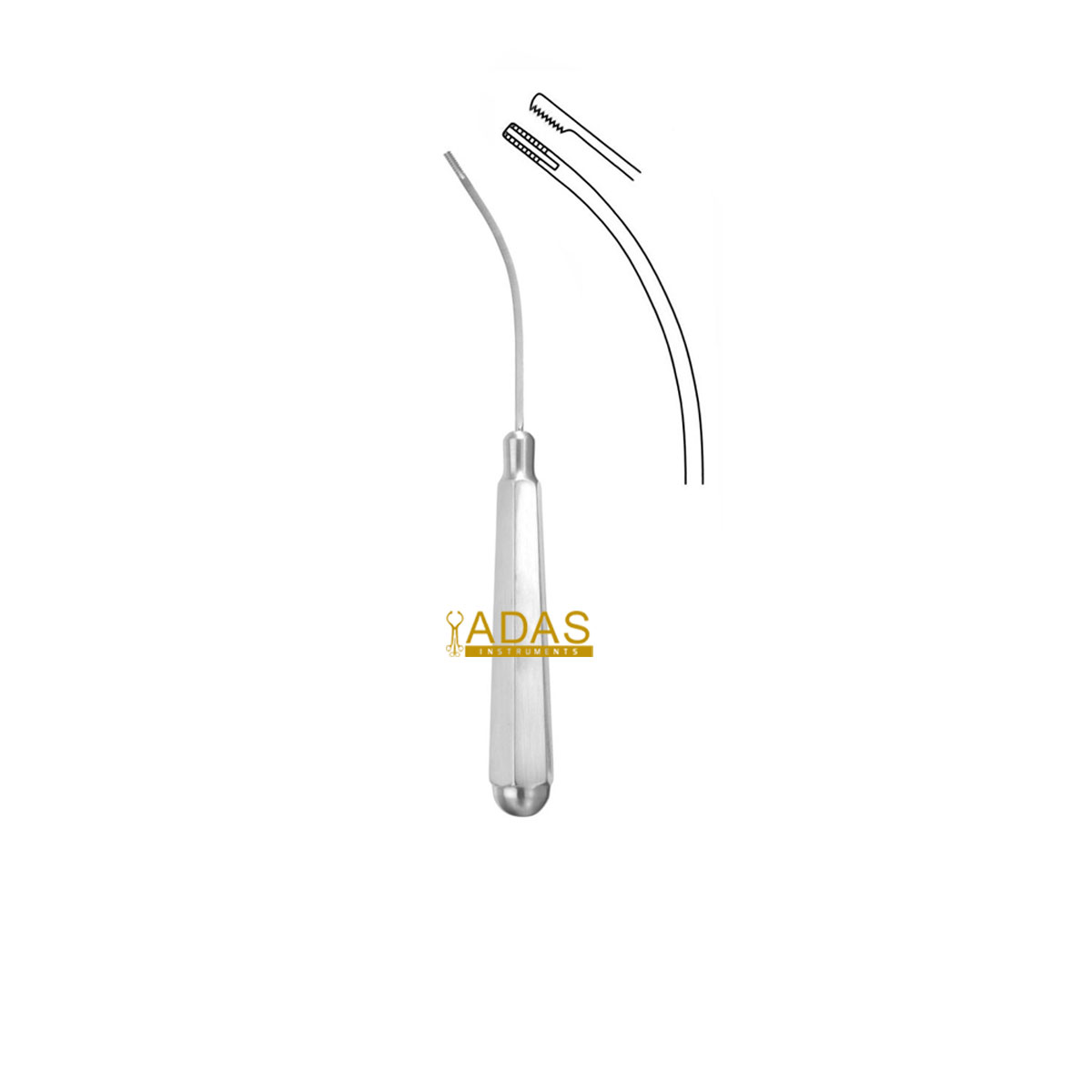
Dingman Cartilage Abrader, 15cm, Curved Left, Curved Right or Set of 2
Price range: $ 26.00 through $ 48.00
The Dingman cartilage abrader is the instrument that takes the edge off a cartilage graft. It does not cut: the working face is a fine abrasive that thins and smooths the margin of a graft so the edge cannot be seen or felt through the skin once it is in place, which is the single most common complaint after a dorsal onlay. At 15cm it is held like a pen rather than a file, and it comes curved to the left, curved to the right or as a pair, because a graft has two sides and the face has to meet each one at the same angle.
Key Features
- Fine abrasive working face, not a blade. It thins cartilage rather than cutting it
- Three options: Curved Left, Curved Right, or a Set of 2
- 15cm, short enough to be held in a pen grip for graft work on the back table
- Smooths a graft edge so it cannot be palpated through thin skin
- Satin finish, no glare back into the field
- High quality medical grade stainless steel, fully autoclavable
- Three year replacement warranty against manufacturing defects
- Item code AN-59.78

What a Dingman cartilage abrader is
Everything else in this category works on bone. The Dingman cartilage abrader works on cartilage, and that one difference decides how the instrument is built, how it is held and what goes wrong when it is used too hard.
A graft is carved with a knife and then it has edges. Under thin nasal skin an edge shows, as a line the patient can see in a mirror and feel with a fingertip, and no amount of suturing hides it. The abrader is how the edge stops being an edge: a fine abrasive face taken across the margin at a shallow angle until it feathers into nothing.
Key design features
An abrasive face, not a blade
This matters more than it sounds. A blade on cartilage leaves a clean cut face and a new edge; an abrasive face removes a little at a time and leaves a taper. Cartilage also springs back from a cut and warps days later, which is the reason a graft is feathered rather than trimmed once it is close to final shape.
Curved left, curved right, or the pair
A graft has two margins and the surgeon works from one side of the table. A face curved the wrong way meets the margin on its corner and digs in. The handed pair is why most sets carry two of these rather than one, and the Set of 2 is the usual order for a tray that does its own graft carving.
Why 15cm and a pen grip
Graft work happens on the back table, under direct vision, with the cartilage held between finger and thumb. A long handle is in the way. At 15cm the instrument balances in a pen grip, which is the grip that gives the lightest touch, and light is the whole point here.
What a worn face feels like
A fresh abrasive face bites and stops. A worn one slides, and a sliding face makes a surgeon press harder, which is how a graft gets thinned through instead of feathered. If the instrument needs pressure, it is finished, and that is true long before anything looks wrong with it.
Which curve to order
These three are this product’s own option list. The curve is about which margin the face can meet flat; the abrasive is the same on all of them.
| Option | Which margin it meets flat | Who orders it |
|---|---|---|
| Curved Left | The left margin of a graft held in the usual way | A surgeon who works one side and carves to one habit |
| Curved Right | The right margin | The mirror of the above. Order the one that matches how you hold the graft |
| Set of 2 | Both margins without turning the graft round | THE USUAL ORDER FOR A WORKING TRAY. Turning a thin graft to reach the other edge is how grafts get dropped and cracked |
Where it is used
It belongs to graft work, so the list follows the grafts rather than the procedures.
| Procedure | What the abrader does there |
|---|---|
| Rhinoplasty, dorsal onlay graft | Feathers the edges of the graft so they cannot be seen or felt through the dorsal skin. The main use |
| Septal cartilage harvest and carving | Thins a harvested plate to the thickness the repair needs, and dresses the cut margins |
| Spreader and batten grafts | Smooths the long edges that sit against the upper lateral cartilage |
| Ear and rib cartilage grafting | Works the same way on conchal and costal cartilage, which are thicker and need more passes |
| Septoplasty | Dresses a crushed or scored septal margin rather than cutting more away |
What it abrades, and what it must leave alone
The important half of this table is the second one, because an abrasive face on the wrong tissue does damage that does not show until the swelling goes down.
| Tissue | What this abrader does with it |
|---|---|
| Cartilage graft margins | Thins and feathers. The working tissue and the reason the instrument exists |
| Septal and conchal cartilage | Thins, in light passes. Thicker than a shaped graft and more forgiving |
| Bone | Not its tissue. A cartilage abrasive loads and stops on bone, and pressing harder only wears the face |
| Perichondrium | MUST BE LEFT ALONE where the graft needs it. Stripping it from a graft that is relying on it changes how the graft behaves |
| Mucosa and skin | Never. The face is fine, but fine abrasives take mucosa quickly and painlessly |
How it compares with the other ways a graft edge is dressed
Three instruments turn up on the same back table for the same job, and they are not interchangeable.
| Instrument | What it does to a graft edge | Where it belongs |
|---|---|---|
| Dingman cartilage abrader, as here | Abrades the margin into a taper, a little per pass | The final shaping, once the graft is close to its intended outline |
| A cartilage knife or a scalpel | Cuts a new, clean face, and a new edge with it | Carving the graft to shape in the first place |
| Crushing forceps | Breaks the cartilage structure so the edge collapses | Where the whole graft is meant to be soft, not where an outline has to survive |
| A nasal rasp | Takes bone, and clogs instantly on cartilage | The bony dorsum. See the rest of this category |
Materials and finish
Every Dingman cartilage abrader we make is cut from high quality medical grade stainless steel. The steel itself is made to a German specification. We do not publish a grade number, because the number on a certificate tells a surgeon nothing about how an abrasive face holds up after fifty autoclave cycles, and the answer to that is in the finish rather than in the alloy.
The abrasive is on the face itself rather than bonded to it, so nothing can shed into a graft pocket, and the rest of the instrument is passivated and satin finished. The face wears smooth with use rather than chipping, which is a slow and honest kind of wear: the day it stops biting is the day it stops being accurate, and it is worth replacing then rather than pressing harder.
Caring for it
Rinse it before the case is cleared. Cartilage debris is softer than bone dust and it dries into the abrasive face like glue, and a loaded face slides instead of cutting, which on this instrument is the difference between feathering a graft and thinning a hole through it.
Soft nylon brush across the face, never wire, because wire polishes an abrasive and polishing is how this face dies. Enzymatic cleaner, ultrasonic cycle, deionized water rinse, dry fully, autoclave at 134 degrees Celsius. Store it so the face is not resting against another instrument.
Ordering and wholesale
The Dingman cartilage abrader is made in our own workshop and sold direct, which is why the price sits where it does against the catalogue houses. Order one for a single set, or in quantity for a hospital list or a distributor line; we do OEM work under your own brand and your own item numbers, and we will hold a run to your pattern rather than ours if you send a sample. Stock items ship from our own workshop. Backorder items take 10 to 12 working days to make. Every instrument carries a three year replacement warranty against manufacturing defects. Production is controlled under an ISO 13485 quality management system.
Frequently asked questions
What is a Dingman cartilage abrader used for?
Thinning and smoothing the edges of a cartilage graft in rhinoplasty, so the margin cannot be seen or felt through the skin once the graft is in place. It is a finishing instrument for graft work, not a cutting one.
What is the difference between an abrader and a cartilage knife?
A knife cuts a new face and leaves a new edge. An abrader removes a small amount across the margin and leaves a taper. A graft is carved with the knife and finished with the abrader, in that order, and the second step is what stops the edge showing.
Should I order the left, the right, or the set of two?
The set of two, if the tray carves its own grafts. A graft has two margins and a face curved the wrong way meets the edge on its corner, so the alternative is turning a thin piece of cartilage round in your fingers, which is how grafts get cracked.
What are the instruments used in plastic surgery?
On a rhinoplasty tray: knives and scissors for soft tissue, elevators to raise the envelope, retractors to hold it open, osteotomes and saws for bone, rasps to smooth bone, and a small group for cartilage, which is where this abrader belongs with the cartilage knives and the crushing forceps.
Can it be used on bone?
No, and it will be ruined by trying. A cartilage abrasive loads up on bone dust and stops working within a few passes. Bone has its own instruments in this category, from coarse toothed rasps down to diamond coated finishing faces.
Related products and categories
The instruments this one shares a tray with: Joseph bayonet nasal saw for the bone cut the graft is being shaped to fit, Fomon rasp, flat and convex double ended for the bony dorsum underneath it, and Gallaher bone and nasal rasp with finger ring where a bone margin needs a coarse face.
The full range is in raspatories and saws, and the tray this belongs to is in rhinoplasty instruments.
| Weight | 0.05 kg |
|---|---|
| Tip options | Curved Left, Curved Right, Set of 2 Left & Right |
Be the first to review “Dingman Cartilage Abrader, 15cm, Curved Left, Curved Right or Set of 2”
Shipping & Delivery Policy
Processing Time: In-stock items are dispatched within 24-48 hours. For custom or out-of-stock items, production time is approximately 10-15 days.
Global Delivery Estimates
We partner with world-class couriers (DHL, FedEx) to ensure fast, tracked delivery.
- USA & Canada: 3-5 Business Days
- Europe & UK: 4-6 Business Days
- Rest of World: 5-7 Business Days
*We offer Air Cargo and Sea Freight options for bulk wholesale orders.
Customs & Duties
International buyers are responsible for any customs duties or taxes imposed by their country. Adas Instruments is not responsible for delays caused by customs clearance.
Lost Packages & Insurance
If your package is lost in transit, please contact us immediately. We offer full support and replacements for confirmed lost shipments. Note: You must report non-delivery within 3 weeks to be eligible for an insurance claim.
Related products
Reviews
There are no reviews yet.