


Gorney Turbinate Scissors | Angled Blades, Tungsten Carbide Inserts
$ 68.00
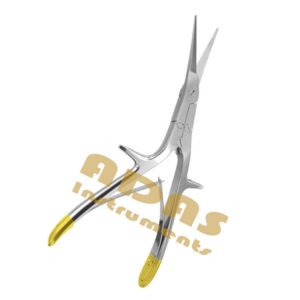
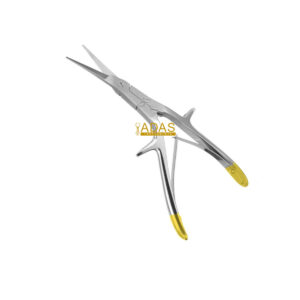
Gorney turbinate scissors, which Google also calls turbinectomy scissors, trim an enlarged inferior turbinate back so the nose can move air again. The blades are angled, because the turbinate runs along the side wall of the nose and a straight scissors cannot lie along it, and the cutting edges carry tungsten carbide inserts so they keep cutting mucosa cleanly rather than chewing it.
Key Features
- Angled blades that lie along the turbinate instead of across it
- Tungsten carbide inserts in the cutting edges
- For turbinate reduction, turbinoplasty and mucosal trimming
- The only pair of scissors in this part of our catalog
- Cut from high quality medical grade stainless steel and fully autoclavable
- Three year replacement warranty against manufacturing defects
- Item code AD-260-21
Available on backorder

What Gorney turbinate scissors are
Gorney turbinate scissors exist for one problem. An inferior turbinate that has swollen permanently blocks a nose more reliably than a deviated septum does, and the fix is to take part of it away. Google’s own summary of the instrument’s purpose is the clear one: turbinate scissors are engineered to navigate the narrow and complex pathways of the nasal cavity to cut, trim or excise hypertrophic mucosal tissue and dense septal cartilage without causing unintended trauma.
Catalogs list it as a tungsten carbide turbinate scissors and as an angled turbinate scissors, and both halves of those names are doing work.
Two features make that possible. The ANGLE, because the turbinate runs front to back along the lateral wall and a straight scissors reaches it across rather than along, which means cutting at the wrong plane with the tips. And the CARBIDE, because turbinate mucosa is wet and soft and a dull scissors pushes it ahead of the blades instead of cutting it.
It is the only pair of scissors in this part of our catalog, which is why it sits in a category of forceps, crushers and mallets. Our own Search Console already has us at position 8.0 for “gorney scissors”, which is page one, and LowFruits measures “gorney turbinate scissors” at 10 searches a month and the class term at 40.
One thing we have deliberately NOT done on this page. The class terms “turbinate scissors” and “turbinectomy scissors” are already the focus keywords of the Heymann turbinectomy scissors on our own site, which is a rebuilt page that carries the word turbinectomy in its own name. One term belongs to one page, so this page keeps the Gorney phrasing and leaves the class terms where they already are. Two of our own pages competing for the same search helps nobody.
What we do not publish is a blade length or the angle in degrees. There is no attribute set on this product, so the angled blades and the carbide inserts come from the product name and from our own older copy, and nothing else does.
Key design features
The angle, and why a straight scissors will not do
The inferior turbinate runs along the side wall of the nose, front to back. A straight scissors introduced through the nostril meets it at an angle and can only reach it with the tips; an angled blade lies along it and cuts with its whole length. That is the difference between trimming a turbinate and nibbling at the front of one.
Tungsten carbide inserts
Brazed into the cutting edges rather than coated on. Soft wet mucosa is the hardest thing in surgery to cut cleanly, because a blunt edge pushes it ahead of itself instead of dividing it, and carbide is what keeps the edge keen through a few hundred cases rather than a few dozen.
Blades that work in a corridor
Long and narrow in the shank so the hand stays outside the nostril while the blades work inside it. The surgeon sees down the line of the instrument rather than past his own fingers, which on a nose is most of the battle.
What is NOT on it
No serrations, no insulation, no light, no suction and no ratchet. Our record carries the angle and the carbide and that is all, so that is all this page claims.
What to order, and what we do not publish
One version, so this table is the specification and its limits.
| Specification | What we publish | Why |
|---|---|---|
| Blades | Angled | From our own product name and our own existing description |
| Cutting edges | Tungsten carbide inserts | From our own product name |
| Angle in degrees | NOT published by us | There is NO attribute set on this product. Ask us before ordering if a particular angle has to be matched |
| Blade and overall length | NOT published by us | Same answer, and it is on our list to measure |
Where it is used
Turbinate work, and the mucosal trimming that goes with it.
| Procedure | What the scissors do | Note |
|---|---|---|
| Inferior turbinate reduction | Trim hypertrophic turbinate tissue back to restore airflow | The main use, and the reason for the angle |
| Turbinoplasty | Reshape rather than remove, preserving the mucosal surface | Where a clean cut edge matters most |
| Mucosal resection | Shape overhanging mucosa while leaving healthy margins | Google’s own words for the job |
| Trimming dense septal cartilage | The heavier work these blades will also take | The cutting forceps are the better choice for anything thicker |
What it holds back, and what it must not do
Sharp, carbide and angled is a combination that deserves a careful right hand column.
| The task | What this scissors does | What it must not do |
|---|---|---|
| Cutting mucosa | Carbide edges divide wet soft tissue instead of pushing it | It must NOT be used to tear or strip. A scissors that is being pulled rather than closed is doing damage it cannot see |
| Reaching along the turbinate | The angled blade lies along the lateral wall | The angle is for reaching, NOT for levering. Using the bend to retract tissue is how an angled instrument goes out of true |
| Staying sharp | Carbide inserts hold the edge far longer than steel | Nothing abrasive on the edges, ever. An abrasive pad takes carbide off exactly where it is doing the work |
| Being a known angle | We do NOT publish the angle in degrees | There is no attribute on this product. Nobody should order it to match an existing instrument until we have measured ours |
How it compares with the rest of the family
This is the only scissors in the family, so the comparison is with the instruments that do the same job a different way.
| Instrument | How it removes tissue | Carbide | Buy it when |
|---|---|---|---|
| Gorney turbinate scissors, this page | Cuts with two blades | Yes | The turbinate has to be trimmed along its length |
| Hartmann nasal cutting forceps | Punches out bites, four sizes | No | Tissue has to come out in measured pieces |
| Weil Blakesley nasal cutting forceps | Bites with fenestrated cups | No | The corridor is angled and the sizes have to change |
| Cottle Kazanjian bone cutting forceps | Divides bone | No | What is in the way is bone, not mucosa |
Materials and finish
Every Gorney turbinate scissors we make is cut from high quality medical grade stainless steel. The steel itself is made to a German specification. We do not publish a grade number. The number on a certificate tells a surgeon nothing about whether two carbide edges still pass each other cleanly after two hundred autoclave cycles, because a scissors whose blades have sprung apart chews tissue instead of cutting it, and the answer to that is in the making rather than in the alloy.
The two blades are ground as a pair and set so they bear against each other along the whole cut rather than meeting at a point. On a scissors that is the entire difference between cutting and crushing, and on an angled scissors it is harder to achieve, because the bend has to be formed before the edges are set and the forming wants to move them.
The carbide inserts are brazed into seats and finished flush. There is no sharp external edge anywhere on the outline, and the sharpness is all on the inside of the blades where it belongs.
Caring for it
Nothing abrasive on the edges. That is the first rule on any carbide instrument and it is the one most often broken in sterile processing.
Wash the joint open, warm water, a soft brush along both blades. Autoclave with the tray. Test it occasionally on a single layer of wet gauze rather than on paper: paper flatters a scissors and wet gauze does not. If it pushes the gauze ahead of the blades instead of cutting it, the edges need attention.
Ordering and wholesale
Every Gorney turbinate scissors is made by Adas Instruments in our own workshop and sold direct, which is why the price sits where it does against the catalog houses. Order one for a single tray, or in quantity for a hospital list or a distributor line. We do OEM work under your own brand and your own item numbers. Send us a sample and we will hold a run to your pattern rather than ours. Stock items ship from our own workshop. Backorder items take 10 to 12 working days to make. Every instrument carries a three year replacement warranty against manufacturing defects. Production is controlled under an ISO 13485 quality management system.
Frequently asked questions
What are turbinate scissors used for?
Trimming an enlarged inferior turbinate so the nose can move air again, and shaping the mucosa around it. Google describes the class as engineered to navigate the narrow pathways of the nasal cavity to cut, trim or excise hypertrophic mucosal tissue without unintended trauma.
Why are the blades angled?
Because the turbinate runs front to back along the side wall of the nose. A straight scissors meets it across rather than along and can only reach it with the tips; an angled blade lies along it and cuts with its whole length.
What do the tungsten carbide inserts do?
They keep the edge keen. Turbinate mucosa is wet and soft, which makes it one of the hardest things to cut cleanly, because a dull blade pushes it ahead of itself instead of dividing it. Carbide holds the edge through a few hundred cases rather than a few dozen.
Are these the same as turbinectomy scissors?
They are the same class of instrument, and Google uses both names. On our own site the Heymann turbinectomy scissors is the page that carries that name, so we keep the Gorney phrasing here rather than have two of our own pages competing for one search.
What length are the blades?
We do not publish a figure, because there is no attribute set on this product at all. The angled blades and the carbide inserts come from our own product name. Ask us before ordering if a length or an angle has to be matched, and it is on our list to measure.
Related products and categories
For taking tissue out in measured bites rather than cutting it, the Takahashi nasal cutting forceps, or the Weil Blakesley nasal cutting forceps if the corridor is angled and the sizes have to change. For bone rather than mucosa, the Cottle Kazanjian bone cutting forceps.
The rest of this family sits under nasal cutting, crusher and septum forceps, and every pair of scissors we make is under plastic surgery scissors.
| Weight | 0.12 kg |
|---|
Be the first to review “Gorney Turbinate Scissors | Angled Blades, Tungsten Carbide Inserts”
Shipping & Delivery Policy
Processing Time: In-stock items are dispatched within 24-48 hours. For custom or out-of-stock items, production time is approximately 10-15 days.
Global Delivery Estimates
We partner with world-class couriers (DHL, FedEx) to ensure fast, tracked delivery.
- USA & Canada: 3-5 Business Days
- Europe & UK: 4-6 Business Days
- Rest of World: 5-7 Business Days
*We offer Air Cargo and Sea Freight options for bulk wholesale orders.
Customs & Duties
International buyers are responsible for any customs duties or taxes imposed by their country. Adas Instruments is not responsible for delays caused by customs clearance.
Lost Packages & Insurance
If your package is lost in transit, please contact us immediately. We offer full support and replacements for confirmed lost shipments. Note: You must report non-delivery within 3 weeks to be eligible for an insurance claim.
Related products

Reviews
There are no reviews yet.