
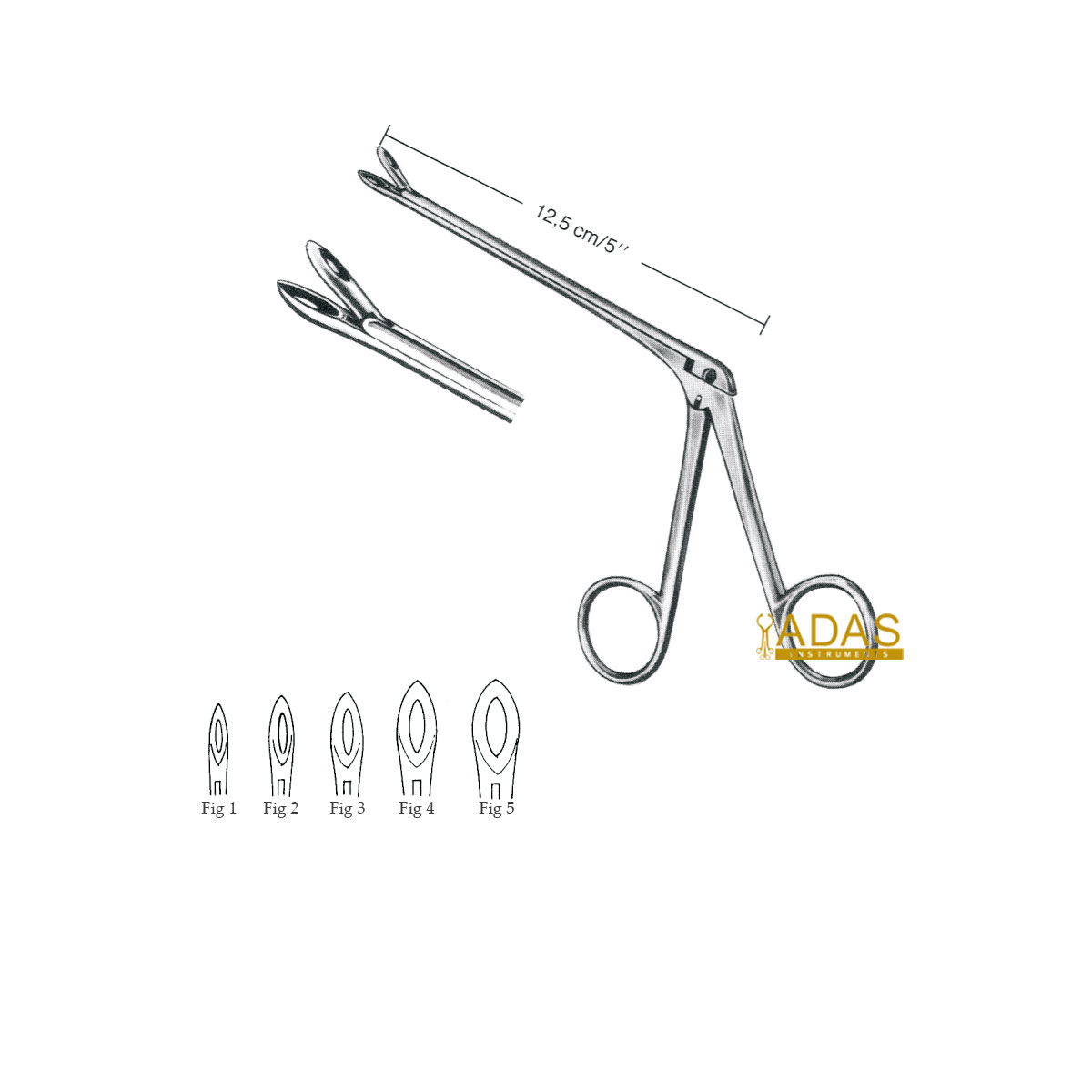
Weil Blakesley Nasal Cutting Forceps | Fig 1 to Fig 5, Straight, 45 or 90 Degree
$ 26.50
Weil Blakesley nasal cutting forceps are the pattern you buy when one jaw and one angle will not cover the work. Five Fig sizes and three shaft angles, straight, 45 degree and 90 degree, which is fifteen combinations and the widest range of anything we make for the nose. The cups are fenestrated, so fluid leaves the jaw and the surgeon can see what is in the bite.
Key Features
- Five sizes, Fig 1 through Fig 5
- Three angles: straight, 45 degree and 90 degree
- Fenestrated cups, so fluid escapes and the bite is visible
- For ethmoid and sinus work in corridors a straight instrument cannot reach
- Cut from high quality medical grade stainless steel and fully autoclavable
- Three year replacement warranty against manufacturing defects
- Item code ADR-165.01

What a Weil Blakesley nasal cutting forceps is
Sinus surgery happens in corridors that are not straight. The frontal recess is above you, the maxillary ostium is out to the side, and an instrument that only points forward reaches neither of them properly. The Weil Blakesley is the answer the trade settled on: the same jaw on a shaft bent to three different angles, in five sizes.
Straight for the anterior ethmoid. 45 degree to get above the middle turbinate. 90 degree for the frontal recess and the cells above it, which is the one no straight instrument sees at all. Fig 1 is the smallest jaw and Fig 5 the largest, and on a sinus list a surgeon will go through three of them in a case.
The cups are fenestrated, which does two jobs. Blood and saline escape rather than being compressed, so the jaw closes on tissue instead of on fluid; and the bite is visible through the window before the surgeon commits to pulling. In a field that bleeds, being able to see what you have is worth more than feel.
It is listed as a Weil Blakesley nasal cutting forceps, as a Weil Blakesley nasal forceps, and shortened on a tray list to a Blakesley. LowFruits measures the short form at 20 searches a month and our own Search Console has us at position 1.0 for “blakesley nasal forceps” on two impressions, so somebody is finding us for it already.
One honest limit. We publish the Fig numbers because they are our own attribute, and we do NOT publish what each Fig number measures in millimeters, because our record does not carry it. Rival listings quote 3.0 mm to 5.5 mm across the range. Ask us before ordering if a jaw has to match an existing set, and it is on our own list to measure.
Key design features
Three angles, and what each one reaches
Straight works the anterior ethmoid and the septum. 45 degree gets over and above the middle turbinate. 90 degree goes into the frontal recess, which is the direction a straight instrument simply does not point. The angle is not a preference, it is a different part of the anatomy.
Five Fig sizes
Fig 1 to Fig 5, smallest to largest. The small figures work next to structures being preserved; the large ones clear bulk. Most units carry two or three rather than all five, and the common pair is a small straight and a larger angled.
Fenestrated cups
A window through each cup face. Fluid out, visibility in. On a bleeding sinus the window is the difference between knowing what is in the jaw and guessing, and the guess is how a piece of something you wanted gets removed.
Wide finger rings
The rings are wide rather than narrow, which matters on a case made of a hundred small closures. A narrow ring concentrates the load on one line of the finger and the surgeon feels it an hour later. It is a small thing that is only noticed when it is wrong.
Which size and which angle to order
Two decisions and fifteen combinations, so here is the short way through it.
| Choice | Options | How to decide |
|---|---|---|
| Angle | Straight | Anterior ethmoid and septum. The first purchase |
| Angle | 45 degree | Over and above the middle turbinate. The second purchase |
| Angle | 90 degree | The frontal recess and the cells above it, which nothing straight reaches |
| Size | Fig 1 to Fig 5 | Small figures beside structures you are keeping, large figures for bulk. We publish the Fig numbers and NOT the millimeters, because our record does not carry them |
Where it is used
This is a sinus instrument first and a nasal one second.
| Procedure | What it does | Angle and size |
|---|---|---|
| Functional endoscopic sinus surgery | Takes ethmoid cells and partitions in a confined corridor | Straight and 45 degree, small figures |
| Frontal recess dissection | Reaches tissue above the plane of the nostril | 90 degree, small figures |
| Polypectomy | Removes polyp tissue in bites | Any angle, larger figures |
| Septal and turbinate work | Trims cartilage and mucosal tissue | Straight, middle figures |
What it holds back, and what it must not do
Fifteen combinations is fifteen chances to be holding the wrong one.
| The task | What this forceps does | What it must not do |
|---|---|---|
| Reaching an angled corridor | Three shaft angles, so the jaw arrives flat on the tissue | A 90 degree instrument must NOT be used as a lever to see round a corner. The angle is for reaching, not for retracting |
| Taking a measured bite | Five Fig sizes, chosen before the case | The large figures must not be used beside a structure being preserved |
| Holding the fragment | Fenestrated cups hold loosely and let you see the bite | It must not be used to drag firmly attached tissue. Loose grip plus hard pull tears |
| Being a known measurement | We publish the Fig numbers and NOT what they measure | Nobody should order a Fig number to match an existing set until we have measured ours. It is on our owed list |
How it compares with the rest of the family
Four cutting forceps, and this is the one with the range.
| Instrument | Sizes | Angles | Buy it when |
|---|---|---|---|
| Weil Blakesley, this page | Fig 1 to Fig 5 | Straight, 45, 90 degree | The corridor is not straight and the sizes have to change |
| Takahashi | One jaw | Curved or straight | A lighter instrument for a long list |
| Hartmann | 5, 7, 8 and 11 mm | One | The bite size is the decision, not the angle |
| Gruenwald | One jaw | One | A clean through cut and nothing to choose |
Materials and finish
Every Weil Blakesley nasal cutting forceps we make is cut from high quality medical grade stainless steel. The steel itself is made to a German specification. We do not publish a grade number. The number on a certificate tells a surgeon nothing about whether a 90 degree shaft is still at 90 degrees after two hundred autoclave cycles and a few hundred closures at the end of a long lever, and the answer to that is in the making rather than in the alloy.
The angled shafts are formed and then stress relieved, and the relief is the step that matters here more than on any other instrument in this family. A 90 degree shaft is a long lever and every closure tries to open the bend out; one that has not been relieved slowly becomes an 80 degree instrument and stops reaching what it was bought to reach.
The rim around each fenestration is finished by hand, because a burr on that edge is a small blade in the middle of a working face. There is no sharp external edge anywhere on the outline.
Caring for it
Flush through the fenestration both ways and brush around its rim. Then wash the joint open.
Warm water, a soft brush, autoclave with the tray. Store the angled ones so nothing rests against the bend, and check the angle against a square occasionally: on this pattern the bend is the instrument, and a 90 degree forceps that has opened out to 80 no longer goes where the surgeon is pointing it.
Ordering and wholesale
Every Weil Blakesley nasal cutting forceps is made by Adas Instruments in our own workshop and sold direct, which is why the price sits where it does against the catalog houses. Order one for a single tray, or in quantity for a hospital list or a distributor line. We do OEM work under your own brand and your own item numbers. Send us a sample and we will hold a run to your pattern rather than ours. Stock items ship from our own workshop. Backorder items take 10 to 12 working days to make. Every instrument carries a three year replacement warranty against manufacturing defects. Production is controlled under an ISO 13485 quality management system.
Frequently asked questions
What are Weil Blakesley forceps used for?
Cutting and removing tissue in the nose and sinuses, especially ethmoid cells and the frontal recess. The three shaft angles let the jaw reach corridors a straight instrument does not point at, and the fenestrated cups let fluid out and let the surgeon see the bite.
What do the Fig numbers mean?
Fig 1 to Fig 5 are five jaw sizes, smallest to largest. We publish the Fig numbers because they are our own attribute; we do not publish what each one measures in millimeters, because our record does not carry that and we will not borrow another manufacturer’s figures.
Which angle should I buy?
Straight first, because it does the anterior ethmoid and the septum. 45 degree second, to get above the middle turbinate. 90 degree when you are working the frontal recess, which nothing straight reaches.
Weil Blakesley or Takahashi?
Both have fenestrated cups. Buy the Weil Blakesley for the range, five sizes and three angles; buy the Takahashi if one jaw in a curved or straight tip covers your work and you want a lighter instrument in the hand.
Why is it so much cheaper than the catalog houses?
Because we make it. A US catalog house prices this pattern at 329.99 dollars and ours is 26.50, and the difference is a distributor chain rather than a difference in the instrument. If the gap bothers you, order one and look at it.
Related products and categories
For one fenestrated jaw on a lighter instrument, the Takahashi nasal cutting forceps. For four discrete jaw sizes, the Hartmann nasal cutting forceps. For a plain through cut, the Gruenwald nasal through cutting forceps.
The rest of this family sits under nasal cutting, crusher and septum forceps, and the specula and polypus instruments that work alongside it are under nasal specula and polypus instruments.
| Weight | 0.06 kg |
|---|---|
| Tip options | 45° degree, 90° degree, Straight Tip |
| Select Fig | Fig 1, Fig 2, Fig 3, Fig 4, Fig 5 |
Be the first to review “Weil Blakesley Nasal Cutting Forceps | Fig 1 to Fig 5, Straight, 45 or 90 Degree”
Shipping & Delivery Policy
Processing Time: In-stock items are dispatched within 24-48 hours. For custom or out-of-stock items, production time is approximately 10-15 days.
Global Delivery Estimates
We partner with world-class couriers (DHL, FedEx) to ensure fast, tracked delivery.
- USA & Canada: 3-5 Business Days
- Europe & UK: 4-6 Business Days
- Rest of World: 5-7 Business Days
*We offer Air Cargo and Sea Freight options for bulk wholesale orders.
Customs & Duties
International buyers are responsible for any customs duties or taxes imposed by their country. Adas Instruments is not responsible for delays caused by customs clearance.
Lost Packages & Insurance
If your package is lost in transit, please contact us immediately. We offer full support and replacements for confirmed lost shipments. Note: You must report non-delivery within 3 weeks to be eligible for an insurance claim.
Related products
Reviews
There are no reviews yet.