Grossman Areola Marker 4-in-1 | Round Areola Marker 40, 44, 48 and 52mm
$ 44.68
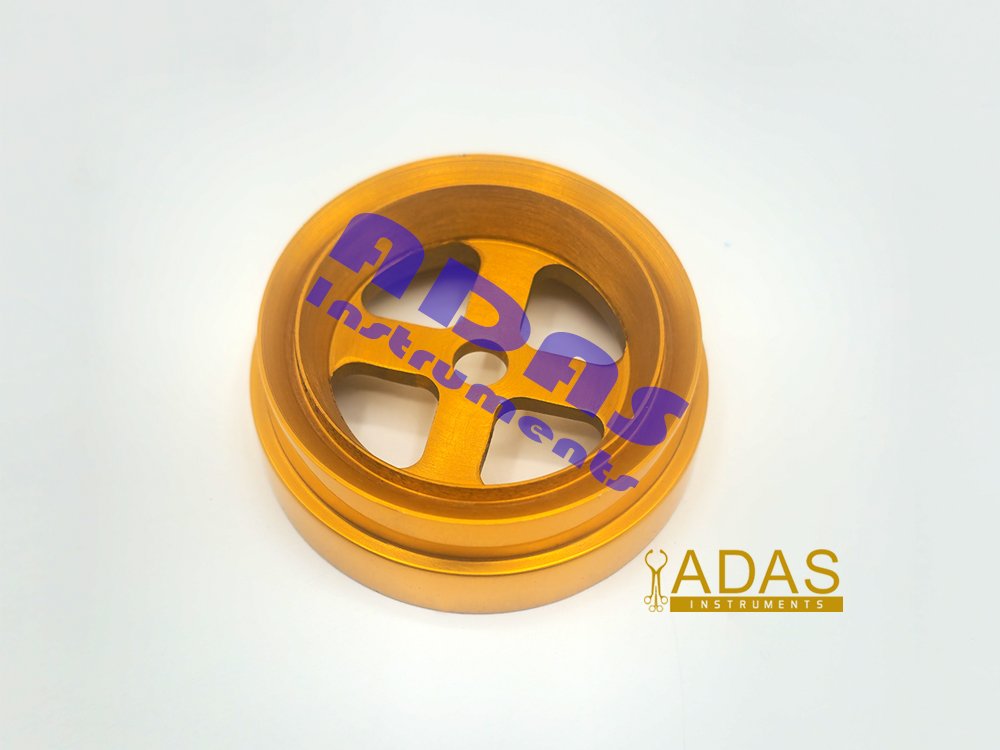
The Grossman areola marker carries four diameters on one instrument, 40, 44, 48 and 52 mm, so a surgeon can mark a breast augmentation, a reduction, a mastopexy or a reconstruction without reaching for a second template. A center aperture drops over the nipple to set the position, and the ring that suits the case sets the size. It is the widest range we make on one handle, and the four sizes sit at the top end of the scale where reconstruction work lives.
Key Features
- Four diameters on one instrument: 40, 44, 48 and 52 mm
- Center aperture to locate on the nipple
- One instrument instead of four single ended templates
- The largest sizes in our areola marker range
- Cut from high quality medical grade stainless steel and fully autoclavable
- Reusable, with no ink reservoir and no cartridge
- Three year replacement warranty against manufacturing defects
- Item code AA-50.40
10 in stock (can be backordered)

What a Grossman areola marker is
Four rings, one handle, and a hole at the center of each. The Grossman pattern is the answer to a practice that cannot predict which size it will need, and it is an instrument that carries the measurement, so the surgeon brings the judgement and the steel holds the number with four of them.
The four sizes are 40, 44, 48 and 52 mm, and that range is the point. They sit above the sizes a straightforward reduction uses and squarely where reconstruction and large volume mastopexy sit. A surgeon matching a reconstructed areola to a remaining one is not choosing from a short list. He is finding the number that already exists on the other side. That is much easier with four rings in one hand than with four instruments spread across a tray.
It is also the only instrument in our range that reaches 52 mm. Above 50 mm there is nothing else, so a practice doing reconstruction on wide areolas either owns this one or marks the largest cases by eye.
Catalogues write it several ways. An areola marker 4 in 1, a four size areola marker, or by the shape of the thing an areola marker cookie cutter. On a spec sheet you will see it as an areola marker 40 44 48 52, which is just the four rings listed out. A Grossman areola marker is all of those, and a Grossman areola marker is what a surgeon asks for.
Key design features
Four diameters, 4 mm apart
40, 44, 48 and 52 mm. The even 4 mm step is deliberate: it is small enough that moving one size is a visible change on the skin and large enough that nobody is agonising between two rings that look identical.
The center aperture
Every ring locates the same way. The nipple goes through the aperture and the ring can then only sit in one place, which is the whole reason a template beats a free hand mark. Position comes from the anatomy and size comes from the ring.
One instrument instead of four
Four single ended markers is four things to count, four things to sterilize and four things to lose. One instrument carrying the same four sizes is also one instrument to find when the tray is crowded, and on a long reconstruction list that is the difference people notice.
Where the range sits
Our single ended Freeman runs 34 to 50 mm and our double ended pairings stop at 45 and 50 mm. The Grossman starts at 40 mm and reaches 52 mm, so it overlaps the top of the Freeman range and then goes past it. If your work is mostly at 34 and 38 mm, this is the wrong instrument and the Freeman is the right one.
Which ring to use
There is nothing to order here except the instrument itself, because all four sizes come on it. The decision happens at the table instead.
| Ring | Typically used for | Note |
|---|---|---|
| 40 mm | Augmentation and smaller mastopexy | The smallest ring on this instrument |
| 44 mm | Mastopexy on a fuller breast | The size most often reached for |
| 48 mm | Large volume reduction and reconstruction | Above the whole Freeman single ended range |
| 52 mm | Reconstruction and the widest areolas | The largest ring we make on any instrument |
Where it is used
It is a breast instrument and it earns its place on the lists where the areola is large or the size cannot be settled in advance.
| Procedure | What the four rings give you | Ring usually chosen |
|---|---|---|
| Breast reconstruction | A match to the remaining side without leaving the field | 48 or 52 mm |
| Breast augmentation | A periareolar incision line on a chosen diameter | 40 mm |
| Mastopexy, the breast lift | Room to move up a size once the nipple is at its new height | 44 mm |
| Large volume breast reduction | A size above what a standard template carries | 48 mm |
What it marks, and what it must not do
Four rings is four chances to mark the wrong one, so the second row is the one that matters most on this instrument.
| The task | What the marker does | What it must not do |
|---|---|---|
| Setting the areola size | Holds four known diameters and repeats any of them on the second side | It does not choose. The surgeon does |
| Marking both sides | The same ring marks the left and the right | Never mark one side from one ring and the other side from the next size up |
| Centering | Locates on the nipple through the aperture | It is not forced onto a nipple that is swollen or retracted |
| Marking the line | Takes surgical ink and lays the outline | It is not a cutting instrument and is never pressed to score deeply |
How it compares with the rest of the family
Three patterns in this category mark an areola with a ring, and the choice between them is a choice about how many sizes you need to hand.
| Instrument | Diameters on one tool | When it is the right choice |
|---|---|---|
| Grossman 4-in-1 | Four, at 40, 44, 48 and 52 mm | Reconstruction, and any practice working above 45 mm |
| Freeman, double ended | Two, paired as neighbors | A surgeon who compares two sizes at the table |
| Freeman, single ended | One, chosen at order | A list where the size is decided in advance |
| McKissock keyhole pattern | One ring plus graduated limbs | When the areola and the resection are drawn together |
Materials and finish
Every Grossman areola marker we make is cut from high quality medical grade stainless steel. The steel itself is made to a German specification. We do not publish a grade number. The number on a certificate tells a surgeon nothing about whether the 48 mm ring still measures 48 mm after two hundred autoclave cycles, and the answer to that is in the making rather than in the alloy.
All four rims are cut on the same instrument, so the sizes are set against each other rather than measured one at a time on separate pieces. Nothing is plated onto a measuring edge, because a plating layer on a 40 mm circle is a change to the 40 mm.
The arms carrying the rings are left plain. There is no spring, no screw and no joint anywhere on the instrument, which is why it has nothing that can go out of adjustment.
Caring for it
Clean all four rings, including the ones you did not use. Dried surgical ink in a rim fills the edge and the next line comes out fatter than the ring it came from. Warm water and a soft brush are enough and nothing abrasive goes near a rim.
Autoclave it with the rest of the tray. With no moving parts there is nothing to trap moisture and nothing to lubricate. Store it flat so no rim is resting its weight against another instrument.
One habit worth keeping on a four ring instrument: put it back on the tray the same way up every time. A set of rings that always faces the same direction is a set a scrub nurse can hand over without turning it round to read it.
Ordering and wholesale
The Grossman 4-in-1 areola marker is made in our own workshop and sold direct, which is why the price sits where it does against the catalogue houses. Order one for a single tray, or in quantity for a hospital list or a distributor line. We do OEM work under your own brand and your own item numbers. Send us a sample and we will hold a run to your pattern rather than ours. Stock items ship from our own workshop. Backorder items take 10 to 12 working days to make. Every instrument carries a three year replacement warranty against manufacturing defects. Production is controlled under an ISO 13485 quality management system.
Frequently asked questions
What is a Grossman areola marker used for?
Measuring and marking out the nipple-areola complex before the incisions of a breast augmentation, reduction, mastopexy or reconstruction. It carries four diameters, so one instrument covers the range instead of four separate templates.
What sizes does the Grossman areola marker come in?
Four on every instrument: 40, 44, 48 and 52 mm. They are 4 mm apart, which is close enough that moving one size changes what you see on the skin.
Are you looking for a single size or a multi ring areola marker?
A single ring if your list marks at one known size. Two rings, as neighbors, if you choose between sizes at the table. Four rings, which is this instrument, if you work above 45 mm or cannot predict the size before you are looking at the patient.
How does it compare with a Freeman areola marker?
The Freeman runs 34 to 50 mm and gives you one or two of those sizes per instrument. The Grossman gives you 40, 44, 48 and 52 mm on one. They overlap between 40 and 50 mm, and above that only the Grossman reaches.
Is the Grossman marker reusable?
Yes. It is solid steel with no ink reservoir, no cartridge and no moving part, and it goes through a standard autoclave cycle with the rest of the tray.
Related products and categories
For one or two sizes rather than four, the Freeman areola marker round shape runs from 34 to 50 mm, and the Freeman double ended areola marker carries two of those sizes on one handle. When the areola and the skin resection are drawn in the same pass, the McKissock keyhole pattern carries a ring and the graduated limbs together.
The rest of the family sits under marking and measuring instruments, and the wider set for this operation is under breast surgery instruments.
| Weight | 0.085 kg |
|---|
Shipping & Delivery Policy
Processing Time: In-stock items are dispatched within 24-48 hours. For custom or out-of-stock items, production time is approximately 10-15 days.
Global Delivery Estimates
We partner with world-class couriers (DHL, FedEx) to ensure fast, tracked delivery.
- USA & Canada: 3-5 Business Days
- Europe & UK: 4-6 Business Days
- Rest of World: 5-7 Business Days
*We offer Air Cargo and Sea Freight options for bulk wholesale orders.
Customs & Duties
International buyers are responsible for any customs duties or taxes imposed by their country. Adas Instruments is not responsible for delays caused by customs clearance.
Lost Packages & Insurance
If your package is lost in transit, please contact us immediately. We offer full support and replacements for confirmed lost shipments. Note: You must report non-delivery within 3 weeks to be eligible for an insurance claim.
Related products