


Freeman Double Ended Areola Marker Round Shape | Two Diameters on One Instrument
Price range: $ 28.00 through $ 55.00
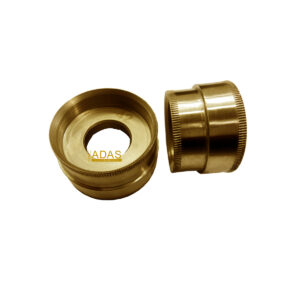
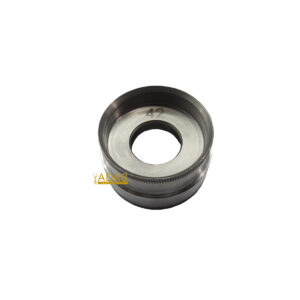
The Freeman double ended areola marker is a circular steel template with a different diameter at each end, so one instrument covers two sizes instead of one. The surgeon drops the center hole over the nipple, settles whichever ring suits the side he is marking, and outlines the new areola for a breast reduction, a mastopexy or a reconstruction without putting the instrument down. We pair the ends five ways, 34 and 36, 34 and 38, 38 and 42, 42 and 45, and 45 and 50 mm, which is where almost every reduction list sits.
Key Features
- Two diameters on one handle, one at each end
- Paired as 34 and 36, 34 and 38, 38 and 42, 42 and 45, or 45 and 50 mm
- Center hole at both ends to locate on the nipple
- Edge options: blunt or sharp
- Finish options: gold plating or satin
- Cut from high quality medical grade stainless steel and fully autoclavable
- Three year replacement warranty against manufacturing defects
- Item code AA-31.41

What a Freeman double ended areola marker is
Two rings, one handle, and a center hole at each end. That is the whole instrument, and the reason it exists is that very few surgeons mark every areola at the same size. It is an instrument that carries the measurement, so the surgeon brings the judgement and the steel holds the number, and it carries two of them.
A surgeon who owns two single ended markers has to swap instruments to compare sizes, and swapping means setting one down on a crowded tray mid decision. The double ended pattern turns that into a flip of the wrist. The saving looks trivial written down and does not feel trivial at the table.
There is a second reason, and it is the one surgeons mention. Marking a reduction is a sequence of small commitments, and the moment of doubt is almost always about one size against the one next to it. Holding both of those sizes in the same hand turns the question into a comparison instead of a recollection. The instrument does not make the decision any easier to get right, but it does make it possible to see the two answers side by side before committing to either.
Catalogues list it as an areola marker two sizes instrument, or as a multi ring areola marker, which it is in the narrow sense that it carries more than one ring. The commonest pairing we send out is an areola marker 34mm and 38mm, and the next is 38 and 42.
Key design features
A center hole at both ends
Both ends locate the same way, on the nipple, through the hole. Neither end is the primary one. That matters because an instrument where only one end self locates is an instrument that gets used one way round.
Five pairings, and why they are paired that way
The pairs are deliberately close: 34 with 36, 34 with 38, 38 with 42, 42 with 45, 45 with 50 mm. A surgeon comparing two sizes is comparing neighbors, not opposites, so a tool carrying 34 and 50 would be two single ended markers welded together and no use to anyone.
Blunt or sharp, chosen for the whole instrument
Both rings carry the same edge type. A blunt rim takes surgical ink and lays a wet line; a sharp rim scores the dermis just enough that the line survives a prep and a drape. If you want one of each, that is the single ended marker in the one-end-of-each pattern, not this.
Two finishes
Gold plating on the handle makes it findable on a tray at a glance. Satin kills the reflection under an overhead light. The finish stops short of the measuring rims.
Which pairing to order
One decision, and it is about the two sizes you actually use rather than the two sizes you might.
| Pairing | Suits | Note |
|---|---|---|
| 34 and 36 mm | Conservative reductions and smaller frames | The closest pair we make |
| 34 and 38 mm | A list that moves between small and standard | 38 mm is the single most ordered size |
| 38 and 42 mm | The most ordered pairing on a reduction list | Both sizes pair with keyhole rings |
| 42 and 45 mm | Mastopexy on fuller breasts | The usual lift pairing |
| 45 and 50 mm | Reconstruction and the widest areolas | The largest pair we make |
Where it is used
Breast work, and specifically the parts of it where the size is a judgement made at the table rather than in the clinic.
| Procedure | What the two ends give you | Typical pairing |
|---|---|---|
| Breast reduction | A size and its neighbor, compared without swapping tools | 38 and 42 mm |
| Mastopexy, the breast lift | Room to go one size up once the nipple is at its new height | 42 and 45 mm |
| Breast reconstruction | A match to the remaining side, with a fallback | 45 and 50 mm |
| Gynecomastia correction | The smaller end for a male chest | 34 and 36 mm |
What it marks, and what it must not do
Two ends double the usefulness and they also double one specific mistake, which is the third row.
| The task | What the marker does | What it must not do |
|---|---|---|
| Setting the areola size | Holds two known diameters and repeats either on the second side | It does not choose between them. The surgeon does |
| Marking the line | Lays ink, or scores the dermis lightly | A sharp rim is not a blade and is never pressed to cut |
| Marking both sides | Either end works on either breast | Never mark the left from one end and the right from the other |
| Centering | Locates on the nipple through either hole | It is not forced onto a nipple that is swollen or retracted |
How it compares with the rest of the family
Four instruments in this category put a ring on an areola, and the only real difference between them is how many sizes you get and what else they do.
| Instrument | Diameters on one tool | When it is the right choice |
|---|---|---|
| Freeman, double ended | Two, paired as neighbors | A surgeon who routinely compares two sizes |
| Freeman, single ended | One, chosen at order | A fixed list where the size is decided in advance |
| Grossman 4-in-1 | Four, at 40, 44, 48 and 52 mm | A reconstruction practice needing the full range |
| McKissock keyhole pattern | One ring plus graduated limbs | When the areola and the resection are drawn together |
Materials and finish
Every Freeman double ended areola marker we make is cut from high quality medical grade stainless steel. The steel itself is made to a German specification. We do not publish a grade number. The number on a certificate tells a surgeon nothing about whether the 38 mm end still measures 38 mm after two hundred autoclave cycles, and the answer to that is in the making rather than in the alloy.
Both rims are cut before the handle is finished, so the two diameters are set against each other on the same instrument rather than measured separately. The plating stops short of the measuring edges, because a plating layer on a 36 mm circle changes the 36 mm.
The handle between the two rings is left plain and slightly flattened. A round handle rolls when it is put down, and an instrument with a measuring edge at both ends should not roll off a tray.
Caring for it
Clean both ends, not just the one you used. Dried surgical ink on the end you did not reach for is the reason a double ended instrument slowly becomes a single ended one. Warm water and a soft brush; nothing abrasive on the rims.
Autoclave with the rest of the tray. No joints, no screws, no spring, nothing to trap moisture and nothing to lubricate. Store it so neither rim rests against another instrument, because a scoring edge dents and a dented edge prints the dent.
Ordering and wholesale
The double ended Freeman marker is made in our own workshop and sold direct, which is why the price sits where it does against the catalogue houses. Order one for a single tray, or in quantity for a hospital list or a distributor line. We do OEM work under your own brand and your own item numbers. Send us a sample and we will hold a run to your pattern rather than ours. Stock items ship from our own workshop. Backorder items take 10 to 12 working days to make. Every instrument carries a three year replacement warranty against manufacturing defects. Production is controlled under an ISO 13485 quality management system.
Frequently asked questions
What is a Freeman double ended areola marker used for?
Marking out the nipple-areola complex before the incisions of a breast reduction, a mastopexy, a reconstruction or a gynecomastia correction, with two diameters available on one instrument so the surgeon can compare sizes without swapping tools.
Are you looking for a single size or a double ended marker?
Single ended if your list always marks at one size and you want the simplest instrument on the tray. Double ended if you routinely choose between two neighboring sizes at the table. Four sizes on one handle is the Grossman, which is a different instrument again.
Which two sizes does the double ended areola marker come in?
Five pairings: 34 and 36, 34 and 38, 38 and 42, 42 and 45, and 45 and 50 mm. The pairs are neighbors on purpose, because a surgeon comparing sizes is comparing a size with the one next to it.
Can both ends be ordered with different edges?
No. On this pattern the edge type applies to the whole instrument, blunt or sharp. If you want ink on one end and a scored line on the other, order the single ended Freeman in the one-end-of-each edge pattern.
Is it reusable and autoclavable?
Yes. Solid steel, no ink reservoir, no cartridge, no moving part, and it runs through a standard autoclave cycle with everything else on the tray. The 38 mm end you measured with last month is still 38 mm.
Related products and categories
The one size version of the same pattern is the Freeman areola marker round shape, which can also be ordered blunt at one end and sharp at the other. For four diameters on one handle see the Grossman areola marker 4-in-1. The McKissock keyhole pattern carries a matching ring with the resection limbs, so the areola and the skin removal are drawn in one pass.
The rest of the family sits under marking and measuring instruments, and the wider set for this operation is under breast surgery instruments.
| Weight | 0.12 kg |
|---|---|
| Select Color Option | Gold Plating, Satin finish |
| Edge Type | 34mm & 38mm, Blunt Edge, Sharp Edge |
| Select Diameter | 34mm & 36mm, 34mm & 38mm, 38mm & 42mm, 42mm & 45mm, 45mm & 50mm |
Be the first to review “Freeman Double Ended Areola Marker Round Shape | Two Diameters on One Instrument”
Shipping & Delivery Policy
Processing Time: In-stock items are dispatched within 24-48 hours. For custom or out-of-stock items, production time is approximately 10-15 days.
Global Delivery Estimates
We partner with world-class couriers (DHL, FedEx) to ensure fast, tracked delivery.
- USA & Canada: 3-5 Business Days
- Europe & UK: 4-6 Business Days
- Rest of World: 5-7 Business Days
*We offer Air Cargo and Sea Freight options for bulk wholesale orders.
Customs & Duties
International buyers are responsible for any customs duties or taxes imposed by their country. Adas Instruments is not responsible for delays caused by customs clearance.
Lost Packages & Insurance
If your package is lost in transit, please contact us immediately. We offer full support and replacements for confirmed lost shipments. Note: You must report non-delivery within 3 weeks to be eligible for an insurance claim.
Related products
Reviews
There are no reviews yet.