
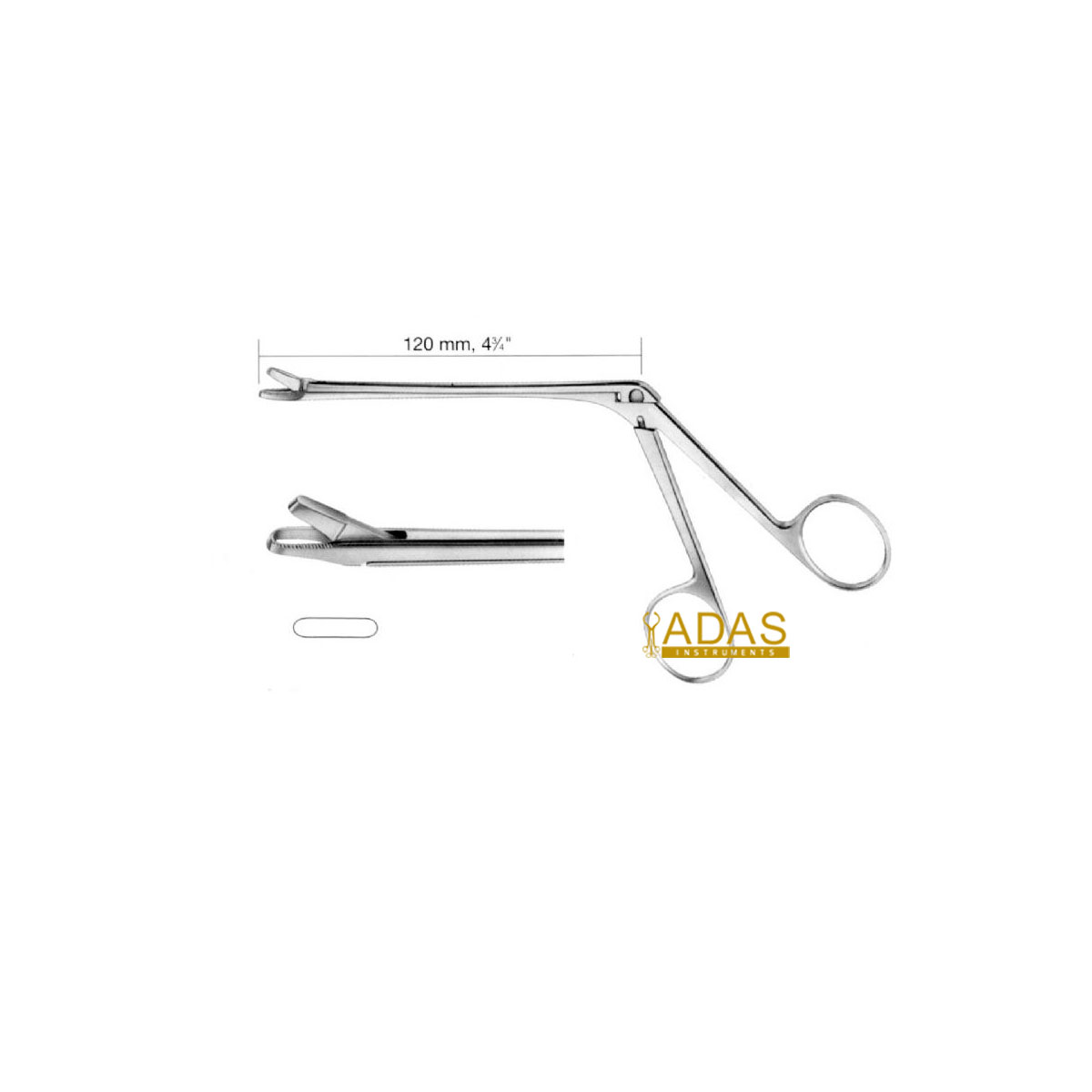
Gruenwald Nasal Through Cutting Forceps | Punch Jaws
$ 34.50
Gruenwald nasal through cutting forceps are the plain version of a punch jaw: a sharpened margin closing against a flat anvil, in one size, with nothing else on the instrument at all. The cut goes all the way through in one closure, which is the only thing this pattern sets out to do and the reason it is still on sinus trays a century after it was designed.
Key Features
- Through cutting punch jaws, so the cut is complete
- One pattern, one size, no options to get wrong
- For septal cartilage, ethmoid partitions and thin bone
- One piece of steel and a joint, nothing plumbed in
- Cut from high quality medical grade stainless steel and fully autoclavable
- Three year replacement warranty against manufacturing defects
- Item code ADR-172.12
Available on backorder

What a Gruenwald nasal through cutting forceps is
Some instruments earn their place by doing several things. This one earns it by doing one thing and having nothing on it that can go wrong. A punch jaw, a box joint, a spring, one size. There is no tip choice, no size range, no coating and no second hinge.
What a punch jaw does is cut all the way through. A sharpened margin closes against a flat anvil, and either the cut is complete or the jaws have not closed. The choice across this whole family is one sentence long: a cup holds what it has just taken out, and a through cutting jaw leaves it in the wound, so the choice is about whether you want the fragment in your hand or on the drape, and on a Gruenwald there is no cup at all, so the fragment stays where it was and comes out with a sucker or a cupped forceps afterwards.
The reason that matters is tearing. Septal cartilage and ethmoid partitions are springy, and a jaw that stops a hair short pulls the last fibers instead of cutting them, which tears a line of mucosa away from the bite. Google’s own words for the class are the useful ones: a punch or sharp margin configuration cuts cleanly through resilient tissue “without ripping”.
It is listed as a Gruenwald nasal through cutting forceps and as a Gruenwald nasal forceps. In catalogs it also appears as a Gruenwald Henke, which is the same pattern with a second surgeon’s name attached, and a US catalog house prices that version at 674.99 dollars. Ours is 34.50. We print both numbers and leave the comparison to you.
There is no attribute set on this product, so no jaw figure and no length appears on this page. Three of the five keyword slots this page could carry are empty for the same reason: there is nothing measured left to put in them that another page in this family does not already own.
Key design features
The punch jaw, and nothing else
A sharpened margin and a flat anvil, ground as a pair. The whole instrument is that one joint of two surfaces, and the reason the pattern has lasted is that there is nothing else on it to fail.
One size, which is a feature
No Fig numbers, no millimeter choices, no angles. A theater that buys a Gruenwald gets a Gruenwald, and the instrument that comes back from sterile processing is the one that went in. On a tray with four sizes of something else on it, that is restful.
Light, single action
One hinge. Less force than a double action instrument and less weight, which suits the work: ethmoid partitions and septal cartilage do not need the leverage that a bony septum needs, and the lighter instrument is quicker in the hand.
Nothing plumbed into it
No light, no suction, no coating, no insert, no ratchet. Nothing to flush, nothing to dry and nothing to work loose.
What to order, and what we do not publish
There is one version, so this table is the specification and its limits.
| Specification | What we publish | Why |
|---|---|---|
| Jaw | Through cutting punch | From our own product name and our own existing description |
| Action | Single action, one hinge | From the pattern. The Jansen Middletons are the double action instruments in this family |
| Jaw size | NOT published by us | There is NO attribute set on this product. Rivals quote 3 mm to 4 mm distal width for the class; that is theirs. Ask us if a figure has to be matched |
| Overall length | NOT published by us | Same answer, and it is on our list to measure |
Where it is used
Sinus and septal work, wherever a clean edge is the object.
| Procedure | What the punch jaw does | Note |
|---|---|---|
| Functional endoscopic sinus surgery | Cuts through ethmoid partitions without dragging on the mucosa | The everyday use of the pattern |
| Septoplasty | Cuts through septal cartilage in one closure | The Jansen Middleton is the heavier choice for bone |
| Polypectomy | Cuts the stalk rather than pulling on the polyp | Pulling a polyp is how mucosa comes with it |
| Trimming a ragged edge | Takes a clean margin off a previous cut | The honest everyday job, on every list |
What it holds back, and what it must not do
Simple instrument, short list of warnings, and one of them matters.
| The task | What this forceps does | What it must not do |
|---|---|---|
| Cutting through tissue | A complete cut, with no halfway state to tear from | It must NOT be closed part way and reopened. A partial closure on springy tissue is the tear this jaw exists to avoid |
| Holding the fragment | Nothing. There is no cup | It is not a grasping forceps. The piece is retrieved with a sucker or a cupped forceps |
| Cutting bone | Thin bone and ethmoid partitions, yes | It is single action. The bony septum and the nasal walls need double action or a bone cutting forceps |
| Being a known size | We do NOT publish a jaw figure | Ask before ordering if a width has to be matched. It is on our owed list |
How it compares with the rest of the family
Four cutting forceps, and the Gruenwald is the simplest of them.
| Instrument | Jaw | Action | Buy it when |
|---|---|---|---|
| Gruenwald, this page | Punch, through cutting | Single action | One clean cut, nothing else, nothing to choose |
| Jansen Middleton, through cutting | Punch, through cutting | Double action | The same cut with the force for bone |
| Takahashi | Fenestrated cups | Single action | You want to see and keep the fragment |
| Hartmann | Punch, four sizes | Single action | The bite size is the decision |
Materials and finish
Every Gruenwald nasal through cutting forceps we make is cut from high quality medical grade stainless steel. The steel itself is made to a German specification. We do not publish a grade number. The number on a certificate tells a surgeon nothing about whether a sharpened margin still meets its anvil along the whole jaw after two hundred autoclave cycles, because a punch that meets at one end tears at the other, and the answer to that is in the making rather than in the alloy.
The margin and the anvil are ground as a pair and stay a pair. A through cutting jaw built from two separately ground halves closes at one point and gaps along the rest, and an instrument that gaps is an instrument that tears. It is the only thing about making a Gruenwald that is difficult.
No sharp external edge anywhere on the outline. The joint is lapped so it opens cleanly with blood in it, which is the state it is normally used in.
Caring for it
Brush the jaw closed and then open. A punch jaw traps a film of tissue right at the margin and it is invisible with the jaws shut.
Wash the joint open, warm water, a soft brush, nothing abrasive on the margin. Autoclave with the tray. Hold the closed jaws up to the light: no line of daylight along the margin. If there is one, the instrument has stopped cutting and started tearing, and it needs regrinding or retiring.
Ordering and wholesale
Every Gruenwald nasal through cutting forceps is made by Adas Instruments in our own workshop and sold direct, which is why the price sits where it does against the catalog houses. Order one for a single tray, or in quantity for a hospital list or a distributor line. We do OEM work under your own brand and your own item numbers. Send us a sample and we will hold a run to your pattern rather than ours. Stock items ship from our own workshop. Backorder items take 10 to 12 working days to make. Every instrument carries a three year replacement warranty against manufacturing defects. Production is controlled under an ISO 13485 quality management system.
Frequently asked questions
What are Gruenwald nasal forceps used for?
Cutting through septal cartilage, ethmoid partitions and thin bone with a complete cut. The jaw is a punch, so the cut either goes all the way through or the jaws have not closed, and there is no partial closure for springy tissue to tear from.
What does through cutting mean?
That a sharpened margin closes against a flat anvil rather than two edges meeting each other. Google describes the action as cutting cleanly through resilient tissue and cartilage “without ripping”, and the ripping is what the design avoids.
Does it hold what it cuts?
No. There is no cup on this pattern, so the fragment stays in the wound and comes out with a sucker or a cupped forceps. If you want it held, the Jansen Middleton with spoon shaped cups is the instrument.
Is it the same as a Gruenwald Henke?
It is the same pattern with a second surgeon’s name attached, which is how some catalogs list it. A US catalog house prices that version at 674.99 dollars; ours is 34.50 and it is made in our own workshop.
What size is the jaw?
We do not publish a figure, because there is no attribute set on this product at all. Rival listings quote 3 mm to 4 mm distal width for the class. Ask us before ordering if a width has to be matched, and it is on our list to measure.
Related products and categories
For the same cut with double action force behind it, the Jansen Middleton through cutting forceps. For a cup that holds the fragment, the Jansen Middleton with spoon shaped cups. For a choice of four jaw sizes, the Hartmann nasal cutting forceps.
The rest of this family sits under nasal cutting, crusher and septum forceps, and the specula and polypus instruments that work alongside it are under nasal specula and polypus instruments.
| Weight | 0.06 kg |
|---|
Be the first to review “Gruenwald Nasal Through Cutting Forceps | Punch Jaws”
Shipping & Delivery Policy
Processing Time: In-stock items are dispatched within 24-48 hours. For custom or out-of-stock items, production time is approximately 10-15 days.
Global Delivery Estimates
We partner with world-class couriers (DHL, FedEx) to ensure fast, tracked delivery.
- USA & Canada: 3-5 Business Days
- Europe & UK: 4-6 Business Days
- Rest of World: 5-7 Business Days
*We offer Air Cargo and Sea Freight options for bulk wholesale orders.
Customs & Duties
International buyers are responsible for any customs duties or taxes imposed by their country. Adas Instruments is not responsible for delays caused by customs clearance.
Lost Packages & Insurance
If your package is lost in transit, please contact us immediately. We offer full support and replacements for confirmed lost shipments. Note: You must report non-delivery within 3 weeks to be eligible for an insurance claim.
Related products
Reviews
There are no reviews yet.