


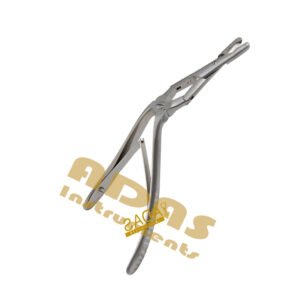
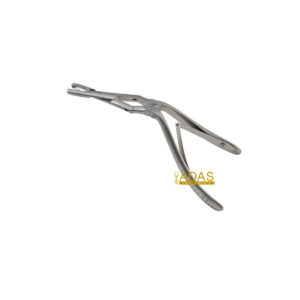
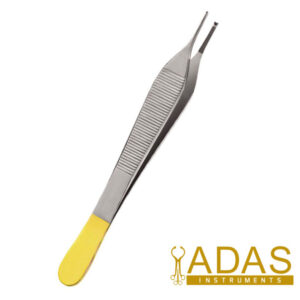
Jansen Middleton Septum Forceps | Spoon Shaped Cups, Curved or Straight
$ 55.00
Jansen Middleton septum forceps with spoon shaped cups take a bite out of the septum and then hold on to it. That is the difference between this pattern and the through cutting one: the cup keeps the fragment of cartilage or bone in the jaws, so it comes out of the nose with the instrument instead of being left loose in a space you cannot see into. Double action, with a curved or a straight tip.
Key Features
- Spoon shaped cups that hold the fragment they cut
- Double action, so two hinges multiply the force your hand puts in
- Curved tip or straight tip
- For resecting septal cartilage and bone, and for retrieving fragments
- Cut from high quality medical grade stainless steel and fully autoclavable
- Three year replacement warranty against manufacturing defects
- Item code ADR-179.19
Available on backorder

What Jansen Middleton septum forceps with spoon shaped cups are
This instrument is the answer to a written exam question, and we know that because we can see people searching for it. Over the last three months Search Console records 31 impressions for the query “what is the name of the double-action, cupped, forward-angled forceps used to resect portions of the nasal septum?”, and this page sits at position 6.3 for it. Double action, cupped, forward angled, resects septum: that is the Jansen Middleton with spoon shaped cups, clause for clause.
It is also the most searched instrument in this part of our catalog by a wide margin. “jansen middleton forcep” is measured at 260 searches a month and “jansen middleton septum forceps” at 170, which is more than every Ferreira, Tebbetts and Emory phrase in our breast retractor range put together. These names are taught, and taught names get looked up.
What the instrument does is take a bite and keep it. Google’s own description of the two jaw patterns is exact: spoon shaped cups are “ideal for grasping, holding, and retrieving cartilage and bone fragments safely”, where through cutting jaws “cleanly cut through resilient tissue and cartilage structures without ripping”. Put plainly, a cup holds what it has just taken out, and a through cutting jaw leaves it in the wound, so the choice is about whether you want the fragment in your hand or on the drape.
Catalogs list it as a spoon shape cup forceps and as a double action septum forceps, and because Google names biopsy as a use of the class it also turns up as a nasal biopsy forceps. All three describe this instrument.
Double action is the other half of it. Two hinges rather than one roughly double the mechanical advantage, so the bite comes from the instrument and not from how hard a surgeon can squeeze through a nostril at an awkward angle.
One thing this page will not do is quote a jaw size. Our own record carries the tip choice and nothing else. Rival listings publish 4 by 11 mm cups, 175 mm overall and a 130 mm working length, and those are their measurements of their instruments. On the highest volume product in this category that is a gap we are not comfortable with, and it is on our own list to close.
Key design features
The spoon shaped cups
Two concave faces that meet to enclose what they have cut. The fragment is held between them and comes out with the instrument, which is why this pattern is the one reached for when the piece being removed matters: a spreader graft, a strut, anything that is going back in somewhere else.
Double action, and what it buys
Two hinges. The force roughly doubles for the same hand effort, and more usefully it arrives evenly, which is what cuts cartilage cleanly rather than crushing it at the edge of the bite. On a long list it is also the difference between a tired hand and a sore one.
Curved or straight tip
Our own attribute, so it goes in the name. The straight tip works straight down the line of the septum; the curved one reaches around the bend at the back of it and is the one most surgeons who have both will pick up second.
Nothing plumbed into it
Steel, two hinges and a spring. No light, no suction, no coating. Nothing to flush and nothing to dry, and the only maintenance is washing both joints open.
Which tip to order, and what we do not publish
One real decision and one honest omission.
| Choice | Options | How to decide |
|---|---|---|
| Tip | Straight | Straight down the septum from the front. The first one most trays buy |
| Tip | Curved | Reaches round the posterior bend. The second one, and the one picked up more often once both are there |
| Tip | Both | A busy septal list, which is where this pattern earns its keep |
| Jaw and shaft dimensions | NOT published by us | Our record carries the tip choice and nothing else. Rivals quote 4 x 11 mm cups and 175 mm overall; those are their figures. Ask us before ordering if a dimension has to be matched |
Where it is used
Septal resection, and anywhere a removed fragment has to be kept.
| Procedure | What the cups do | Note |
|---|---|---|
| Septoplasty | Take out a portion of deviated cartilage and hold it | The main use, and the reason the pattern exists |
| Septal graft harvest | Remove a piece and bring it out intact | A through cutting jaw would leave it in the nose |
| Submucous resection | Resect cartilage and bone along the septum | Double action does the work on the bony part |
| Removing loose fragments | Grasp and retrieve a piece already cut by something else | Google’s own description: grasping, holding and retrieving safely |
What it holds back, and what it must not do
A cupped jaw and a double hinge are a lot of force in a small space.
| The task | What this forceps does | What it must not do |
|---|---|---|
| Taking a bite of septum | Cuts and holds the fragment in the cups | It is NOT a dissector. The mucosa is lifted off with an elevator first; this instrument is for what is underneath |
| Holding what it cut | The cups enclose the fragment so it leaves with the instrument | It must not be used as a grasping forceps on soft tissue. Cupped edges on mucosa tear it |
| Working the bony septum | Double action gives the force for the bony part | It is not a bone cutter for the nasal walls. That is a bone cutting forceps |
| Being a known size | We do NOT publish a jaw figure for this instrument | Nobody should order it to fit a particular cup size until we have measured it. It is on our owed list and this is the page it costs the most on |
How it compares with the rest of the family
Six instruments in this family bite nasal tissue, and the first question is whether you want to keep what comes out.
| Instrument | Jaw | Keeps the fragment | Buy it when |
|---|---|---|---|
| Jansen Middleton, spoon cups, this page | Spoon shaped cups, double action | Yes | The piece coming out matters |
| Jansen Middleton, through cutting | Punch jaws, double action | No | A clean cut matters more than the fragment |
| Takahashi | Fenestrated cups | Partly, through the fenestration | Septal and ethmoid work on a lighter instrument |
| Weil Blakesley | Fenestrated cups, Fig 1 to Fig 5 | Partly | You need a size range rather than one jaw |
Materials and finish
Every Jansen Middleton septum forceps we make is cut from high quality medical grade stainless steel. The steel itself is made to a German specification. We do not publish a grade number. The number on a certificate tells a surgeon nothing about whether two spoon cups still meet along their whole rim after two hundred autoclave cycles, because a cup that meets at the tip only stops holding what it cuts, and the answer to that is in the making rather than in the alloy.
The cups are ground as a pair and matched. A spoon jaw only holds if the two rims close together along their whole length, and a pair that has been ground separately meets at one point and gaps everywhere else. It is the reason this is a slower jaw to make than a flat one.
Both hinges are fitted together rather than pinned one at a time, so they share the load. There is no sharp external edge anywhere on the outline, which on a cupped instrument means the outside of each cup as well as the shanks.
Caring for it
Wash both joints open. There are two of them on a double action instrument and both hold blood, and a stiff double action joint is a stiff instrument whatever the jaws are like.
Pay attention to the inside of the cups: a fragment of cartilage dried into a concave face is hard to see and harder to brush out. Warm water, a soft brush, autoclave with the tray. Close the cups empty against the light every so often and check they still meet all the way round.
Ordering and wholesale
Every Jansen Middleton septum forceps is made by Adas Instruments in our own workshop and sold direct, which is why the price sits where it does against the catalog houses. Order one for a single tray, or in quantity for a hospital list or a distributor line. We do OEM work under your own brand and your own item numbers. Send us a sample and we will hold a run to your pattern rather than ours. Stock items ship from our own workshop. Backorder items take 10 to 12 working days to make. Every instrument carries a three year replacement warranty against manufacturing defects. Production is controlled under an ISO 13485 quality management system.
Frequently asked questions
What are Jansen Middleton septum forceps used for?
Cutting and removing portions of the nasal septum, and retrieving the fragments. They are double action, forward angled and cupped, which is the combination a written exam question describes and the reason this instrument is so widely taught.
What is the difference between spoon shaped cups and through cutting jaws?
The cups hold what they cut and the through cutting jaws do not. Google puts it the same way: spoon cups are for grasping, holding and retrieving fragments safely, while through cutting jaws cut cleanly through resilient tissue without ripping. If the piece coming out is a graft, you want the cups.
Why does double action matter?
Two hinges roughly double the mechanical advantage. The bite comes from the instrument rather than from how hard you can squeeze at an awkward angle inside a nostril, and the pressure arrives evenly, which is what cuts cartilage instead of crushing its edge.
What size are the cups?
We do not publish a figure. Our own record carries the curved or straight tip choice and nothing else, and the 4 by 11 mm and 175 mm figures you will find elsewhere are other manufacturers measuring their own instruments. It is on our list to measure and it is the gap we most want to close.
Do I order curved or straight?
Straight if you are buying one, because it does the front of the septum and most of the work. Curved if you already have a straight one, because it reaches round the posterior bend that the straight tip fights.
Related products and categories
For a clean cut rather than a held fragment, the Jansen Middleton through cutting forceps. For fenestrated cups on a lighter instrument, the Takahashi nasal cutting forceps, or the Hartmann nasal cutting forceps if you want a choice of four jaw sizes.
The rest of this family sits under nasal cutting, crusher and septum forceps, and every forceps we make that grips rather than cuts is under hemostats and grasping forceps.
| Weight | 0.12 kg |
|---|---|
| Tip options | Curved Tip, Straight Tip |
Be the first to review “Jansen Middleton Septum Forceps | Spoon Shaped Cups, Curved or Straight”
Shipping & Delivery Policy
Processing Time: In-stock items are dispatched within 24-48 hours. For custom or out-of-stock items, production time is approximately 10-15 days.
Global Delivery Estimates
We partner with world-class couriers (DHL, FedEx) to ensure fast, tracked delivery.
- USA & Canada: 3-5 Business Days
- Europe & UK: 4-6 Business Days
- Rest of World: 5-7 Business Days
*We offer Air Cargo and Sea Freight options for bulk wholesale orders.
Customs & Duties
International buyers are responsible for any customs duties or taxes imposed by their country. Adas Instruments is not responsible for delays caused by customs clearance.
Lost Packages & Insurance
If your package is lost in transit, please contact us immediately. We offer full support and replacements for confirmed lost shipments. Note: You must report non-delivery within 3 weeks to be eligible for an insurance claim.
Related products
Reviews
There are no reviews yet.