
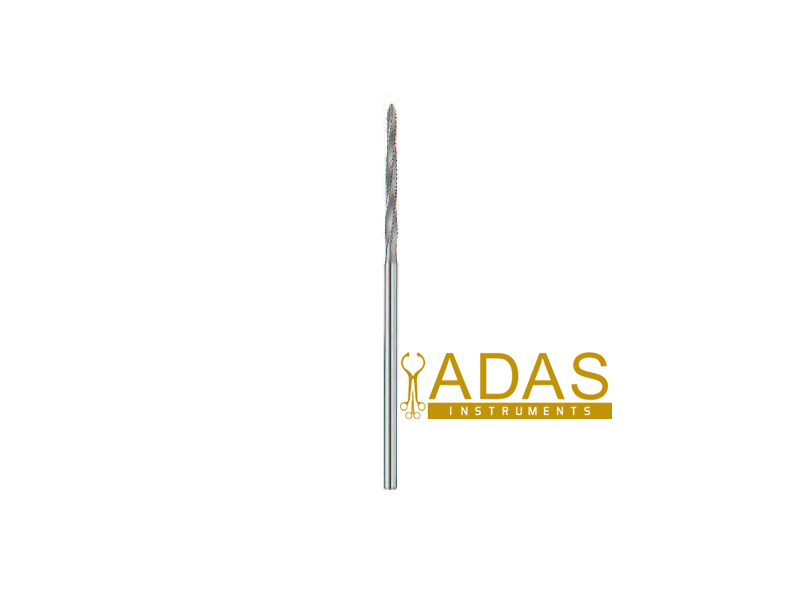
Lindemann Bur, Side Cutting, 35, 22 or 10 mm
$ 12.00
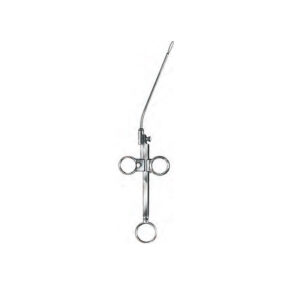
The Lindemann bur is a bone cutting bur used in oral surgery, maxillofacial procedures and implantology. AI Mode describes deep flutes that slice through dense bone and carry the debris away, so the bur cuts fast without clogging, for osteotomy and implant site preparation, cutting a window in cortical bone, sectioning roots and contouring bone. Ours has a spiral fluted head that tapers to a point on a long smooth shank, in 35, 22 or 10 mm, at 12 dollars each.
Key Features
- Spiral fluted cutting head
- Head tapers to a point
- Side cutting along the flutes
- Long smooth shank
- Three sizes: 35 mm, 22 mm or 10 mm
- 12 dollars, any size
- Three year replacement warranty against manufacturing defects
- Item code ADM-156.45

What the Lindemann bur is
The Lindemann bur is a side cutting surgical bur. A round bur cuts with its tip; the Lindemann cuts along its side, with spiral flutes that run up the head. Run in a handpiece and drawn along the bone, it cuts a narrow slot rather than a round hole. That is why it is used to make the lines of an osteotomy: the cuts that let a jaw be split, a window be opened, or a root be sectioned.
Google AI Mode, read on 5 November 2026, describes the Lindemann bur as an aggressive bone cutting instrument used in oral surgery, maxillofacial procedures and implantology. In its words, its deep flutes and straight or cross cut blades slice through dense hard tissue and expel the debris so the bur does not overheat. It names osteotomy and implant site preparation, and apicoectomy and cystectomy, where it cuts the cortical lid over a root tip or a cyst. It adds root sectioning and the extraction of impacted third molars, and bone contouring and grafting.
Gemini, read the same day, places it in oral and maxillofacial surgery, dental implantology and oral surgery, on cortical bone, dense bone of the lower jaw, tooth roots and the borders of an osteotomy. It lists the Lindemann bone cutter as a catalog name, and sets it apart from a round bone bur: the Lindemann has helical side cutting flutes for side to side cuts, where a round bur cuts mainly at its tip.
On the orthognathic tray, the Lindemann side cutting bur sits beside the saws and the osteotomes. It makes the fine cuts the separators and levers then open. As a bone cutting bur it is a consumable: it is replaced when the flutes go dull, which is why it is sold singly, at 12 dollars. A tray for a jaw case carries a spare, so a dull bur can be changed in the middle of a cut without waiting for another to come out of the sterile store.
Key design features
A spiral fluted head
Our photograph shows a cutting head with flutes that spiral up its length. The flutes cut on the side of the head as it turns, and their spiral carries the bone chips up and out of the cut. AI Mode describes the same deep flutes that expel debris so the cut stays clean and cool.
A pointed tip
The head tapers to a point. The point starts the cut in the bone surface without walking across it; then the side of the head takes over and the bur is drawn along the line. That is the difference between a Lindemann surgical bur and a round bur, which cuts mainly at its tip.
A long smooth shank
The shank in our photograph is long and smooth below the head. It goes into the handpiece, and its length keeps the head of the handpiece clear of the cut so the line can be seen while it is made. Our listing does not say which handpiece fitting the shank takes; ask us before you order.
Three sizes
The listing sells the Lindemann bur in 35, 22 and 10 mm, all at 12 dollars. Our data does not say which part of the bur that figure measures, so we do not guess. Ask us, and we will tell you before you order which size suits the cut you plan.
Which size to order
Three sizes at one price, read off the variations on 5 November 2026. What the size measures is not on the listing, so ask us before you order.
| Size, from the listing | Price | Read from |
|---|---|---|
| 35 mm | 12 dollars | The variations |
| 22 mm | 12 dollars | The variations |
| 10 mm | 12 dollars | The variations |
Where it is used
AI Mode and Gemini, read on 5 November 2026, name these cases for the Lindemann bur. The reasons in the last column are ours, read off the head and the shank.
| Case | What it cuts | Why this one |
|---|---|---|
| Osteotomy | The lines of the bone cut | Side cutting flutes cut a slot |
| Implant site preparation | A channel in the bone | Named by AI Mode |
| Apicoectomy and cystectomy | The cortical lid over a root or a cyst | Named by AI Mode |
| Root sectioning | A root, to free an impacted tooth | The pointed tip starts the cut |
What it does, and what it must not do
The Lindemann bur cuts bone along its side. It is not for enamel or for drilling a round hole, and it is not a lever. Use it with irrigation, as any bone bur, so the bone is not heated.
| Job | Use the Lindemann bur? | What to use instead or beside it |
|---|---|---|
| Cutting the line of an osteotomy | Yes | This is the job it is made for |
| Spreading the cut once it is made | No | The Smith ramus separator |
| Freeing the maxilla after the cuts | No | The Obwegeser maxilla mobilizer |
| Cutting enamel or a cavity | No | An operative dental bur |
| Levering bone | Never | A lever or an elevator |
How it compares with the rest of the orthognathic tray
Five orthognathic instruments make up this family on our site. The working ends and handles are read off each listing’s own photograph, the options off the variations and the prices off the order form, on 5 November 2026.
| Instrument | Working end, from our photograph | Handle, from our photograph | Size or options | Price |
|---|---|---|---|---|
| Smith ramus separator | two long flat narrow blades | long handles with a spring between them | with or without a ratchet | 55 dollars |
| Smith sagittal split separator | small flat angled blade on a curved shank | hollow fluted handle | right or left | 34 dollars |
| Obwegeser mobilizer | flat end bent into a curve | straight flat bar | 23 cm | 24 dollars |
| Tessier lever | short upright end, cross serrated, on a right angled shank | large hollow handle | 15 cm, right, left or a set of 2 | 32 or 60 dollars |
| Lindemann bur (this page) | spiral fluted cutting head tapering to a point | long smooth shank for the handpiece | 35, 22 or 10 mm | 12 dollars |
Materials and finish
The Lindemann bur is sold here as a bone cutting bur, and our listing does not state what the cutting head is made of. AI Mode names a material for Lindemann burs from other makers; we do not print one our own data does not carry. Ask us before you order, and we will confirm the material, the shank fitting and what each size measures.
Look at the flutes before each use. Flutes that have gone dull or have lost an edge cut slowly and heat the bone, and that bur should be replaced rather than pressed harder.
Caring for it
Rinse the Lindemann bur as soon as it comes out of the handpiece, before blood and bone dust dry in the flutes. Brush along the flutes, clean it in a bur cleaning tray, dry it, and sterilize it on the cycle your own department sets for rotary instruments. Store it in a bur block so the head does not knock against other steel.
Ordering and wholesale
The Lindemann bur is made by Adas Instruments in our own workshop and sold direct, which is why the price sits where it does against the catalog houses. Order one for a single tray, or in quantity for a hospital list or a distributor line. We do OEM work under your own brand and your own item numbers. Send us a sample and we will hold a run to your pattern rather than ours. Stock items ship from our own workshop. Backorder items take 10 to 12 working days to make. Every instrument carries a three year replacement warranty against manufacturing defects. Production is controlled under an ISO 13485 quality management system.
Frequently asked questions
What is the Lindemann bur used for?
It cuts bone in oral surgery, maxillofacial procedures and implantology: osteotomy and implant site preparation, cutting the cortical lid in apicoectomy, sectioning roots and contouring bone, in AI Mode’s words. Ours is 35, 22 or 10 mm, at 12 dollars.
What makes the Lindemann a side cutting bur?
Its flutes spiral up the side of the head and cut as it turns, so the bur is drawn along the bone and cuts a slot. A round bur cuts mainly at its tip. Gemini draws the same line between the two.
Which Lindemann size should I order?
The listing sells 35, 22 and 10 mm, all at 12 dollars. Our data does not say which part of the bur the size measures, so ask us before you order and we will match the size to the cut you plan.
What is the Lindemann bur made of?
Our listing does not state the material of the cutting head, so we do not print one here. AI Mode names a material for other makers’ Lindemann burs. Ask us, and we will confirm it for ours before you order.
Is a surgical bur reusable?
A surgical bur can be cleaned and sterilized between uses, following your own department’s rules for rotary instruments, until its flutes dull. A dull bur cuts slowly and heats the bone, so it is replaced rather than pressed harder.
Related products and categories
Three more instruments from the same orthognathic tray: the Smith ramus separator, the Smith sagittal split separator and the Obwegeser maxilla mobilizer, 23 cm. The rest of the range is under maxillofacial instruments, which sits inside our ENT instruments.
| Weight | 0.05 kg |
|---|---|
| Select Size | 10 mm, 22 mm, 35 mm |
Be the first to review “Lindemann Bur, Side Cutting, 35, 22 or 10 mm”
Shipping & Delivery Policy
Processing Time: In-stock items are dispatched within 24-48 hours. For custom or out-of-stock items, production time is approximately 10-15 days.
Global Delivery Estimates
We partner with world-class couriers (DHL, FedEx) to ensure fast, tracked delivery.
- USA & Canada: 3-5 Business Days
- Europe & UK: 4-6 Business Days
- Rest of World: 5-7 Business Days
*We offer Air Cargo and Sea Freight options for bulk wholesale orders.
Customs & Duties
International buyers are responsible for any customs duties or taxes imposed by their country. Adas Instruments is not responsible for delays caused by customs clearance.
Lost Packages & Insurance
If your package is lost in transit, please contact us immediately. We offer full support and replacements for confirmed lost shipments. Note: You must report non-delivery within 3 weeks to be eligible for an insurance claim.
Related products

Reviews
There are no reviews yet.