


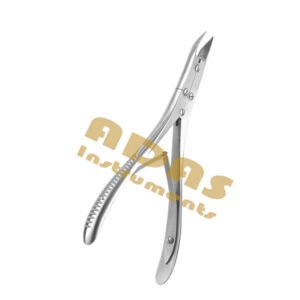
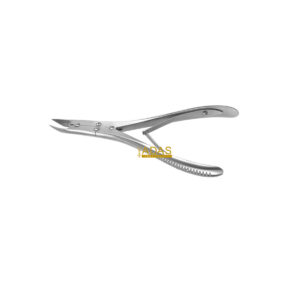
McIndoes Bone Cutting Forceps | Double Action
$ 38.00
McIndoes bone cutting forceps are double action, which on a bone cutter is not a refinement but the whole mechanism. Two hinges instead of one roughly double the force that reaches the blades, so nasal bone is cut by the instrument rather than by how hard the surgeon can squeeze. There is a written exam question that describes it: a bone cutting instrument with two hinges in the middle.
Key Features
- Double action, two hinges multiplying the force at the blades
- For nasal and facial bone, and thick cartilage
- Spring handles that open the blades between cuts
- One piece pattern with nothing plumbed in
- Cut from high quality medical grade stainless steel and fully autoclavable
- Three year replacement warranty against manufacturing defects
- Item code AQ-10.18
Available on backorder

What McIndoes bone cutting forceps are
Bone cutting forceps are built like heavy shears and the only real question about any of them is how the force gets to the blades. Google’s own explanation is the clearest short one: double action forceps use a dual pivot mechanism to vastly increase mechanical advantage, while single action forceps are lighter and suited to lower density bone.
The McIndoes is the double action pattern. Two hinges, so the surgeon’s grip is multiplied twice before it reaches the blade, and the cut is made by the geometry of the instrument rather than by force of hand. That matters because the alternative to leverage is leaning on the handles, and leaning on a bone cutter inside a nose is how a controlled cut becomes a fracture going somewhere nobody chose.
Catalogs list the class as a bone cutter forceps, as a bone cutter double action in the trade word order, as a double action bone cutting forceps written out in full, and as a bone biting forceps. Four names, one instrument.
It is taught, and it is taught by its mechanism. Two of the phrases people type into Google are “a bone cutting instrument with two hinges in the middle” and “a bone cutting instrument that has one hinge”, which are the exam question and its distractor. This instrument is the first of those.
One thing has to be said because the search data says it loudly. GOOGLE THINKS McINDOE MEANS SCISSORS. Our own Search Console records “mcindoe scissors” reaching this site at position 50.8, and the McIndoe name does belong to a well known pair of scissors. This product is a BONE CUTTING FORCEPS. We have deliberately not taken the scissors phrase as a keyword, because a visitor who clicks it wants a different instrument.
There is no attribute set on this product, so no jaw figure and no length appears on this page. The double action comes from our own product name and our own older copy.
Key design features
Double action, and what the second hinge actually does
One hinge gives the blades whatever the hand gives the handles, reduced by the ratio of the lever. A second hinge compounds that ratio, and the usual figure quoted for the arrangement is roughly double. The practical effect is that the surgeon stops squeezing hard, and stopping squeezing hard is what keeps a bone cut where it was aimed.
Spring handles
The handles push themselves apart, so the blades open between cuts without the surgeon doing anything. On a nose that takes six or eight cuts it means the instrument is always ready, and it is the small feature that makes a heavy instrument feel quick.
Blades for bone, not for cartilage alone
Heavier and blunter than anything in the nasal cutting family. They are made to divide bone and thick cartilage, which means they are the wrong instrument for mucosa, for polyp tissue and for anything delicate, and the comparison table says so.
Nothing plumbed into it
Steel, two hinges and a spring. No coating, no insert, no ratchet, no light. Nothing to flush, nothing to wear through and nothing on it that is not doing work.
What to order, and what we do not publish
One pattern, so this table is the specification and its honest limits.
| Specification | What we publish | Why |
|---|---|---|
| Action | Double action, two hinges | From our own product name and our own existing description |
| Handles | Spring handles that open the blades between cuts | From the pattern and our own older copy |
| Jaw size | NOT published by us | There is NO attribute set on this product. Ask us before ordering if a figure has to be matched |
| Overall length | NOT published by us | Same answer, and it is on our list to measure |
Where it is used
Bone work, in the nose and around it.
| Procedure | What this forceps does | Note |
|---|---|---|
| Rhinoplasty and septorhinoplasty | Divides nasal bone and the bony septum | Used with an osteotome and mallet rather than instead of them |
| Reduction of a nasal fracture | Trims a fragment that will not reduce into place | The straightening forceps move bone; this one removes it |
| Maxillofacial work | Divides small facial bone | The pattern is used well beyond the nose |
| Thick cartilage | Cuts costal and thick septal cartilage that a nasal forceps cannot | The honest overlap with the crushers and the cutting forceps |
What it holds back, and what it must not do
This is the strongest instrument in the category and the right hand column is the whole point of the table.
| The task | What this forceps does | What it must not do |
|---|---|---|
| Cutting bone | Two hinges put the force at the blades | It must NOT be levered. A bone cutter is closed, not twisted, and twisting is how a cut becomes an uncontrolled fracture |
| Working in a confined space | Spring handles keep it ready between cuts | It is not a fine instrument. If the space is tight enough to need delicacy, it is the wrong tool |
| Cutting soft tissue | Nothing. The blades are made for bone | Mucosa, polyp tissue and skin all belong somewhere else entirely |
| Being the right McIndoe | This is the BONE CUTTING FORCEPS | The McIndoe name also belongs to a pair of SCISSORS and our own search data shows people arriving here looking for them. This is not that instrument |
How it compares with the rest of the family
Two bone cutters on this site and two instruments that get confused with them.
| Instrument | Action | What it cuts | Buy it when |
|---|---|---|---|
| McIndoes, this page | Double action, two hinges | Nasal and facial bone | Bone has to be divided and the cut has to stay where it is aimed |
| Cottle Kazanjian | Double action | Nasal bone and thick cartilage | The same work under the Cottle Kazanjian pattern |
| Jansen Middleton, through cutting | Double action | Cartilage and thin bone | The septum rather than the nasal walls |
| Gruenwald | Single action | Cartilage and ethmoid partitions | Nothing bony. A light clean cut |
Materials and finish
Every McIndoes bone cutting forceps we make is cut from high quality medical grade stainless steel. The steel itself is made to a German specification. We do not publish a grade number. The number on a certificate tells a surgeon nothing about whether two hinges still share the load after two hundred autoclave cycles, because a double action joint where one pivot is tighter than the other cuts crooked long before it cuts badly, and the answer to that is in the making rather than in the alloy.
Both pivots are machined and fitted as a pair. On a double action instrument they have to carry the same share of the load; one that is slightly tighter takes more of it, wears faster, and the blades gradually stop meeting square. It is the fault that ends a bone cutter and it starts in the hinges rather than at the edge.
The blades are hardened and then ground, in that order, so the edge is hard all the way through rather than hardened on the surface. There is no sharp external edge anywhere on the outline.
Caring for it
Wash both joints open, every time. Bone cutting produces debris rather than staining, and a double action joint with bone dust in it is stiff on the next case and worn by the tenth.
Warm water and a soft brush. Autoclave with the tray. Close the blades empty and look along the edge: they should meet along their whole length, and a pair that meets at the tip only is an instrument crushing bone rather than cutting it.
Ordering and wholesale
Every McIndoes bone cutting forceps is made by Adas Instruments in our own workshop and sold direct, which is why the price sits where it does against the catalog houses. Order one for a single tray, or in quantity for a hospital list or a distributor line. We do OEM work under your own brand and your own item numbers. Send us a sample and we will hold a run to your pattern rather than ours. Stock items ship from our own workshop. Backorder items take 10 to 12 working days to make. Every instrument carries a three year replacement warranty against manufacturing defects. Production is controlled under an ISO 13485 quality management system.
Frequently asked questions
What are bone cutting forceps used for?
Cutting, dividing and bisecting bone and tough bony tissue. In the nose that means nasal bone, the bony septum and the thick cartilage a nasal cutting forceps cannot manage.
What does double action mean on a bone cutter?
That there are two hinges rather than one. The force is multiplied twice before it reaches the blades, which roughly doubles the mechanical advantage. Google puts it as a dual pivot mechanism that vastly increases mechanical advantage against a single action instrument suited to lower density bone.
Is this the McIndoe scissors?
No. The McIndoe name belongs to a well known pair of scissors as well as to this bone cutting forceps, and our own search data shows people looking for the scissors and arriving here. This product is the bone cutting forceps and we have not taken the scissors phrase as a keyword for that reason.
McIndoes or Cottle Kazanjian?
Both are double action bone cutters and either will do the work. The Cottle Kazanjian is the pattern most often specified on a rhinoplasty tray by name; the McIndoes is the plainer double action cutter. The comparison table above sets them side by side.
What size are the jaws?
We do not publish a figure, because there is no attribute set on this product at all. Ask us before ordering if a dimension has to be matched, and it is on our list to measure.
Related products and categories
The other double action bone cutter in this family is the Cottle Kazanjian bone cutting forceps. For cartilage and thin bone on the septum instead, the Jansen Middleton through cutting forceps. For flattening the cartilage once it is out, the Cottle cartilage crusher.
The rest of this family sits under nasal cutting, crusher and septum forceps, and the chisels and gouges that work on bone alongside it are under osteotomes, chisels and gouges.
| Weight | 0.06 kg |
|---|
Be the first to review “McIndoes Bone Cutting Forceps | Double Action”
Shipping & Delivery Policy
Processing Time: In-stock items are dispatched within 24-48 hours. For custom or out-of-stock items, production time is approximately 10-15 days.
Global Delivery Estimates
We partner with world-class couriers (DHL, FedEx) to ensure fast, tracked delivery.
- USA & Canada: 3-5 Business Days
- Europe & UK: 4-6 Business Days
- Rest of World: 5-7 Business Days
*We offer Air Cargo and Sea Freight options for bulk wholesale orders.
Customs & Duties
International buyers are responsible for any customs duties or taxes imposed by their country. Adas Instruments is not responsible for delays caused by customs clearance.
Lost Packages & Insurance
If your package is lost in transit, please contact us immediately. We offer full support and replacements for confirmed lost shipments. Note: You must report non-delivery within 3 weeks to be eligible for an insurance claim.
Related products

Reviews
There are no reviews yet.