
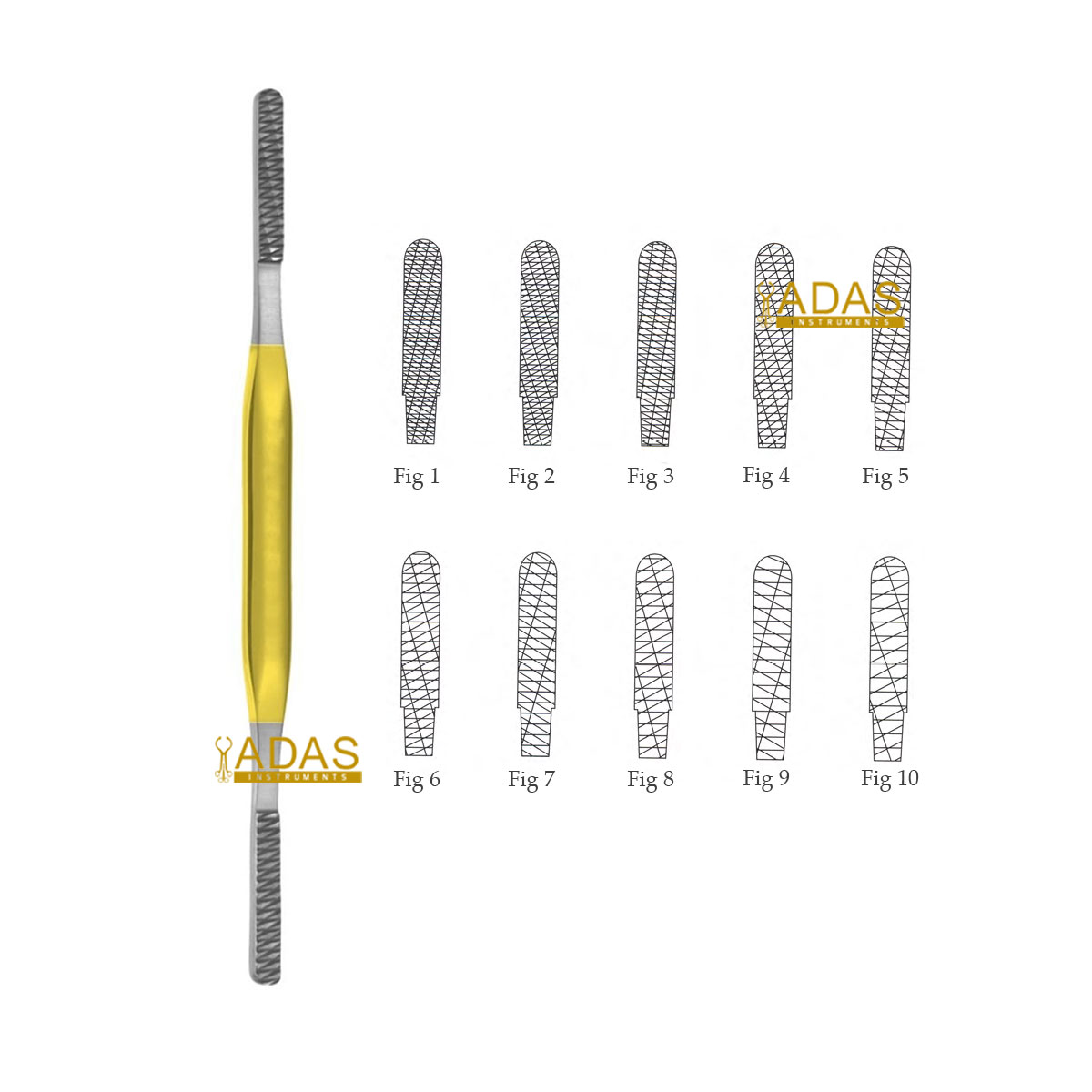
Nasal Raspatory Double Ended, Tungsten Carbide, Six Grits
$ 80.00
The nasal raspatory double ended is a surgical rasp used in rhinoplasty, septorhinoplasty and reconstructive facial surgery to scrape, reshape and smooth the nasal bone and cartilage, such as when a dorsal hump is taken down. AI Mode notes that a rasp at each end lets the surgeon turn the instrument over to change grit without reaching for another one. Ours is the tungsten carbide pattern with a gold colored grip and six grit pairings from 3/4 to 9/10, at 80 dollars.
Key Features
- A rasp at each end, with cross cut serrations
- Tungsten carbide, as our listing name records
- Six grit pairings: 3/4, 5/6, 5/7, 6/7, 7/8 and 9/10
- Gold colored middle grip
- Body of high quality medical grade stainless steel, reusable
- 80 dollars, any pairing
- Three year replacement warranty against manufacturing defects
- Item code PO-04.03

What the double ended nasal raspatory is
The nasal raspatory double ended is a file for the bridge of the nose. In a rhinoplasty the hump on the bridge is made of bone at the top and cartilage below it, and taking it down to a straight line is done in small strokes, a little at a time, with the surgeon feeling the profile through the skin between passes. A rasp with a coarse face and a fine face lets that work start fast and finish smooth with one instrument in the hand.
Google AI Mode, read on 4 November 2026, describes the double ended tungsten carbide nasal raspatory as a surgical instrument used in rhinoplasty, septorhinoplasty and reconstructive facial surgery. It scrapes, reshapes and smooths the nasal bone and cartilage, such as when a dorsal hump is taken down. The double end lets the surgeon turn it over to change grit.
Gemini, read the same day, places it in plastic and reconstructive, facial plastic and ENT surgery, on the bone of the nasal bridge, the nasal cartilages and the margins of the bone in a rhinoplasty. It lists the tc nasal raspatory and the nasal raspatory double ended tungsten carbide as catalog names, and describes tungsten carbide teeth in grits from 3/4 to 9/10. Buyers who start wider type bone rasp, and the tungsten carbide nasal raspatory.
Key design features
A rasp at each end
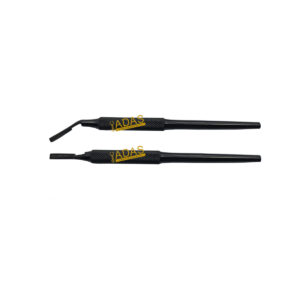
Our photograph shows a rasp at both ends of one instrument, with the grip in the middle. The surgeon works with one end, then turns the raspatory over in the fingers to work with the other. AI Mode puts the point of the double end in that turn: the grit changes without a reach for a second instrument.
Cross cut serrations
The rasp faces in our photograph are cross cut, with rows of teeth running across each other. A cross cut face takes bone off in fine particles on each stroke, and the drawings beside it, numbered Fig 1 to Fig 10, show the rasp patterns the range is made in.
Six grit pairings
The listing sells six options, written 3/4, 5/6, 5/7, 6/7, 7/8 and 9/10, all at 80 dollars. Each option is a pair, one number for each end. The listing does not say which numbers cut coarser, so ask us before you order and we will send the drawing of both ends of the pairing you want.
A gold colored grip
The middle grip in our photograph is gold colored. On a tray of steel instruments, that grip tells the tungsten carbide raspatory apart at a glance. It also gives the fingers a place to hold that is clear of both rasp faces.
Which grit pairing to order
Six pairings at one price, read off the variations on 4 November 2026. The listing does not say which number cuts coarser, so ask us for the drawing of each end before you order.
| Option | What the listing says | Price |
|---|---|---|
| 3/4 | Grit 3 at one end, grit 4 at the other | 80 dollars |
| 5/6 | Grit 5 at one end, grit 6 at the other | 80 dollars |
| 5/7 | Grit 5 at one end, grit 7 at the other | 80 dollars |
| 6/7 | Grit 6 at one end, grit 7 at the other | 80 dollars |
| 7/8 | Grit 7 at one end, grit 8 at the other | 80 dollars |
| 9/10 | Grit 9 at one end, grit 10 at the other | 80 dollars |
Where it is used
AI Mode and Gemini, read on 4 November 2026, name these cases for the double ended nasal raspatory.
| Case | What it shapes | Why this one |
|---|---|---|
| Rhinoplasty | The dorsal hump of the nasal bone | The rasp takes the hump down in strokes |
| Septorhinoplasty | Nasal bone and cartilage | Turn it over to change grit |
| Reconstructive facial surgery | Bone margins of the nose | Cross cut faces smooth the edge |
| Facial plastic and ENT surgery | The bone of the nasal bridge | Gemini names both |
What it does, and what it must not do
The nasal raspatory double ended files and smooths the bone of the nose. It does not cut through bone and it is not a lever.
| Job | Use the raspatory? | What to use instead or beside it |
|---|---|---|
| Taking down and smoothing a dorsal hump | Yes | This is the job it is made for |
| Cutting through the nasal bone | No | A nasal osteotome |
| Lifting the soft tissue off the bridge first | Beside it | A periosteal elevator |
| Trimming cartilage | Beside it | A blade or nasal scissors |
| Levering the nasal bones | Never | Nothing; the rasp is not a lever |
How it compares with the rest of the tray
Ten maxillofacial instruments for fracture work, stripping, wiring and shaping bone make up this set on our site. The working ends are read off each listing’s own photograph, the options off the variations, the lengths off the name and the prices off the order form, on 4 November 2026.
| Instrument | Working end, from our photograph | Options on the listing | Length | Price |
|---|---|---|---|---|
| Hargis stripper | forked tip with a V notch on an angled shank, handle curling at the end | one size | 19 cm | 25 dollars |
| Gillies | long narrow flat blade bent near its rounded end, grooved handle | one size | 20 cm | 30 dollars |
| Dingman | narrow shaft curving gently at the tip, grooved handle | one size | 21 cm | 30 dollars |
| Rowe | flat bar with a closed loop at the top end and a ring handle | one size | 25 cm | 40 dollars |
| Obwegeser zygomatic arch awl | long curved shaft, pointed tip with an eye, fluted handle | one size | not given on the listing | 20 dollars |
| Obwegeser maxillary awl | slim shaft, pointed tip with an eye, ridged handle | 13, 15 or 17.5 cm | by option | 20, 24 or 17 dollars |
| Kelsey Fry straight | handle of a long wire loop, straight needle point | one size | 15 cm | 19 dollars |
| Kelsey Fry curved | handle of a long wire loop, needle point curving gently | one size | 18 cm | 19 dollars |
| Chompret syndesmotome | slim instrument with a hooked tip, flat handle | Fig 1, 2, 3 or 4 tip | 15 cm | 22 dollars |
| Nasal raspatory (this page) | a cross cut rasp at each end, gold colored middle grip | six grits, 3/4 to 9/10 | not given on the listing | 80 dollars |
Materials and finish
The rasp faces of this tc nasal raspatory are tungsten carbide, as our listing name records, and the body is high quality medical grade stainless steel. The steel itself is made to a German specification. We do not publish a grade number.
The nasal raspatory double ended has a plain steel finish on the body. Look at both rasp faces before each case. Teeth packed with bone dust do not cut, and a face with chipped teeth should be set aside.
Caring for it
Rinse the nasal raspatory double ended as soon as the case ends, before bone dust and blood dry in the teeth. Brush across the cross cut faces in both directions, wash it, dry it, and steam sterilize it on the normal cycle with the rest of the tray.
Ordering and wholesale
The nasal raspatory double ended is made by Adas Instruments in our own workshop and sold direct, which is why the price sits where it does against the catalog houses. Order one for a single tray, or in quantity for a hospital list or a distributor line. We do OEM work under your own brand and your own item numbers. Send us a sample and we will hold a run to your pattern rather than ours. Stock items ship from our own workshop. Backorder items take 10 to 12 working days to make. Every instrument carries a three year replacement warranty against manufacturing defects. Production is controlled under an ISO 13485 quality management system.
Frequently asked questions
What is the double ended nasal raspatory used for?
It scrapes, reshapes and smooths the nasal bone and cartilage in rhinoplasty, septorhinoplasty and reconstructive facial surgery, such as when a dorsal hump is taken down. Ours is the tungsten carbide pattern in six grit pairings, at 80 dollars.
Why is a raspatory made double ended?
So the grit can be changed without changing instruments. AI Mode says the surgeon turns it over to change grit. A coarser face takes the hump down and a finer face smooths the line, all with one raspatory in the hand.
Which raspatory grit pairing should I order?
The listing sells 3/4, 5/6, 5/7, 6/7, 7/8 and 9/10, one number for each end, all at 80 dollars. It does not say which numbers cut coarser, so ask us and we will send the drawing of both ends before you order.
What is a bone rasp?
A bone rasp is a file for bone, with rows of teeth that take the surface off in fine particles. On the nose it is used to take down and smooth the bridge, and this one has a rasp at each end so two grits are in the hand at once.
Can it be autoclaved?
Yes. The tc nasal raspatory goes through the normal steam cycle with the rest of the tray. Brush the teeth clean of bone dust first, dry both faces fully, and store it so the rasp faces do not rub against other instruments.
Related products and categories
Three more instruments from the same maxillofacial tray: the Hargis anterior border stripper, the Gillies zygoma elevator, 20 cm and the Dingman zygoma elevator, 21 cm. The rest of the range is under maxillofacial instruments, which sits inside our ENT instruments.
| Weight | 0.15 kg |
|---|---|
| Cutting Serration Type | 3/4 Grits, 5/6 Grits, 5/7 Grits, 6/7 Grit, 7/8 Grits, 9/10 Grits |
Be the first to review “Nasal Raspatory Double Ended, Tungsten Carbide, Six Grits”
Shipping & Delivery Policy
Processing Time: In-stock items are dispatched within 24-48 hours. For custom or out-of-stock items, production time is approximately 10-15 days.
Global Delivery Estimates
We partner with world-class couriers (DHL, FedEx) to ensure fast, tracked delivery.
- USA & Canada: 3-5 Business Days
- Europe & UK: 4-6 Business Days
- Rest of World: 5-7 Business Days
*We offer Air Cargo and Sea Freight options for bulk wholesale orders.
Customs & Duties
International buyers are responsible for any customs duties or taxes imposed by their country. Adas Instruments is not responsible for delays caused by customs clearance.
Lost Packages & Insurance
If your package is lost in transit, please contact us immediately. We offer full support and replacements for confirmed lost shipments. Note: You must report non-delivery within 3 weeks to be eligible for an insurance claim.
Related products


Reviews
There are no reviews yet.