
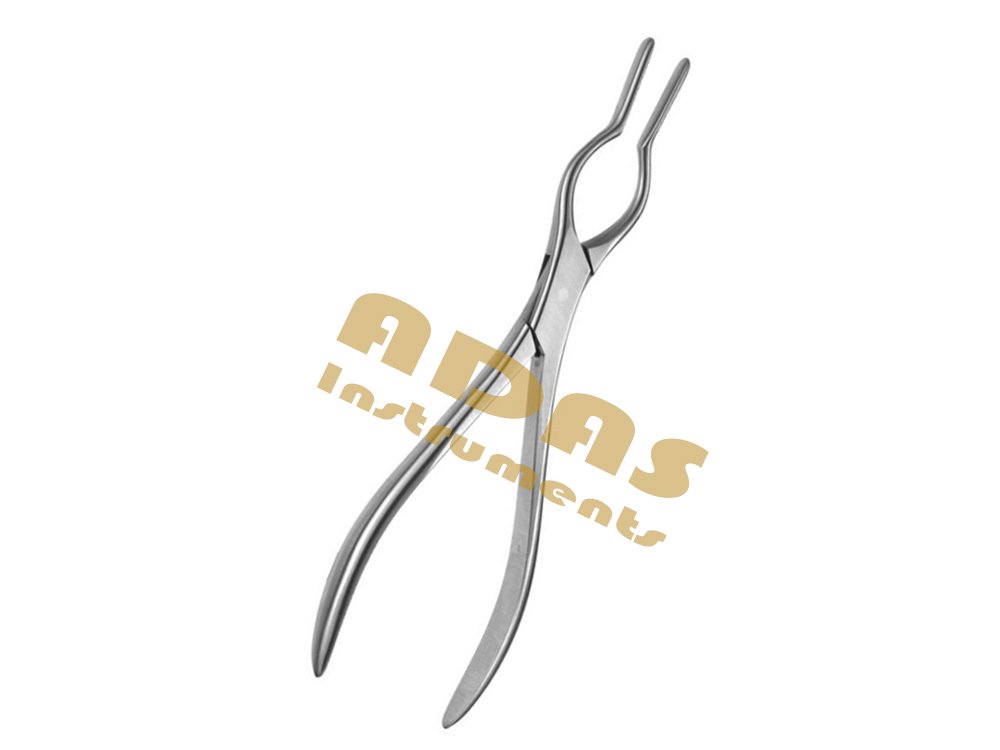
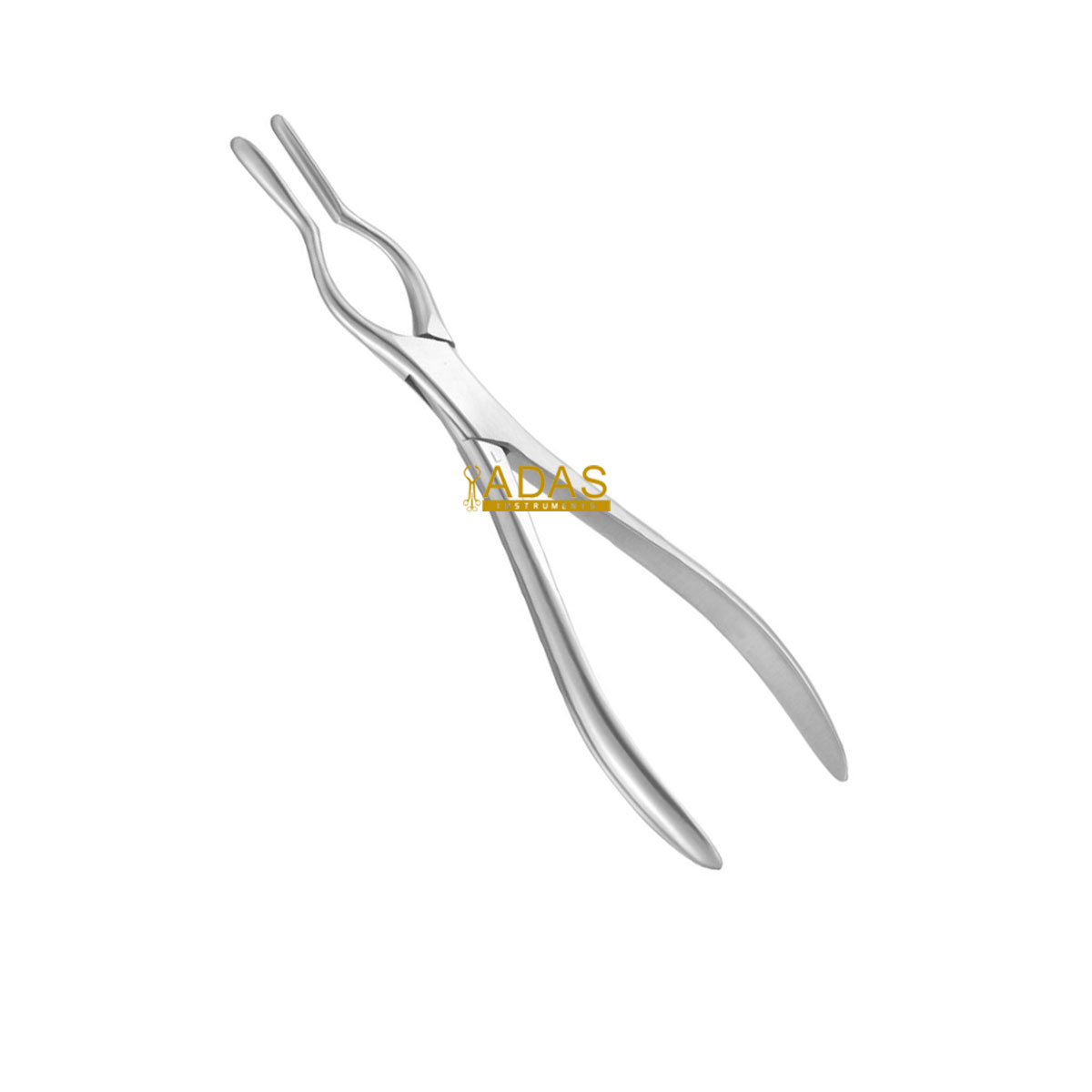
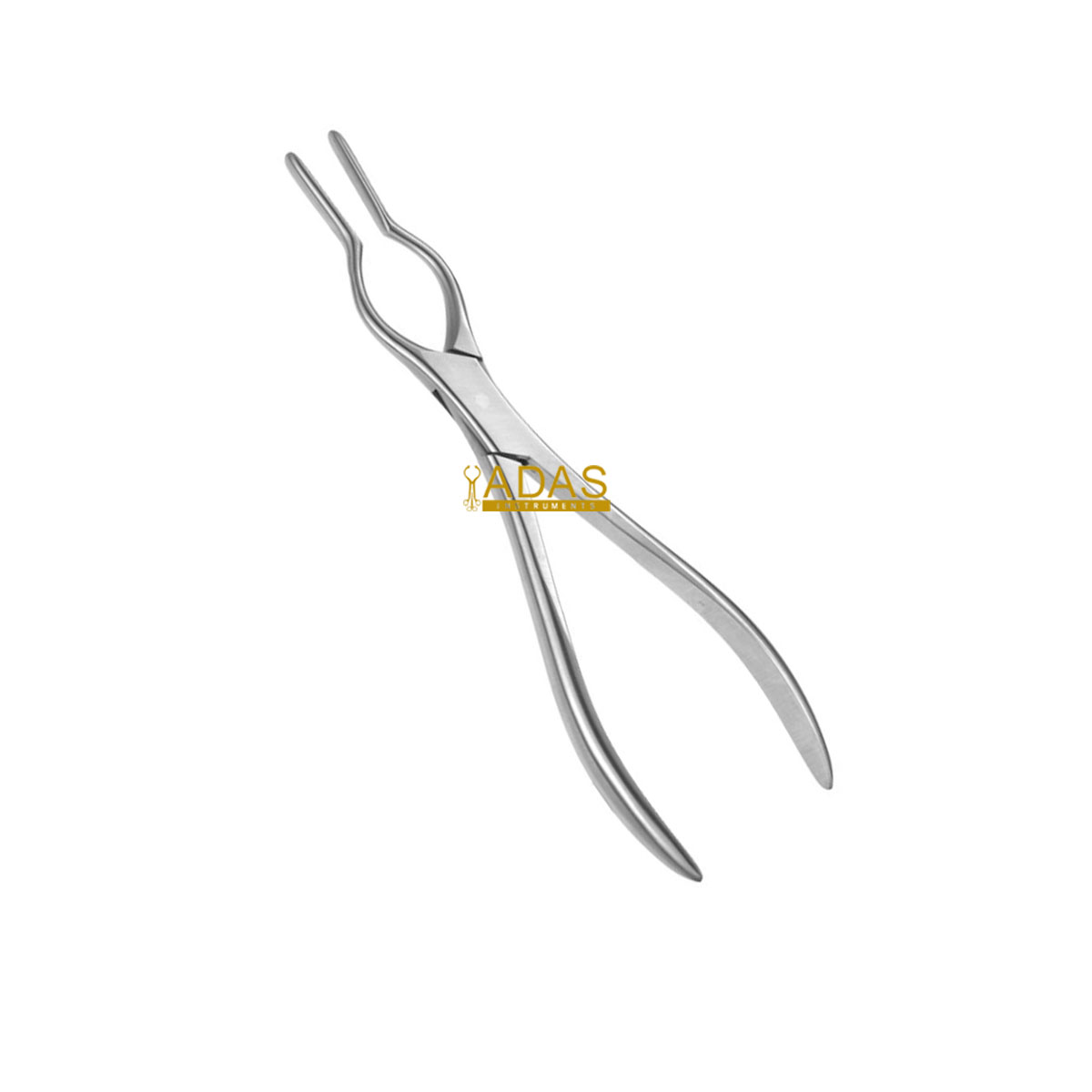
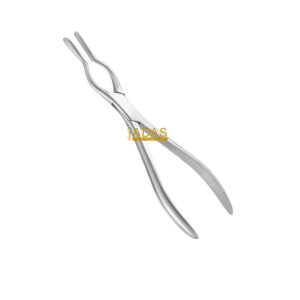
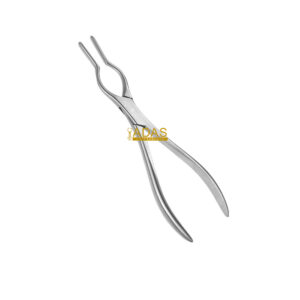
Walsham Septum Straightening Forceps | Left, Right or Pair, 23 cm
Price range: $ 35.00 through $ 65.00
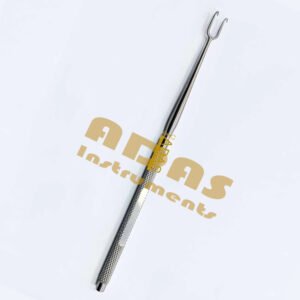
Walsham septum straightening forceps reset the lateral nasal wall after a fracture, which is a different job from straightening the septum itself. The blades are concave on the inside so they sit around a nasal bone instead of across it, and because each wall needs its own angle the instrument comes left handed, right handed, or as a matched pair that covers both in one tray. Ours are 23 cm and they are 35 dollars, against 154.99 for the same pattern from a US catalog house.
Key Features
- Resets the lateral nasal wall, not the septum
- Left, right, a matched pair, or universal
- Concave inner neck, so the blade wraps the bone
- 23 cm, which is the standard working length for this pattern
- Cut from high quality medical grade stainless steel and fully autoclavable
- Three year replacement warranty against manufacturing defects
- Item code AQ-10.88

What Walsham septum straightening forceps are
Two instruments get picked up when a nose has been broken, and surgeons mix their names up constantly. The Asch straightens the septum. The Walsham resets the wall of the nose on either side of it. They look similar enough on a tray that the question comes up in writing: Search Console shows seven separate searches asking Walsham against Asch, and we sit at position 1.0 for “difference between walsham and asch forceps”, so this page may as well answer it first.
The Walsham takes the lateral nasal wall rather than the septum, which is why it comes left and right and is used as a pair. Google’s own description of the pattern says the same thing in fewer words: it is used for reducing the lateral nasal wall and resetting displaced nasal bones, and it is often used as a pair to remodel individual nasal walls safely.
That is why the side matters. A left handed instrument sits on the left wall the way a right handed one sits on the right, and a surgeon working both sides of a fracture wants the pair. We sell them singly and as a set of two, and there is a universal version for a tray that cannot carry three of anything.
It is listed as a Walsham forceps, as Walsham nasal forceps, as a nasal fracture reduction forceps, and in catalogs as a septum realignment forceps. All three describe this instrument. The Cottle Walsham, which is the longer eponym, is a separate page and the difference between the two is set out below.
One thing this page will not do is quote a blade measurement. Our own record carries the 23 cm length and the side options and nothing else, and the jaw figures you will find on rival listings are theirs rather than ours.
Key design features
The concave inner neck
The inside face of the neck is dished rather than flat. A flat blade pressed against the side of a nose holds one line of it; a dished one wraps the bone and moves the whole of it at once. It is the detail that makes a reduction feel controlled rather than approximate, and it is the hardest part of the instrument to forge consistently.
Left, right and a matched pair
Three ways to buy it and the choice is about how you work. A surgeon who takes one side at a time needs one instrument. A surgeon who reduces both walls in the same pass needs the pair, and the pair is the common order on a fracture list. The universal version is a compromise and we say so plainly.
23 cm, and why it is not longer
23 cm is the standard for this pattern and it is not an accident. The instrument works from outside the nostril with the blade inside it, so the length sets how much of the handle is in the way of the surgeon’s own view. Longer gives no extra reach that matters here.
Nothing plumbed into it
One piece of steel and a joint. No light, no suction, no coating and no ratchet. There is nothing to flush, nothing to dry and nothing to wear through, which is why this pattern tends to outlive the tray it sits on.
Which side to order
One decision, and it is not about size.
| Option | What it is for | How to decide |
|---|---|---|
| Left | The left lateral wall | A surgeon who reduces one side at a time, or a tray that already has a right |
| Right | The right lateral wall | The same, the other way round |
| Set of 2, left and right | Both walls in one pass | The usual order on a fracture list, and the one most trays carry |
| Universal | Either side, at a compromise angle | A tray with no room for a pair. It does both jobs less exactly than a dedicated side does one |
Where it is used
Trauma first, and then anywhere a nasal bone has to move.
| Procedure | What the Walsham does | Note |
|---|---|---|
| Closed reduction of a nasal fracture | Resets the displaced lateral wall | The main use, and usually the pair |
| Septorhinoplasty | Repositions the bony walls after the septum has been dealt with | The Asch or the Cottle Walsham handles the septum |
| Revision of an old fracture | Moves a wall that has healed in the wrong place | Harder work, and the concave neck earns its place |
| Nasal bone osteotomy | Takes the wall to its new position after the cut | Used with a mallet and an osteotome, not instead of them |
What it holds back, and what it must not do
The right hand column is the half of this table that matters.
| The task | What this forceps does | What it must not do |
|---|---|---|
| Moving a nasal bone | Wraps the wall with a concave blade and repositions it | It is NOT a bone cutter. If the wall will not move, it needs an osteotome and a mallet first |
| Holding a reduction | Holds while the position is checked | It does not lock. There is no ratchet and nothing holds the jaws shut for you |
| Working on the septum | Nothing. This is a wall instrument | The septum is the Asch and the Cottle Walsham. Using the Walsham on septal cartilage is using the wrong instrument |
| Protecting the lining | The blade is blunt along its whole length | It has no built in gap, and a gap is the ASCH feature rather than this one: the Asch blades stop short of each other so the lining is not crushed |
How it compares with the rest of the family
Four instruments in this family touch a broken or deviated nose, and the difference between them is which part of it they move.
| Instrument | What it moves | Comes in sides | Buy it when |
|---|---|---|---|
| Walsham, this page | The lateral nasal wall | Left, right, pair, universal | A fracture has pushed a wall in |
| Cottle Walsham | The septum and the bony base | No, one pattern | The septum itself has to be straightened |
| Asch | The septum, with a gap that spares the lining | No, one pattern | The cartilage has to move and the mucosa has to survive it |
| Rubin, tungsten carbide | The septum, with a carbide grip | No | The same job on a list that runs every day |
Materials and finish
Every Walsham septum straightening forceps we make is cut from high quality medical grade stainless steel. The steel itself is made to a German specification. We do not publish a grade number. The number on a certificate tells a surgeon nothing about whether a concave neck still holds its own curve after two hundred autoclave cycles and a few hundred reductions, and the answer to that is in the making rather than in the alloy.
The concave face is forged and then stress relieved. An instrument that is bent into shape and not relieved slowly opens out under load, and on this pattern that shows up as a blade that no longer wraps the bone it was shaped for. It is a fault that arrives too gradually to notice on any one case.
There is no sharp external edge anywhere on the blade, inside or outside. The inside is the face that lies against the nose and it is the one that gets the attention.
Caring for it
Open the joint and wash it there. A nasal fracture is a bloody operation and the joint is where blood dries into a film that makes the instrument stiff by the third cycle.
Warm water and a soft brush along both faces of each blade. Autoclave with the tray. Store the pair together, because a left on its own is a right somebody has lost, and look at the inside face against the light occasionally: a concave neck that has flattened is an instrument that has done its work and should come off the tray.
Ordering and wholesale
Every Walsham septum straightening forceps is made by Adas Instruments in our own workshop and sold direct, which is why the price sits where it does against the catalog houses. Order one for a single tray, or in quantity for a hospital list or a distributor line. We do OEM work under your own brand and your own item numbers. Send us a sample and we will hold a run to your pattern rather than ours. Stock items ship from our own workshop. Backorder items take 10 to 12 working days to make. Every instrument carries a three year replacement warranty against manufacturing defects. Production is controlled under an ISO 13485 quality management system.
Frequently asked questions
What are Walsham forceps used for?
Resetting the lateral wall of the nose after a fracture, and repositioning nasal bones during septorhinoplasty. They are not septum instruments: the septum is the job of the Asch and the Cottle Walsham.
What is the difference between Walsham and Asch forceps?
The Walsham moves the WALL of the nose and the Asch moves the SEPTUM. The Walsham has a concave inner neck and comes left and right so it can wrap each wall; the Asch has angled blades with a permanent gap between them that keeps the lining from being crushed. It is the most searched question in this part of our catalog and that is the whole answer.
Do I need the left and right pair?
If you reduce both walls in the same pass, yes, and that is the usual order. If you work one side at a time, a single instrument does it. The universal version does both at a compromise angle and we would rather say that than sell it as equal.
What length are they?
23 cm, which is the standard for this pattern. We publish the length and the side options because those are on our own record, and we do not publish a jaw measurement, because that is not.
Are they the same as Cottle Walsham forceps?
No, and they are a separate instrument on a separate page. The Cottle Walsham works on the septum and the bony base; this one works on the lateral wall. The comparison table above sets out which to pick.
Related products and categories
For the septum itself rather than the wall, the Asch septum straightening forceps with its permanent blade gap, or the Cottle Walsham septum straightening forceps. For the same septal work on a daily list, the Rubin forceps with tungsten carbide inserts.
The rest of this family sits under nasal cutting, crusher and septum forceps, and the wider set for the operation is under rhinoplasty instruments.
| Weight | 0.15 kg |
|---|---|
| More Option | Left, Right, Set of 2 Left & Right, Universal |
Be the first to review “Walsham Septum Straightening Forceps | Left, Right or Pair, 23 cm”
Shipping & Delivery Policy
Processing Time: In-stock items are dispatched within 24-48 hours. For custom or out-of-stock items, production time is approximately 10-15 days.
Global Delivery Estimates
We partner with world-class couriers (DHL, FedEx) to ensure fast, tracked delivery.
- USA & Canada: 3-5 Business Days
- Europe & UK: 4-6 Business Days
- Rest of World: 5-7 Business Days
*We offer Air Cargo and Sea Freight options for bulk wholesale orders.
Customs & Duties
International buyers are responsible for any customs duties or taxes imposed by their country. Adas Instruments is not responsible for delays caused by customs clearance.
Lost Packages & Insurance
If your package is lost in transit, please contact us immediately. We offer full support and replacements for confirmed lost shipments. Note: You must report non-delivery within 3 weeks to be eligible for an insurance claim.
Related products
Reviews
There are no reviews yet.