
Cottle Cartilage Crusher | Serrated or Smooth Bed
$ 45.00
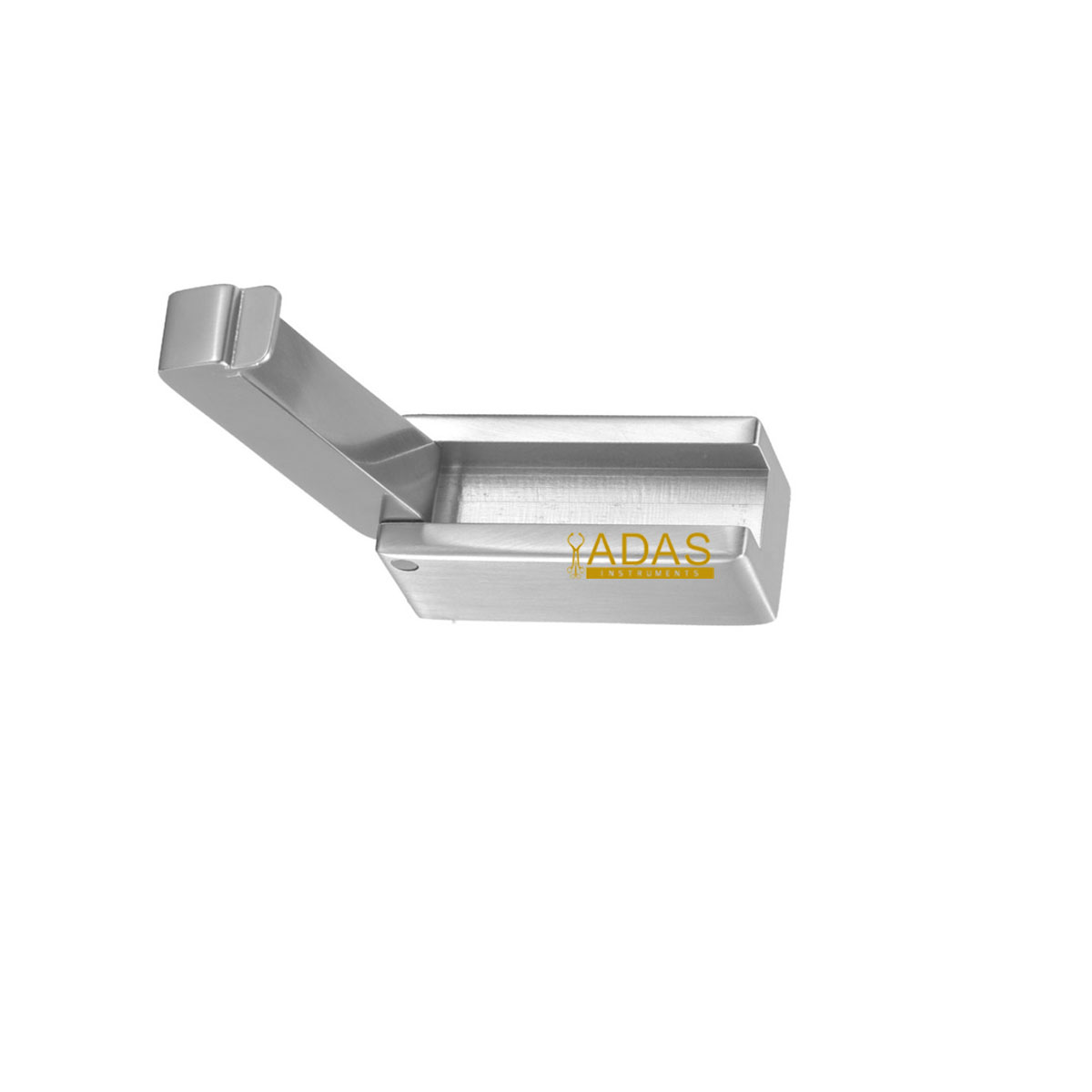
The Cottle cartilage crusher is the everyday block, and the one decision it asks is serrated bed or smooth. A smooth bed flattens a graft to an even thickness; a serrated one scores it at the same time, which makes the cartilage bend in a chosen direction instead of just going limp. The graft goes in the bed, the lid closes, and a block crusher is not squeezed, it is tapped with a mallet, which is how the force stays even across the whole graft.
Key Features
- Serrated or smooth bed, chosen when you order
- Block crusher, tapped with a mallet rather than squeezed
- Flattens a graft evenly across its whole surface
- Hinged lid, nothing to adjust and nothing to set
- Cut from high quality medical grade stainless steel and fully autoclavable
- Three year replacement warranty against manufacturing defects
- Item code AQ-52.15

What a Cottle cartilage crusher is
This is the crusher most rhinoplasty trays carry, and the reason is that it does the common job well rather than the hard job adequately. Septal cartilage, harvested and sitting on a trolley, needs to be made flat and pliable and then put back. The Cottle block does that in one tap.
The choice between the two beds is a real one and it is worth getting right. A SMOOTH bed crushes: the fibers break, the graft loses its spring and comes out an even thickness, and it will bend whichever way you push it. A SERRATED bed crushes and scores at the same time, which leaves a line of weakness and makes the graft bend along that line. If you want a graft that curls in a chosen direction, you want the serrations; if you want a flat sheet, you want the smooth face.
So it is sold as a serrated cartilage crusher or as a smooth cartilage crusher. Both are our own attribute, which is why both are in the product name now. The old name said Serrated Jaws, and that described one of the two options we actually sell. It also said jaws, and a block crusher has a bed.
It is listed as a Cottle cartilage crusher, a Cottle bone crusher, a cartilage crusher and a nasal cartilage crusher. LowFruits measures “cartilage crusher” at 50 searches a month and “cottle cartilage crusher” at 40, which makes this the only product in this family whose own eponym carries a measured number. A US catalog house prices the pattern at 178.99 dollars; ours is 45.
What we do not publish is the bed dimension. Rival listings quote a 15 to 16 mm working anvil for the pattern. Ours is one bed in two surface finishes and we do not publish its size, because our record does not carry it.
Key design features
Serrated or smooth, and what each one leaves behind
Smooth gives you a flat, pliable sheet with no preferred direction. Serrated gives you a sheet with a grain: it bends along the score lines and resists bending across them. Surgeons who do a lot of dorsal onlay work tend to want one of each.
A block, not a pair of pliers
The graft sits in the bed and the lid comes down flat. The force arrives across the whole piece at the same moment, which is what produces an even result rather than a crushed stripe with untouched cartilage either side of it.
Lighter than the Jost, deliberately
Septal cartilage does not need the mass the Jost carries, and a lighter block is quicker to handle on a trolley and easier to hold square while it is tapped. Rib cartilage is where that stops being true, and that is what the Jost is for.
A hinged lid and nothing else
No screw, no clip, no ratchet, no interchangeable plates. One bed, one lid, one hinge. Nothing on it can be lost or fitted the wrong way round in the middle of a case.
Which bed to order
One decision, and it is about what the graft has to do afterwards.
| Bed | What it leaves | Usually chosen for |
|---|---|---|
| Smooth | A flat, pliable sheet with no preferred bend direction | Camouflage grafts, spreader grafts, anything that has to lie flat |
| Serrated | A sheet with a grain that bends along the score lines | Dorsal onlay and anywhere the graft has to curl in a chosen direction |
| One of each | Both options on the trolley | A theater doing regular rhinoplasty, and the common order |
| Neither, use the Jost | A heavier block for denser cartilage | Rib cartilage, or septum thick enough that this block needs several taps |
Where it is used
Graft preparation, on a trolley rather than in the patient.
| Procedure | What the crusher does | Bed |
|---|---|---|
| Septal graft preparation | Flattens harvested septal cartilage to an even thickness | Either |
| Camouflage grafting | Crushes cartilage to a pliable sheet that hides an irregularity | Smooth |
| Dorsal onlay graft | Crushes and scores so the graft follows the dorsum | Serrated |
| Spreader graft preparation | Takes the spring out of a strip so it sits where it is put | Smooth |
What it holds back, and what it must not do
Crushing cannot be undone, which makes the right hand column the important half.
| The task | What this crusher does | What it must not do |
|---|---|---|
| Flattening a graft | Even force across the whole piece in one tap | It must NOT be struck repeatedly to speed things up. Cartilage crushed past pliable becomes mush and there is no way back |
| Scoring a graft | The serrated bed scores while it crushes | The smooth bed does NOT score. If the graft has to bend one way, order the serrated one rather than improvising |
| Being used with a mallet | That is how a block crusher works | It must not be squeezed in a vice or leaned on. A tap is controlled; a steady press is not |
| Working on cartilage in the nose | Nothing. It is a bench instrument | Cartilage still attached is the morselizer job |
How it compares with the rest of the family
The four cartilage instruments in this family, and what separates them.
| Instrument | What it does to cartilage | Where | Buy it when |
|---|---|---|---|
| Cottle crusher, this page | Crushes, and scores if the bed is serrated | On a bench | Everyday septal graft work |
| Jost crusher | Crushes, heavier | On a bench | Rib cartilage and dense septum |
| Gorney septal morselizer | Softens in place | In the nose | The septum has to bend where it sits |
| Cartilage cutting block | Nothing. It holds it while you carve | On a bench | The graft has to be cut to size and shape |
Materials and finish
Every Cottle cartilage crusher we make is cut from high quality medical grade stainless steel. The steel itself is made to a German specification. We do not publish a grade number. The number on a certificate tells a surgeon nothing about whether a bed and a lid still meet flat after two hundred autoclave cycles and a few thousand mallet blows, and whether a serrated bed still has edges on its serrations, and the answer to that is in the making rather than in the alloy.
The bed and the lid are machined as a pair and lapped flat together, and on the serrated version the serrations are cut after that lapping so they are the same depth across the whole face. Serrations that are deeper at one end score the graft unevenly, which is worse than not scoring it at all.
The hinge is set so the lid falls square. There is no sharp external edge anywhere on the block, which matters on an instrument held in a gloved hand and struck.
Caring for it
Open it and wash both faces, and on the serrated version brush along the grooves rather than across them. Crushed cartilage dries into the bottom of a serration and stays there.
Warm water, a soft brush, nothing abrasive on either face. Autoclave open so steam reaches both faces, and store open. Close it empty against the light occasionally: the faces should meet all the way across.
Ordering and wholesale
Every Cottle cartilage crusher is made by Adas Instruments in our own workshop and sold direct, which is why the price sits where it does against the catalog houses. Order one for a single tray, or in quantity for a hospital list or a distributor line. We do OEM work under your own brand and your own item numbers. Send us a sample and we will hold a run to your pattern rather than ours. Stock items ship from our own workshop. Backorder items take 10 to 12 working days to make. Every instrument carries a three year replacement warranty against manufacturing defects. Production is controlled under an ISO 13485 quality management system.
Frequently asked questions
What is a Cottle cartilage crusher used for?
Flattening and softening a harvested cartilage graft so it lies flat and can be shaped. The graft goes in the bed, the lid closes, and the block is tapped with a mallet, which spreads the force across the whole piece at once.
Serrated or smooth, which should I order?
Smooth for a flat pliable sheet with no preferred bend direction, which suits camouflage and spreader grafts. Serrated if the graft has to bend along a chosen line, which suits dorsal onlay work. Units doing regular rhinoplasty usually buy one of each.
How is it different from the Jost crusher?
The Jost is heavier and is built for thick septal cartilage and rib. The Cottle is the everyday block for septal grafts and it is the one with the bed choice. If your work includes rib harvests, you will want both.
Is it squeezed or tapped?
Tapped, with a surgical mallet. A block crusher is not a pair of pliers: the point of the design is that the force arrives evenly across the graft, and a steady squeeze cannot do that.
What size is the bed?
We do not publish a figure, because our own record carries only the serrated or smooth option. Rival listings quote a 15 to 16 mm anvil for the pattern. Ask us before ordering if the size has to match something.
Related products and categories
For denser cartilage and rib, the heavier Jost cartilage crusher. For softening a septum still in the nose, the Gorney septal morselizer. For carving a graft instead of crushing it, the Teflon cartilage cutting block.
The rest of this family sits under nasal cutting, crusher and septum forceps, and the wider set for the operation is under rhinoplasty instruments.
| More Option | Serrated, Smooth |
|---|
Be the first to review “Cottle Cartilage Crusher | Serrated or Smooth Bed”
Shipping & Delivery Policy
Processing Time: In-stock items are dispatched within 24-48 hours. For custom or out-of-stock items, production time is approximately 10-15 days.
Global Delivery Estimates
We partner with world-class couriers (DHL, FedEx) to ensure fast, tracked delivery.
- USA & Canada: 3-5 Business Days
- Europe & UK: 4-6 Business Days
- Rest of World: 5-7 Business Days
*We offer Air Cargo and Sea Freight options for bulk wholesale orders.
Customs & Duties
International buyers are responsible for any customs duties or taxes imposed by their country. Adas Instruments is not responsible for delays caused by customs clearance.
Lost Packages & Insurance
If your package is lost in transit, please contact us immediately. We offer full support and replacements for confirmed lost shipments. Note: You must report non-delivery within 3 weeks to be eligible for an insurance claim.
Related products

Reviews
There are no reviews yet.