


Sheen Grid Plate | Surgical Rhinoplasty Cartilage Marking Tool
Price range: $ 15.00 through $ 23.00
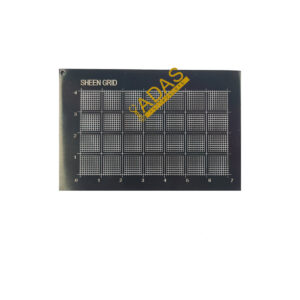
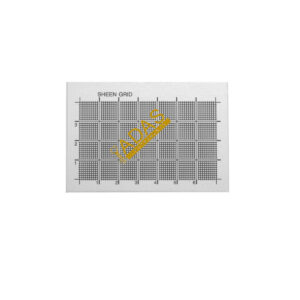
The Sheen grid plate is a flat steel plate, etched with millimeter and inch markings on both sides, that a rhinoplasty surgeon uses to measure a cartilage graft, cut it on, and photograph it against. Jack Sheen gave his name to it, and the reason it has lasted is that those three jobs happen one after the other in the same thirty seconds and the plate does all three without the graft ever leaving the surface. It is used in rhinoplasty, septorhinoplasty and facial reconstruction wherever a graft has to come out at a stated size.
Key Features
- Millimeter and inch markings etched on both sides
- Rigid enough to cut and trim cartilage on
- A plain background for intraoperative graft photography
- Finish options: satin or black titanium
- Cut from high quality medical grade stainless steel and fully autoclavable
- No moving parts and nothing to adjust
- Three year replacement warranty against manufacturing defects
- Item code AQ-10.95

What a Sheen grid plate is
A cartilage graft comes out of a septum or an ear at roughly the right size and then has to be made exactly the right size. That happens on a surface, with a blade, in the middle of an operation, and the surface it happens on decides how well it goes. A towel does not hold a measurement. A metal tray is unmarked. This plate is the surface with the measurement on it.
It is an instrument that carries the measurement, so the surgeon brings the judgement and the steel holds the number, and it is the only instrument in this category that is also a work surface. Three jobs, in the order they happen: measure the graft, cut it to the figure, and photograph what came out.
Nobody searches for it. The seed returned a single idea, which is a proven zero, and that says something useful rather than something discouraging: a surgeon who wants a Sheen plate knows what it is and is checking a price. Grafting surgeons who have never used one tend to be working on a towel or on the back of a kidney dish, which is where the instrument makes the most obvious difference.
Three names describe the three jobs, and catalogues use all of them. As a cartilage graft measuring plate it gives the dimensions. As a rhinoplasty cartilage cutting plate it gives the surface to trim on. And as a cartilage graft photography plate it puts a scale in the picture beside the graft.
Key design features
Etched on both sides
Millimeter and inch markings, cut into the steel on both faces, so the plate works whichever way up it lands on the tray. The graduations run to the edges rather than stopping short, because a graft is often laid at the edge of the plate where a blade can clear it.
Rigid enough to cut on
The plate is the cutting surface, which means it has to be thick enough not to flex under a blade and hard enough not to collect a scored line every time one is used. A plate that flexes moves the graft mid cut, and a plate that cuts is a plate that will soon have a false grid on it.
A background for photography
Grafts get photographed, for records, for teaching and for the conversation afterwards. A graft photographed on a grid carries its own scale, which no photograph of a graft on a glove ever does. The black titanium finish gives the strongest contrast against pale cartilage.
Nothing to adjust
There is no joint, no screw, no slide and no spring. It cannot go out of calibration because there is nothing to calibrate. The only thing that can go wrong with it is the etched grid becoming unreadable, which is why the grid is cut rather than printed.
Which finish to order
One plate, two finishes, and the choice depends on whether you photograph grafts.
| Finish | Why people choose it | Note |
|---|---|---|
| Satin | No reflection under an overhead light | The usual choice for straightforward cutting work |
| Black titanium | Strongest contrast for photography | The choice for teaching units and records |
| Either | Both carry the same etched grid on both faces | The grid is cut before the finish goes on |
| Both | Where one is kept for records and one for the tray | 30 dollars together |
Where it is used
Cartilage work, which in practice means noses and ears, plus the facial reconstruction that borrows from both.
| Procedure | What the plate is used for | Why it matters there |
|---|---|---|
| Rhinoplasty | Measuring, cutting and trimming tip and dorsal grafts | Graft size is the whole result |
| Septorhinoplasty | Working septal cartilage down to a stated size | Harvested cartilage is finite |
| Facial reconstruction | Shaping grafts for a defect of a measured size | The defect is measured first, the graft second |
| Ear and auricular work | Trimming conchal cartilage grafts | Small pieces that are easily lost on a towel |
What it does, and what it must not do
Three of these rows are about the plate’s three jobs. The fourth is the mistake that ruins one.
| The task | What the plate does | What it must not do |
|---|---|---|
| Measuring a graft | Gives the dimensions against an etched grid | It does not hold the graft. A forceps does |
| Cutting the graft | Gives a rigid surface that does not flex under a blade | The blade is drawn, never stabbed into the plate |
| Photographing it | Puts a scale in the picture alongside the graft | It is not wiped down with anything abrasive to clean it for a photograph |
| Staying accurate | Nothing to adjust, so nothing to go out of adjustment | A plate with a scored false line on it is retired, not read carefully |
How it compares with the rest of the family
Four instruments here give a dimension. This is the only one you can cut on.
| Instrument | What it does | Can you work on it | Our price |
|---|---|---|---|
| Sheen grid plate | Measures, and gives a surface to cut and photograph on | Yes | 15 dollars |
| Surgical ruler | Measures straight distances | No | 12 dollars |
| Ginsberg caliper | Measures two point distances up to 40 mm | No | 32 dollars |
| Castroviejo caliper | Measures two point distances up to 20 mm | No | 24.50 dollars |
Materials and finish
Every Sheen grid plate we make is cut from high quality medical grade stainless steel. The steel itself is made to a German specification. We do not publish a grade number. The number on a certificate tells a surgeon nothing about whether the etched grid is still readable after five years of autoclave cycles, and the answer to that is in the making rather than in the alloy.
The grid is cut into the surface, on both faces, before any finish is applied. A printed grid on a plate that is cut on would last a handful of cases. The thickness is set so the plate does not flex under a blade held at an angle, which is the way a graft is actually trimmed rather than the way it is drawn in a textbook.
The edges are finished square and deburred. This is an instrument that is picked up flat, off a wet tray, with gloves on. A square corner on a flat instrument finds a glove sooner or later, and a glove failure over an open nose is a bigger problem than a blunt corner.
The finish goes on after the grid is cut, so a black titanium plate measures exactly what a satin one does. Nothing is coated into a graduation, because a filled line is a line that cannot be read quickly.
Caring for it
Clean the grid, not just the faces. Dried cartilage and fluid sit in an etched line and a filled graduation is a graduation nobody can read at a glance. Warm water and a soft brush along the lines; nothing abrasive at all, because an abrasive pad on an etched grid is how a grid stops being a grid.
Autoclave it with the rest of the tray. Store it flat. Inspect the surface for scored lines from blade work every few months, and retire a plate that has picked up a line deep enough to be mistaken for a graduation. That is the one failure mode this instrument has.
Ordering and wholesale
The Sheen grid plate is made in our own workshop and sold direct, which is why the price sits where it does against the catalogue houses. Order one for a single tray, or in quantity for a hospital list or a distributor line. We do OEM work under your own brand and your own item numbers. Send us a sample and we will hold a run to your pattern rather than ours. Stock items ship from our own workshop. Backorder items take 10 to 12 working days to make. Every instrument carries a three year replacement warranty against manufacturing defects. Production is controlled under an ISO 13485 quality management system.
Frequently asked questions
What is a Sheen grid plate used for?
Measuring, cutting and photographing cartilage grafts during rhinoplasty, septorhinoplasty and facial reconstruction. The graft is laid on the etched grid, trimmed to the figure on the same surface, and photographed against it with the scale in the picture.
Is the Sheen grid plate the same as a Sheen cartilage grid?
Yes, the two names describe the same instrument and both are in use. Some catalogues list it as a cartilage grid plate and some as a graft marking plate. The item code on this page is the way to be sure of what you are ordering.
Can you cut cartilage directly on the grid plate?
Yes, that is one of the three reasons it exists. The plate is thick enough not to flex under a blade. Draw the blade rather than stabbing it, and inspect the surface every few months for a scored line deep enough to be read as a graduation.
What size or material should I order the grid plate in?
There is one size and it is steel. The only choice is the finish: satin if the plate is for cutting work, black titanium if grafts are being photographed, because pale cartilage shows up far better against it.
Does the Sheen grid plate have markings in millimeters or inches?
Both, etched on both faces, so the plate reads the same whichever way up it is picked up.
Related products and categories
For a two point measurement rather than a surface, the Ginsberg caliper 0-40mm covers graft dimensions up to 40 mm and the Castroviejo caliper 20mm covers the smaller figures. For straight distances away from the plate, the surgical ruler graduated in mm and inches is the simpler instrument.
The rest of the family sits under marking and measuring instruments, and the wider set for nasal work is under rhinoplasty instruments.
| Weight | 0.09 kg |
|---|---|
| Select Color Option | Black Titanium Coloring, Satin finish |
Be the first to review “Sheen Grid Plate | Surgical Rhinoplasty Cartilage Marking Tool”
Shipping & Delivery Policy
Processing Time: In-stock items are dispatched within 24-48 hours. For custom or out-of-stock items, production time is approximately 10-15 days.
Global Delivery Estimates
We partner with world-class couriers (DHL, FedEx) to ensure fast, tracked delivery.
- USA & Canada: 3-5 Business Days
- Europe & UK: 4-6 Business Days
- Rest of World: 5-7 Business Days
*We offer Air Cargo and Sea Freight options for bulk wholesale orders.
Customs & Duties
International buyers are responsible for any customs duties or taxes imposed by their country. Adas Instruments is not responsible for delays caused by customs clearance.
Lost Packages & Insurance
If your package is lost in transit, please contact us immediately. We offer full support and replacements for confirmed lost shipments. Note: You must report non-delivery within 3 weeks to be eligible for an insurance claim.
Related products
Reviews
There are no reviews yet.