
Crile Artery Forceps, Straight and Curved Hemostatic Clamps
Price range: $ 10.00 through $ 12.00
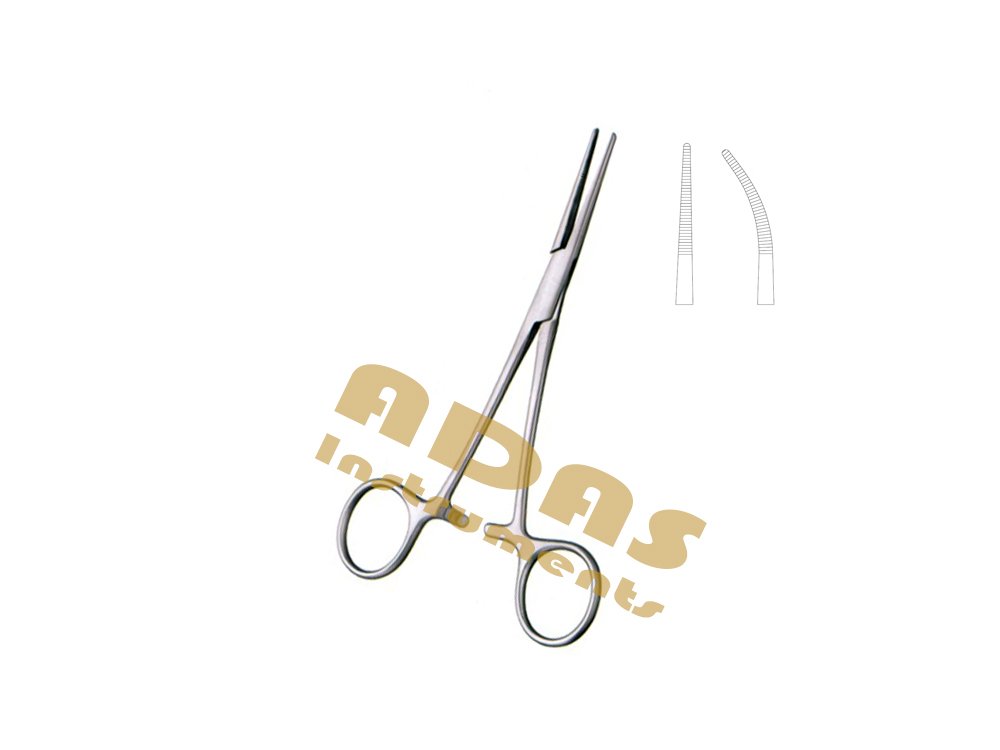
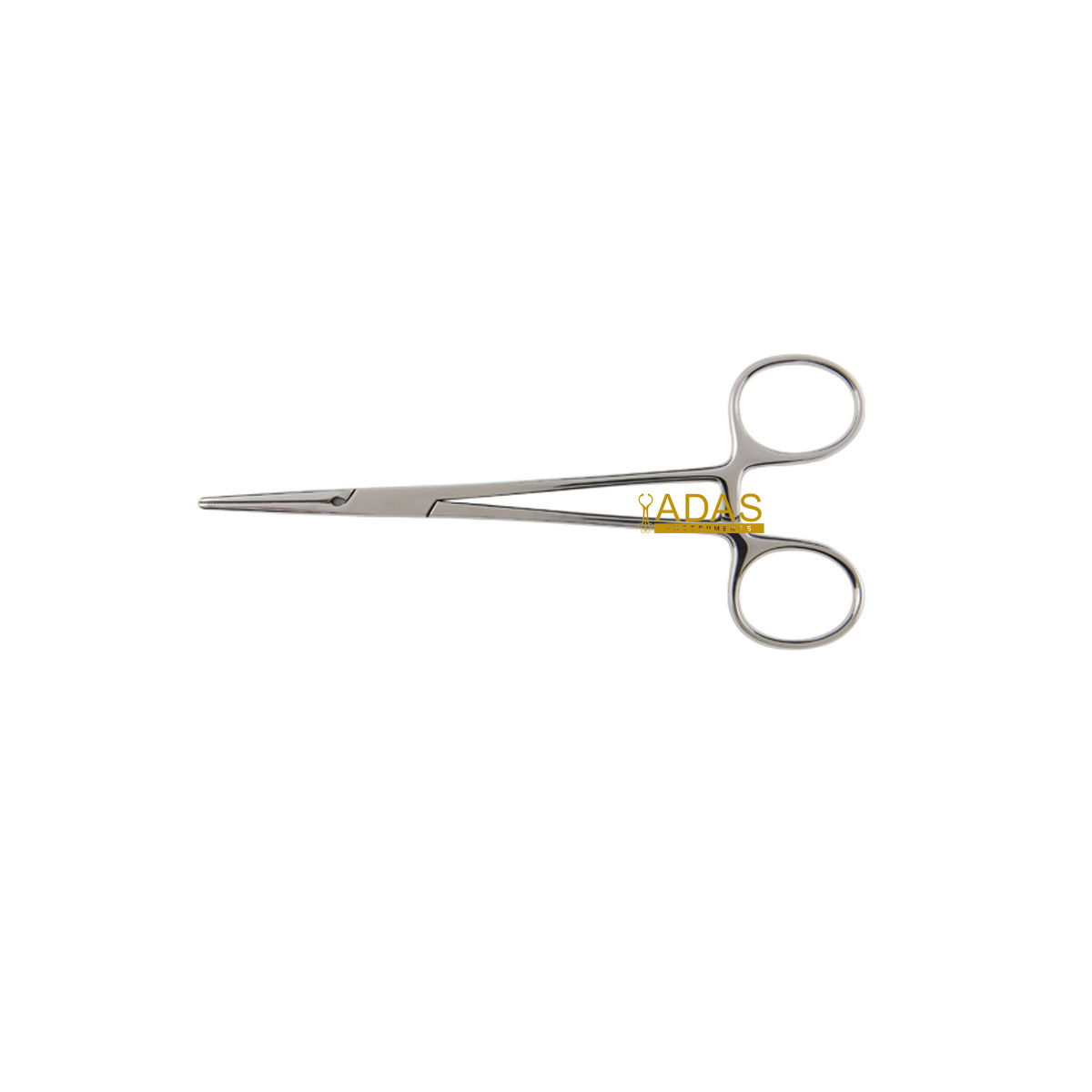
Crile artery forceps clamp blood vessels and hold bleeding under control, with transverse serrations running the full length of both jaws rather than only halfway. That full grip is what separates a Crile from a Kelly, and it is why the jaws hold a vessel or a tissue bundle without sliding back toward the hinge. Adas Instruments supplies them in 14 cm and 16 cm, with a curved or a straight tip, for general, gynecologic and orthopedic work.
Key Features
- Full length transverse serrations on both jaws, so the hold does not slide toward the hinge
- Curved or straight tip, chosen on the Select Size and Tip options fields
- 14 cm and 16 cm lengths
- Ring handles with a multi position ratchet, locked one handed
- Box joint for jaw alignment
- High quality medical grade stainless steel, satin finish to cut glare
- Item code AE-19.16

What the Crile artery forceps is
The Crile artery forceps is a ring handled hemostatic clamp used to occlude a vessel and stop it bleeding. Surgeons also list it as a Crile hemostat, a Crile clamp or a Crile hemostatic clamp. The pattern is named after George Washington Crile, the American surgeon, and it sits in the middle of the artery forceps range: bigger in the jaw than a mosquito clamp, finer than a Rochester Pean.
What makes it a Crile and not something else is the serration. The transverse ridges run the entire length of both jaws. On a Kelly they stop about halfway. That single difference is the most searched question about this instrument, and it is the reason the jaws hold a vessel evenly from tip to hinge instead of gripping hardest at the front.
Key design features of the Crile artery forceps
Every part of the instrument is there to keep a vessel closed without cutting it.
- Full jaw serrations. Transverse ridges along the whole inner face, so clamping force is spread rather than concentrated.
- No teeth. The jaw closes flat, which is what makes it atraumatic enough for a vessel wall.
- Box joint. The two halves pass through each other rather than riding on a pin, so the jaw tips stay in line after years of use.
- Multi position ratchet. The catch steps through several notches above the finger rings, so you set the clamping pressure and let go.
- Curved or straight tip. Straight for a vessel on the surface, curved to reach around a structure.
Crile artery forceps sizes and build options
Two lengths, each in a curved or a straight tip. The size chart below is the variation list, so what you see is what ships.
| Length | Imperial | Tip | Item code |
|---|---|---|---|
| 14 cm | 5.5 in | Curved or straight | AE-19.14 |
| 16 cm | 6 1/4 in | Curved or straight | AE-19.16 |
Choose 14 cm for superficial work and 16 cm where the vessel sits deeper. The imperial figures are there because most United States buyers order in inches. The tip choice matters more than the length on this pattern: a straight jaw sits flat on a vessel lying on the surface, while a curved jaw lets you come around behind a structure without lifting it. Most trays carry both.
Where Crile artery forceps are used
The Crile artery forceps is a general instrument, which is why it turns up on so many trays. What the uses below have in common is a vessel or a tissue bundle that needs holding shut while something else is done. The specialty is in the first column and the actual procedure words are in the second, because those are what surgeons search for.
| Specialty | What it is used for |
|---|---|
| General surgery | Clamping medium vessels at open laparotomy, holding tissue bundles before ligation |
| Gynecologic surgery and OB/GYN | Securing vascular pedicles during hysterectomy and cesarean section |
| Orthopedic surgery | Holding fascia and soft tissue while bone is exposed |
| Plastic and reconstructive surgery | Flap dissection, controlling bleeding in subcutaneous planes |
| Veterinary surgery | Routine hemostasis in small animal practice |
What the jaws hold
This pattern has no suture gauge, because it is a clamp and not a needle holder. What matters instead is what the jaw can take without damaging it.
| Structure | How the jaw takes it |
|---|---|
| Medium sized blood vessels | Full jaw serration spreads the clamping force along the whole vessel wall |
| Subcutaneous vascular pedicles | Held to the hinge, so the pedicle cannot creep out under tension |
| Fascia | Gripped flat without the shear a toothed jaw would apply |
| Soft tissue bundles | Taken as a mass before a tie is thrown |
How the Crile artery forceps compares with other patterns
Four instruments sit close enough to the Crile artery forceps to be confused with it, and the differences are small but real. Searches for crile forceps vs kelly forceps outnumber every other comparison on this pattern, which is why that row is first.
| Pattern | How it differs | When you reach for it instead |
|---|---|---|
| Kelly forceps | Serrated only halfway along the jaw | When you want the proximal jaw smooth so it cannot snag at the base |
| Rochester Pean forceps | Longer and heavier, fully serrated | Deep fields where reach matters more than finesse |
| Halsted mosquito forceps | Much smaller jaw, for the smallest vessels | Small vessel work where a Crile jaw would be too broad |
| Kocher clamp forceps | Carries 1×2 interlocking teeth | Tough fibrous tissue that slides out of a smooth jaw |
Crile artery forceps materials and finish
The Crile artery forceps is made from high quality medical grade stainless steel, hardened so the serrations keep their shape and the ratchet keeps its bite. The finish is satin rather than mirror, which cuts the glare under operating lights. The steel itself is made to a German specification. The finished instrument carries the CE mark.
There is no carbide insert on this pattern and there is no coating. A hemostat works by closing flat on soft tissue, so an insert would add cost without adding hold, and a coating would wear off the serration crests first. What keeps the grip is the hardness of the steel and the depth of the ridges cut into it.
Crile artery forceps care and sterilization
Rinse under cold running water straight after use, before blood has a chance to dry in the serrations. A soft brush along the jaw is enough; a wire brush will round the ridges off. Open the jaws fully for ultrasonic cleaning and for autoclaving, because a closed box joint traps moisture and a closed ratchet will not steam through. Dry fully, then store with the ratchet unlatched so the spring is not held under load.
Ordering Crile artery forceps and wholesale
Adas Instruments makes these to order as well as from stock, and we supply hospitals, clinics and distributors in the United States. Wholesale quantities and instrument set builds are quoted on request. Backorder items dispatch in 10 to 12 working days. Item code AE-19.16, and every instrument carries a three year replacement warranty against manufacturing defects. Production is controlled under an ISO 13485 quality management system.
Frequently asked questions
What are Crile artery forceps used for?
They clamp blood vessels to stop bleeding, and hold tissue bundles and vascular pedicles while a tie is thrown. The full jaw serration lets the same instrument take fascia and soft tissue without teeth, which is why it is a general purpose clamp rather than a specialist one. In our range it comes in 14 cm and 16 cm.
What is the difference between Crile and Kelly forceps?
The serrations. A Crile is serrated along the full length of the jaw; a Kelly is serrated only about halfway, leaving the part nearest the hinge smooth. Both are ring handled, ratcheted and untoothed, and both come in similar lengths, so the jaw is the surest way to tell them apart.
What is the difference between Rochester Pean and Crile forceps?
Both are fully serrated. The Rochester Pean is the longer, heavier instrument, built for deep fields and larger vessels, while the Crile is finer in the jaw and easier to work with in a shallow wound. If you are choosing between them, pick on reach first and jaw weight second.
What is another name for Crile forceps?
Crile hemostat is the common American form, and you will also see Crile clamp, Crile hemostatic clamp and Crile hemostatic forceps in catalogues. In a United States operating room the shortest form you will hear is simply criles, usually curved criles.
What sizes do Crile artery forceps come in?
We supply 14 cm, which is 5.5 inches, and 16 cm, which is 6 and a quarter inches. Both are available with a curved or a straight tip. Other lengths exist in the wider trade, but these are the two we make.
Related products and categories
Surgeons who work with the Crile artery forceps usually compare it against the baby Mixter artery forceps, the Leriche forceps and the Kocher delicate artery forceps. The whole family sits in hemostats and grasping forceps, and this pattern is also listed under breast surgery instruments.
| Weight | 0.04 kg |
|---|---|
| Select Size | 14 cm / 5.5", 16cm / 6 1/4" |
| Tip options | Curved Tip, Straight Tip |
Be the first to review “Crile Artery Forceps, Straight and Curved Hemostatic Clamps”
Shipping & Delivery Policy
Processing Time: In-stock items are dispatched within 24-48 hours. For custom or out-of-stock items, production time is approximately 10-15 days.
Global Delivery Estimates
We partner with world-class couriers (DHL, FedEx) to ensure fast, tracked delivery.
- USA & Canada: 3-5 Business Days
- Europe & UK: 4-6 Business Days
- Rest of World: 5-7 Business Days
*We offer Air Cargo and Sea Freight options for bulk wholesale orders.
Customs & Duties
International buyers are responsible for any customs duties or taxes imposed by their country. Adas Instruments is not responsible for delays caused by customs clearance.
Lost Packages & Insurance
If your package is lost in transit, please contact us immediately. We offer full support and replacements for confirmed lost shipments. Note: You must report non-delivery within 3 weeks to be eligible for an insurance claim.
Related products
Reviews
There are no reviews yet.