
Needle Holder vs Hemostat: How to Tell Them Apart
Nov
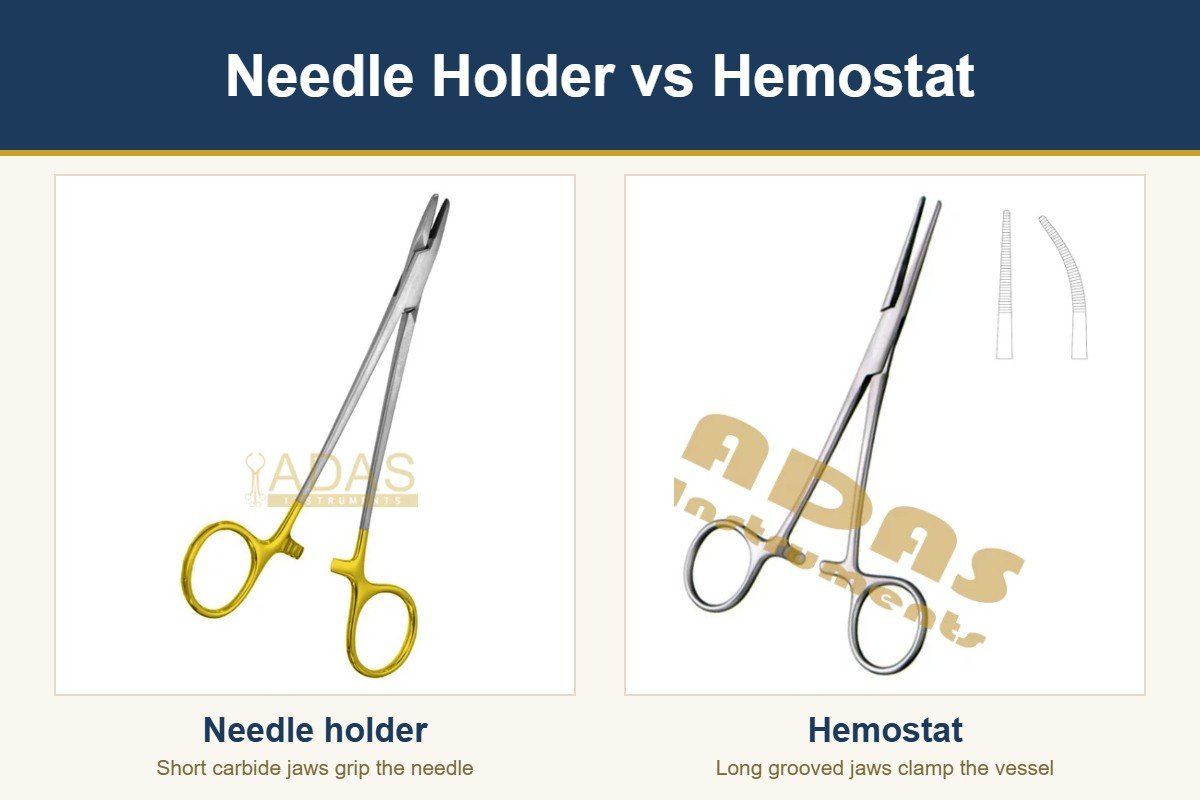
Needle holder vs hemostat comes down to the jaws. A needle holder, also called a needle driver, has short, wide jaws with a cross hatched grip, often on a tungsten carbide insert, made to hold a curved suture needle without letting it turn. A hemostat has long, slim jaws with crosswise grooves, made to clamp a bleeding vessel shut. Adas Instruments makes both in high quality medical grade stainless steel, from a 12.5 cm Webster needle holder to a 16 cm Crile hemostat.
On a tray the two look almost the same: two rings, a box lock, a ratchet. They are built for opposite jobs. If you are stocking a set, buy our plastic surgery needle holders for suturing and our hemostats and grasping forceps for clamping, and do not let one stand in for the other. Below is how to tell them apart in two seconds, and what goes wrong when they get swapped.
Key takeaways
- Look at the jaw first: on a needle holder it is short and wide, on a hemostat it is long and slim.
- A cross hatched pattern grips a needle; crosswise grooves grip a vessel and let a needle roll.
- Gold rings on the handle usually mean a tungsten carbide jaw insert, which is a needle holder feature.
- A hemostat used to drive needles soon springs its tips apart and stops closing fully on a vessel.
What a needle holder is built to do
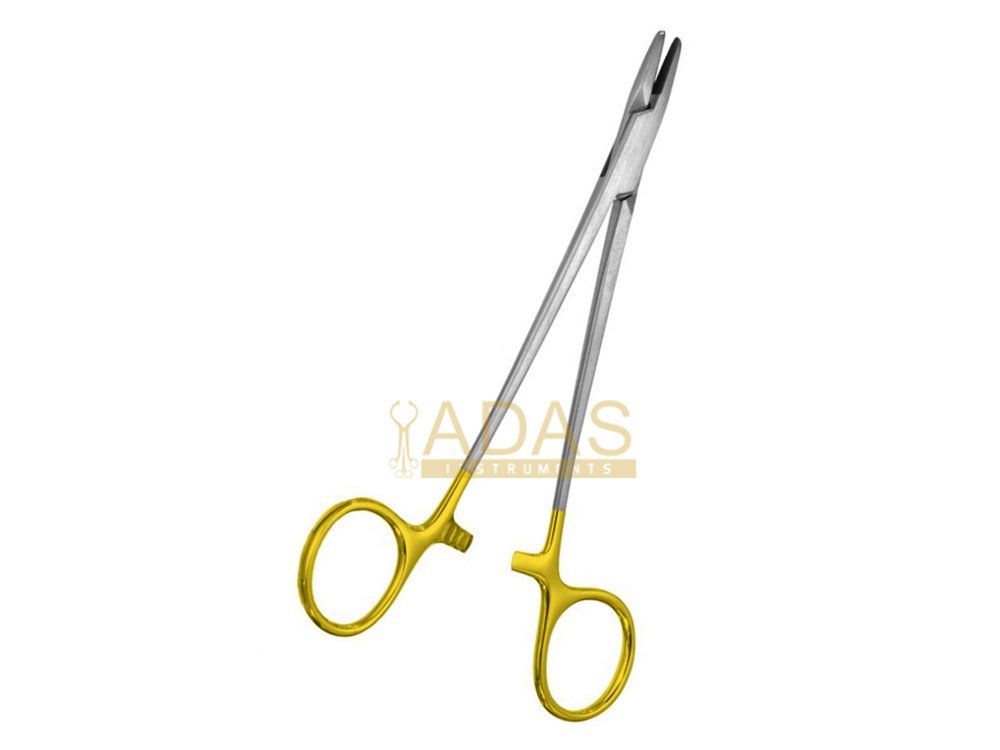
A needle holder has one job: hold a curved needle firmly while the surgeon pushes it through tissue in an arc. The needle is gripped a little behind its middle, toward the thread end, and it must not twist when it meets resistance.
Three things make that possible. The jaws are short compared with the handles, so the hand gets more closing force at the tip. The grip face is cross hatched, a fine diamond pattern that holds a round needle from every side. And on most patterns that face is a tungsten carbide insert, brazed into the steel jaw because carbide is far harder than stainless steel and keeps its pattern much longer. The trade marks those instruments with gold rings, and Adas Instruments follows that rule on every carbide holder it makes.
Not every needle holder is serrated. The Webster has smooth jaws for very fine needles that a coarse pattern would mark, and the Castroviejo comes with smooth, serrated or diamond dust tips on a spring handle.
What a hemostat is built to do
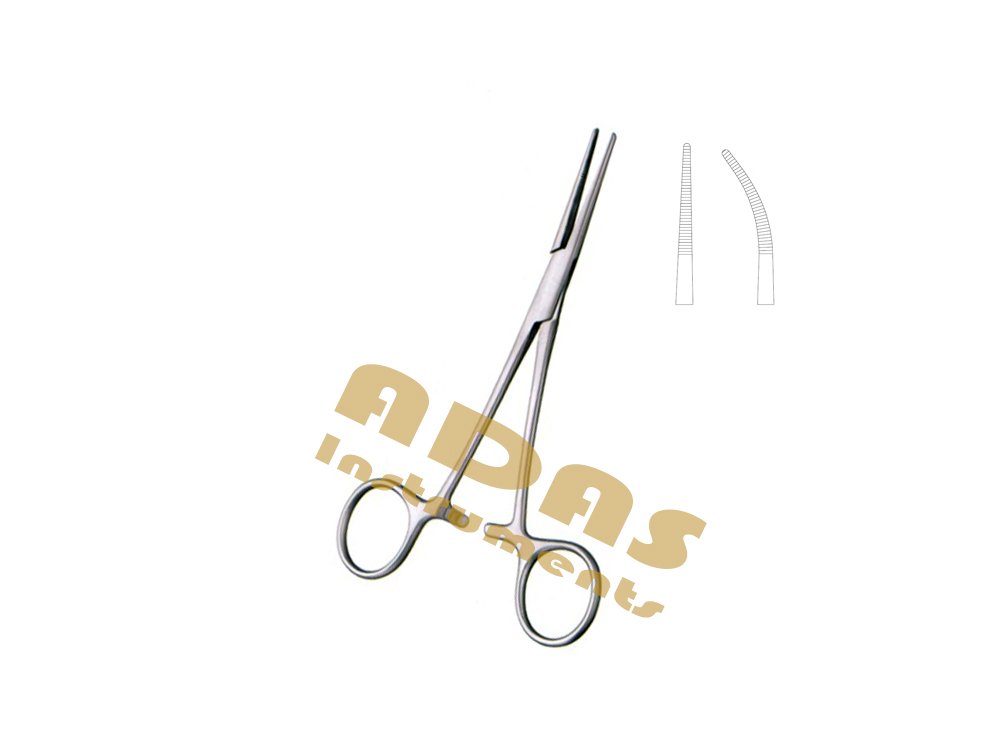
A hemostat clamps a bleeding vessel and holds it shut, hands free, until the surgeon ties or seals it. Its jaws are long and slim so they can reach into a small space and close across a vessel without taking a big bite of the tissue around it.
The grooves run across the jaw, not in a diamond. That pattern stops a slippery vessel from sliding out. How far the grooves run is what separates the patterns: a Kelly is grooved on the lower half of the jaw, a Crile along its full length, and a Halsted mosquito is the small, fine version for little vessels.
Needle holder vs hemostat at a glance
| Feature | Needle holder | Hemostat |
|---|---|---|
| Jaw shape | Short and wide | Long and slim |
| Grip pattern | Cross hatched, or smooth for fine needles | Grooves across the jaw, part or full length |
| Jaw insert | Often tungsten carbide (gold rings) | Plain stainless steel |
| Main job | Drive a curved suture needle | Clamp a vessel or hold tissue |
| Common patterns | Mayo Hegar, Webster, Castroviejo, Olsen Hegar | Halsted mosquito, Crile, Kelly, Rochester Pean |
| Sizes we make | 12.5 cm Webster up to 27.5 cm Mayo Hegar | Crile in 14 cm and 16 cm, straight or curved |
Shop needle holders direct from the maker
20 needle holder patterns in the range, most with tungsten carbide jaws. Mayo Hegar from 15 dollars, Castroviejo from 14 dollars. Wholesale pricing for clinics and distributors, plain or laser marked.
How to tell them apart in two seconds
- Look at the jaw length. If the jaw is about as long as a fingernail and wide, it is a needle holder. If it is long and narrow, it is a hemostat.
- Look at the grip face. A tiny diamond pattern means needle holder. Lines running across the jaw mean hemostat.
- Check the rings. Gold rings almost always mean a carbide insert, and carbide is put on needle holders, not on hemostats.
- Watch for the one exception. The Olsen Hegar is a needle holder with scissor blades behind the jaws, so one instrument can hold the needle and cut the thread.
Why a hemostat should not drive a needle
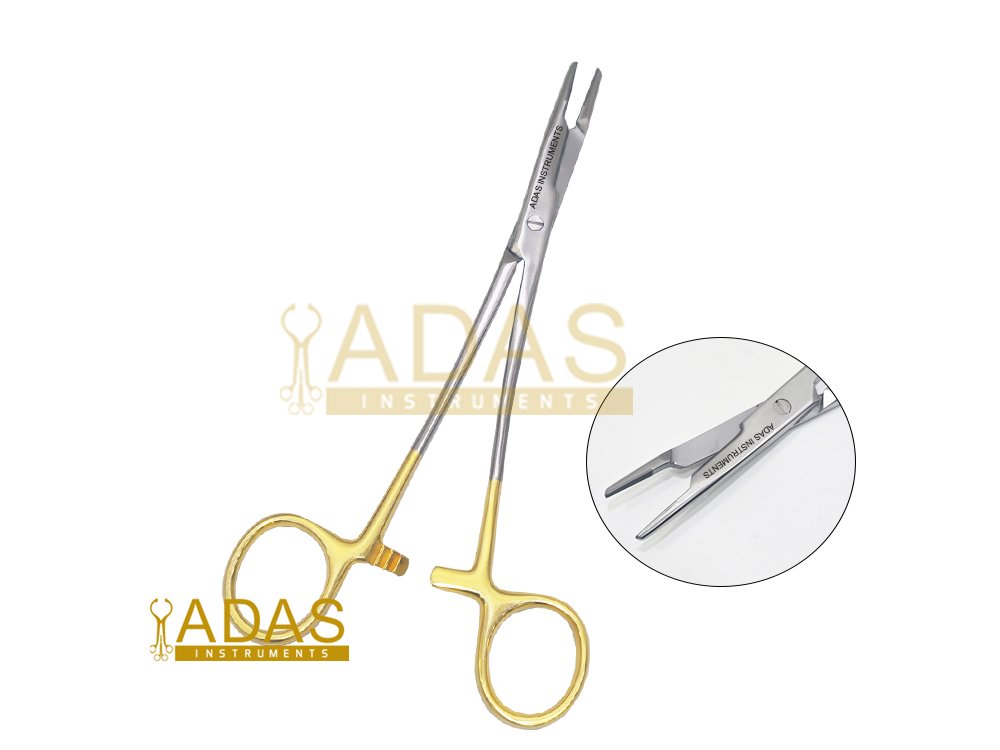
It is tempting when the needle holder is out of reach, and it does work once. The trouble starts after that. The crosswise grooves let a curved needle roll as it meets tissue, so the bite goes in at the wrong angle. The slim jaws flex under the force needed to drive a needle, and every time they do, the tips spring a little further apart.
A hemostat whose tips no longer meet is finished for its real job, because it will not close fully on a vessel. Hold the closed jaws up to a light: if you see a gap at the front, take it out of the set. The reverse swap is no better. A needle holder used as a clamp has jaws too short to reach across a vessel, and its grip is made to hold steel, not soft tissue.
Our view is simple. If a budget forces a choice, cut the number of hemostats on the tray, not the needle holders. A carbide needle holder keeps its grip far longer than a plain jaw, and a surgeon fighting a slipping needle loses more time than any spare clamp saves.
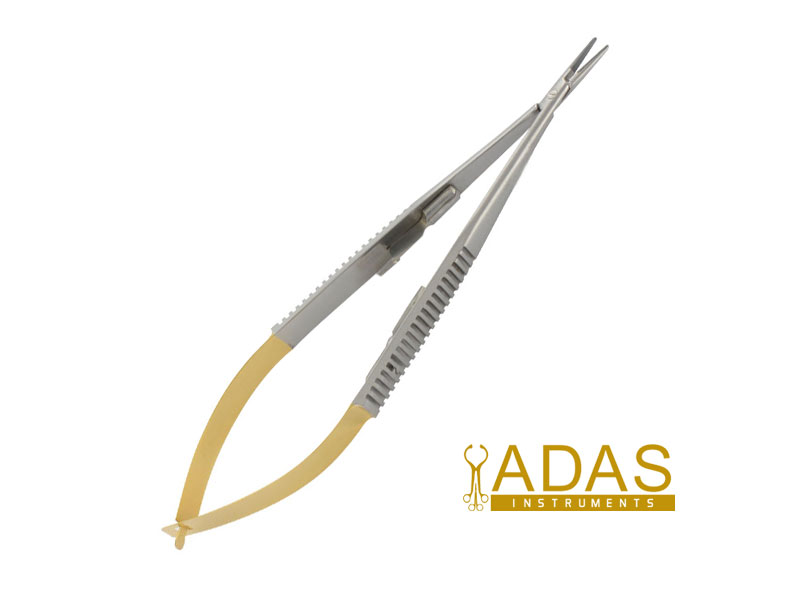
Which needle holder goes with which job
| Pattern | Sizes | Best for |
|---|---|---|
| Mayo Hegar needle holder | 14 cm to 27.5 cm | General closure; the longer sizes for deep layers |
| Webster needle holder | 12.5 cm, smooth jaws | Fine skin closure with small needles |
| Castroviejo needle holder | 14 cm to 23 cm, straight or curved | Eye surgery and microsurgery |
| Olsen Hegar needle holder | 12.5 cm to 19 cm | Suturing and cutting with one instrument |
For every pattern in more detail, see our guide to types of needle holders and the guide to types of hemostats.
Frequently Asked Questions
What is the difference between a hemostat and a needle holder?
A hemostat has long, slim jaws with grooves across them and clamps blood vessels. A needle holder has short, wide jaws with a cross hatched or smooth grip, often tungsten carbide, and holds a curved needle while suturing. They look alike but are built for different jobs.
How do you tell the difference between a needle driver and a hemostat?
Look at the jaws. A needle driver has short, broad jaws with a fine diamond pattern and often gold rings for a carbide insert. A hemostat has long, narrow jaws with lines running across them and plain steel rings.
What is another name for a needle holder?
Needle driver is the other common name, and it is the word most American surgeons and nurses use. Some catalogs also say needle forceps. They all mean the same ring handled instrument with a ratchet that holds a suture needle.
What is the purpose of a needle holder?
A needle holder grips a curved suture needle firmly so the surgeon can drive it through tissue in a clean arc without the needle twisting. The ratchet keeps the needle locked between bites, so the hand can relax without losing it.
Can you use a hemostat as a needle holder?
Only in an emergency. The grooves let the needle roll, and driving needles springs the slim jaws apart until the tips no longer meet, which ruins the hemostat for clamping vessels. Keep a proper needle holder on every tray.
