
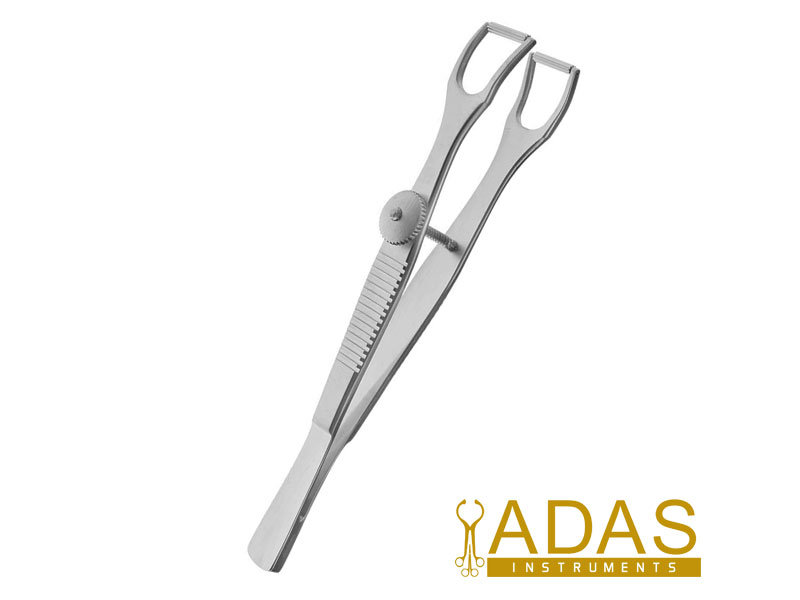
Cottle Columella Forceps, Roller Tips with Adjustment Screw
$ 22.50
Cottle columella forceps are a nasal instrument that holds the columella and the caudal septum aside so the surgeon can see and work behind them. The jaws are 11 mm wide and fenestrated, the roller tips that give the pattern its name, and an adjustment screw locks the jaw width so the grip holds itself rather than needing a hand on it. That is why it sits on septoplasty, septorhinoplasty and turbinate trays, where the structure being moved is also the one that must not be marked.
Key Features
- 11 mm wide fenestrated roller tips
- Adjustment screw locks the jaw width for a self retaining hold
- 4 3/8 in overall, about 11 cm
- Spring handle, no ratchet and no ring handles
- High quality medical grade stainless steel, passivated and boil tested
- Satin finish, no glare under an operating room lamp
- Reusable and fully autoclavable
- Item code AC-130.10
10 in stock (can be backordered)

What Cottle columella forceps are
Cottle columella forceps are a short nasal instrument built to do one thing: take hold of the columella and the caudal septum, move them aside, and keep them there. The jaws are 11 mm wide and fenestrated, which is where the name roller tips comes from, and an adjustment screw locks the jaw width so the hold is self retaining. They are made by Adas Instruments, reusable and fully autoclavable.
The pattern carries the name of Maurice Cottle, who did much to establish modern septal surgery. Catalogs also list it as a cottle columella clamp, as cottle nasal columella forceps and simply as a columella clamp, and orders arrive under all of them. The clamp forms are searched more often than the forceps form.
Calling it a forceps undersells it slightly. A thumb forceps holds while your fingers press. This one is set and then let go of, which is a clamp’s behaviour, and that difference is the reason it exists.
Why the tips are wide, and why that is the whole design
This is the part worth understanding before ordering.
The columella is cartilage covered in thin skin, and it sits at the front of the nose where every result is visible. It has to be pulled firmly enough to expose what is behind it, and it cannot be marked while that happens. Those two requirements pull against each other.
A narrow tip solves the first and fails the second: all the force lands on two small points and cartilage remembers a crush. Two 11 mm rings spread the same pull across a wide face, so the tissue is held by friction rather than compressed, and the fenestration means the surgeon can still see the tissue inside the grip.
- 11 mm fenestrated tips. Load spread wide, tissue still visible.
- Adjustment screw. The jaw width locks, so the hold repeats.
- Self retaining. The hand that was holding it is freed.
- Short, 4 3/8 in. The work is just inside the nostril.
The measurements, and what each one is for
Every figure here is a figure we build to.
| FEATURE | WHAT IT MEASURES | WHY IT IS THAT WAY | ITEM CODE |
|---|---|---|---|
| Roller tip width | 11 mm | Wide enough to hold cartilage by friction, not by point pressure | AC-130.10 |
| Tip form | Fenestrated, two rings | The opening lets the surgeon see the tissue being held | AC-130.10 |
| Overall length | 4 3/8 in, about 11 cm | Short, because the work is just inside the nostril | AC-130.10 |
| Adjustment screw | Locks jaw width | Makes the hold self retaining and repeatable | AC-130.10 |
| Handle | Spring, no ratchet | Opens on release, no ratchet to free mid case | AC-130.10 |
Nothing is listed there that we do not make. The item code is AC-130.10 and the pattern ships as one build, so there is no jaw option to specify on this one.
Where these are used
Cottle columella forceps go where the nose has to be held open from the inside.
| SPECIALTY | WHAT THE FORCEPS IS DOING THERE |
|---|---|
| Rhinoplasty and septorhinoplasty | Columella held aside to expose the caudal septum |
| Septoplasty | Septal deviation worked on with the columella retracted |
| Otolaryngology and ENT | Endonasal access held open without a second pair of hands |
| Turbinate surgery | Structures pulled aside so turbinate tissue can be reached |
| Facial plastic surgery | Nasal tip work where symmetry has to be judged |
| Nasal fracture repair | Displaced structures held while they are set |
| Teaching hospitals | A self retaining hold teaches steady traction |
The pattern does not travel far outside the nose, and that is honest rather than a weakness. It was designed around one anatomical structure, and instruments built that specifically tend to be the right instrument for that structure and no use anywhere else.
What you are holding, and what the instrument does with it
Read this the other way round from a normal jaw table. Here the tissue is fixed and the question is what the instrument does to it.
| WHAT YOU ARE HOLDING | WHAT THE INSTRUMENT DOES | WHY IT MATTERS |
|---|---|---|
| Columella | Held between two broad fenestrated rings | Cartilage marks under a narrow tip |
| Caudal septal margin | Drawn to one side and held there | The view behind it is the point |
| Septal cartilage | Steady traction without a pinch | Cartilage remembers a crush |
| Caudal septal skin flap | Broad face spreads the load | Thin skin tears on a point |
| Nasal tip structures | Positioned and held for judging symmetry | Both hands stay free |
| Displaced nasal structures | Held while they are set | The screw keeps the position |
| Nothing dense or scarred | Ask for a toothed forceps instead | This jaw grips by friction, not by teeth |
One thing this instrument is wrong for. Dense or scarred tissue that has to be pulled apart needs teeth, and a fenestrated ring will simply slide. Ask for a toothed pattern for that work.
How it compares with the neighbours
These are the instruments buyers weigh against each other before the order goes in.
| INSTRUMENT | JAW AND MECHANISM | WHEN YOU REACH FOR IT |
|---|---|---|
| Cottle columella forceps | 11 mm fenestrated rings, adjustment screw | Holding the columella aside and leaving it held |
| Adson forceps | Narrow 1×2 teeth, finger pressure only | Taking a skin edge at the surface |
| Gillies dissecting forceps | Slim 1×2 teeth or serrated, 15 cm | Skin edges in a deeper or narrower field |
| Cushing bayonet forceps | Offset shank, 19 cm, carbide faces | Deep nasal or cranial work down a line of sight |
| Dressing thumb forceps | Plain serrated jaw, many lengths | Dressings and packing, no retraction |
The comparison buyers actually make is against an adson forceps, because both end up in the same nasal tray. They are not alternatives. An Adson takes a skin edge between narrow teeth under finger pressure; this takes one named structure between broad rings and holds it without you. For work deeper in the nose along a line of sight, a cushing bayonet forceps is the instrument, not this one.
Materials and finish
Every pair of cottle columella forceps is made in high quality medical grade stainless steel. Every pair is passivated and boil tested before packing, and the finish is satin rather than mirror so there is no glare inside a lit nostril.
On this pattern the screw is what has to be checked, because it is the only moving part and it carries the whole design. It should turn smoothly, hold its setting under load, and not creep as the case goes on. Set it, pull against it, and check the jaw width has not changed before each list.
Care and sterilization
Rinse in cool water straight after use so nothing dries in the fenestrations, which is the one place on this instrument that traps tissue. Clean with a neutral pH enzymatic detergent and an ultrasonic bath, work the screw through its range while it is wet, rinse in deionized water, dry fully, then steam autoclave at 134 degrees Celsius.
Store the instrument with the jaws open and the screw backed off, so the spring is not held under tension between cases. Retire any pair whose screw no longer holds a setting, because a clamp that will not stay set is not doing the job it was bought for.
Ordering and wholesale
Cottle columella forceps are supplied by Adas Instruments to hospitals, surgical distributors and OEM buyers, in single units and in bulk. The item code is AC-130.10 and it is printed in the measurement table above so a procurement search finds it. Backorder items dispatch in 10 to 12 working days, and every instrument carries a three year replacement against manufacturing defects.
For wholesale and OEM orders, instruments ship unpackaged in bulk or individually poly bagged, and laser marking with a distributor code or a hospital asset number is available on the handle. Tell us the quantity and the quotation comes back with the lead time for that run.
Production is controlled under an ISO 13485 quality management system.
Frequently asked questions
What are Cottle columella forceps used for?
Holding the columella and the caudal septum to one side so the surgeon can see and work on what is behind them. That is the whole job, and it is why the pattern turns up in septoplasty, in septorhinoplasty and in turbinate work, where the structure that has to move out of the way is also the structure you must not damage.
What is the purpose of the roller tips?
Spreading the load. The tips are 11 mm wide and fenestrated, so instead of two points pressing into cartilage they present two broad rings. The columella is held by friction across a wide face rather than pinched, which is what lets the surgeon pull steadily on tissue that would mark under a narrow tip.
What does the adjustment screw do?
It locks the jaw width, so the instrument holds its own grip. Set the screw and the forceps becomes self retaining: the columella stays retracted without a hand on it and without the pressure creeping up as the case goes on. That frees the hand that was holding it.
How is a Cottle columella forceps different from an Adson?
Completely different intent. An Adson has narrow toothed jaws for taking a skin edge and it is held closed by your fingers. A Cottle has broad fenestrated jaws and a screw, and it is built to take one specific structure and keep holding it. Point pressure from a narrow tip is exactly what you are avoiding here.
What is the overall length?
4 3/8 inches, about 11 cm, which is short on purpose. Everything this instrument does happens just inside the nostril, so length would only put more of the instrument between the surgeon and the field.
Related products and categories
Buyers usually pair cottle columella forceps with a dressing thumb forceps for the packing that follows. The pattern sits in rhinoplasty instruments, and it is also listed under dressing and tissue forceps.
| Weight | 0.05 kg |
|---|
Be the first to review “Cottle Columella Forceps, Roller Tips with Adjustment Screw”
Shipping & Delivery Policy
Processing Time: In-stock items are dispatched within 24-48 hours. For custom or out-of-stock items, production time is approximately 10-15 days.
Global Delivery Estimates
We partner with world-class couriers (DHL, FedEx) to ensure fast, tracked delivery.
- USA & Canada: 3-5 Business Days
- Europe & UK: 4-6 Business Days
- Rest of World: 5-7 Business Days
*We offer Air Cargo and Sea Freight options for bulk wholesale orders.
Customs & Duties
International buyers are responsible for any customs duties or taxes imposed by their country. Adas Instruments is not responsible for delays caused by customs clearance.
Lost Packages & Insurance
If your package is lost in transit, please contact us immediately. We offer full support and replacements for confirmed lost shipments. Note: You must report non-delivery within 3 weeks to be eligible for an insurance claim.
Related products
Reviews
There are no reviews yet.