

Surgical Ruler Graduated in mm and Inches | Stainless Steel Measuring Ruler
Price range: $ 12.00 through $ 25.00
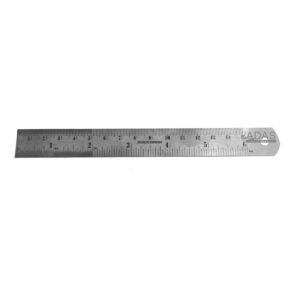
The surgical ruler is a flat steel rule graduated in millimeters along one edge and inches along the other, for the straight measurements a surgeon takes before and during a case: a wound, a graft, an incision length, the gap between two marks. It is reusable steel rather than a sterile disposable, so the rule that measured a graft last month is the same rule measuring one today. We finish it in satin, gold plating or black titanium, and the satin version is the one most people order because it does not throw an overhead light back at the field.
Key Features
- Graduated in millimeters on one edge and inches on the other
- Flat steel rule, reusable and fully autoclavable
- Graduations etched, not printed
- Finish options: satin, gold plating, black titanium
- Cut from high quality medical grade stainless steel
- No ink, no cartridge, nothing to replace
- Three year replacement warranty against manufacturing defects
- Item code AA-31.06

What a surgical ruler is
It is a ruler. There is no mechanism to explain and no eponym attached to it, which makes it the plainest product in this category and the one most likely to be bought by somebody who has never heard of us. So the only things worth saying about it are the things that are actually different from the next ruler along.
It is steel, so it goes through the autoclave with everything else and comes back. The graduations are cut into the metal rather than printed on it, so they are still there in five years. Both scales are on the same rule, millimeters one side and inches the other, because a unit that documents in one and orders in the other should not need two rules. It is an instrument that carries the measurement, so the surgeon brings the judgement and the steel holds the number.
One more thing is worth saying plainly, because it is the question a stranger asks first. At 12 dollars this is not the cheapest surgical ruler available and we are not pretending otherwise. A sterile single use rule in plastic or card costs well under a dollar and a steel rule from a catalogue house starts around 7 dollars. What the extra buys is an etched scale instead of a printed one, and a rule that is still flat and still readable after five years of cycles.
It goes by several plain names and they all mean this. A surgical metal ruler, a metal surgical ruler, or in wound care simply a skin ruler. The only one of those we would quarrel with is the disposable sort, because a skin ruler in card is a different product at a different price.
Key design features
Both scales, one rule
It is a surgical ruler mm and inches on the same piece of steel: millimeters along one edge, inches along the other. US units have not gone away in a theater that documents a wound in centimeters and buys a dressing by the inch, and carrying both scales on one rule is cheaper and faster than carrying two.
Etched, not printed
A printed scale on a reusable instrument fades, and a half faded scale is worse than no scale because people keep reading it. Ours are cut into the surface. They will wear with the steel and not before it.
Three finishes, and why satin wins
Satin kills the reflection. A polished rule held flat under an overhead light puts a bright line across the field at the exact moment somebody is trying to read a graduation off it. Gold plating makes the rule easy to spot on a crowded tray, and black titanium does both jobs at once and also marks a set as belonging to one surgeon.
Steel against a disposable
Single use sterile rules, in plastic or card, cost well under a dollar and are the right answer at a bedside. In an operating room where the tray is already being sterilized, a steel rule is one fewer item to stock, one fewer thing to open, and nothing to throw away.
Which finish to order
One size of rule, three finishes, and the choice is about light and about finding it on a tray.
| Finish | Why people choose it | Note |
|---|---|---|
| Satin | No reflection under an overhead light | The most ordered finish |
| Gold plating | Easy to find among flat instruments | Plating stops short of the graduations |
| Black titanium | No reflection, and marks a set as one surgeon’s | Also the strongest contrast for photography |
| Any of the three | All measure identically | The finish is applied after the scale is cut |
Where it is used
Everywhere, which is both its strength and the reason it is easy to overlook when a tray is being specified.
| Setting | What gets measured | Why steel rather than a disposable |
|---|---|---|
| Plastic and reconstructive surgery | Graft dimensions, flap length, incision length | It is already on the sterilized tray |
| Wound assessment | Wound length, width and the gap between margins | A repeatable rule rather than a fresh one each time |
| Dermatology and minor surgery | Lesion size before and after excision | Documented measurements that match over months |
| Rhinoplasty and facial work | Cartilage graft dimensions | Small figures, read off an etched scale |
What it measures, and what it must not do
Nothing here is complicated. The last row is the one that costs money when it is ignored.
| The task | What the ruler does | What it must not do |
|---|---|---|
| Straight distances | Gives a figure in millimeters or inches | It does not follow a curve. A caliper does that |
| Graft sizing | Measures the graft and the bed it is going into | It is not a cutting surface. A grid plate is |
| Documentation | Gives a figure that will match the next one taken the same way | A figure read off a bent rule is not a measurement |
| Being on the tray | Goes through the autoclave with everything else | It is never used to lever, scrape or pry anything |
How it compares with the rest of the family
Four instruments in this category give you a number, and the ruler is the one for straight lines.
| Instrument | What it measures | Our price |
|---|---|---|
| Surgical ruler | Straight distances, mm and inches | 12 dollars |
| Castroviejo caliper | Two point distances up to 20 mm, around and behind things | 24.50 dollars |
| Ginsberg caliper | Two point distances up to 40 mm | 32 dollars |
| Sheen grid plate | Cartilage graft dimensions, on a surface you can cut on | 15 dollars |
Materials and finish
Every surgical ruler we make is cut from high quality medical grade stainless steel. The steel itself is made to a German specification. We do not publish a grade number. The number on a certificate tells a surgeon nothing about whether the etched graduations are still readable after five years of autoclave cycles, and the answer to that is in the making rather than in the alloy.
The rule is cut flat and stays flat, which sounds obvious and is the single most common fault in a cheap steel rule. A rule with a slight bow in it reads long, because the distance along the curve is not the distance between the two points.
The ends are finished square and deburred. A ruler is the one instrument on a tray that gets picked up by the middle and used by the end, and a sharp end on a flat instrument finds a glove.
The finish goes on after the scale is cut, so a gold or black titanium rule measures exactly what a satin one does. Nothing is plated into a graduation, because a filled graduation is a graduation that cannot be read at a glance.
Caring for it
Clean the graduations, not just the faces. Dried fluid in an etched line is what makes an otherwise good rule unreadable. Warm water and a soft brush along the length of the scale, never across it.
Autoclave it with the rest of the tray. Store it flat. A steel rule kept standing in a jar with other instruments acquires a bow within a year, and a bowed rule reads long for the rest of its life without ever looking broken.
Ordering and wholesale
The surgical ruler is made in our own workshop and sold direct, which is why the price sits where it does against the catalogue houses. Order one for a single tray, or in quantity for a hospital list or a distributor line. We do OEM work under your own brand and your own item numbers. Send us a sample and we will hold a run to your pattern rather than ours. Stock items ship from our own workshop. Backorder items take 10 to 12 working days to make. Every instrument carries a three year replacement warranty against manufacturing defects. Production is controlled under an ISO 13485 quality management system.
Frequently asked questions
What is a surgical ruler used for?
Taking straight measurements before and during surgery: wound length and width, graft dimensions, incision length, lesion size, and the distance between two marks on skin. It is the instrument for anything measured in a straight line.
Do you prefer a reusable metal ruler or a disposable plastic one?
Steel in an operating room, where the tray is already being sterilized and a reusable rule is one fewer item to stock. Disposable at a bedside or in a clinic where there is no autoclave in the workflow. Ours is the steel answer.
Is the surgical ruler graduated in mm or in inches?
Both, on the same rule. Millimeters along one edge and inches along the other, so a unit that documents in one and orders in the other does not need two instruments.
Is a steel surgical ruler autoclavable?
Yes, and it is designed for it. There are no moving parts, no coating over the graduations and nothing to trap moisture, so it goes through a standard cycle with everything else on the tray.
What does a surgical ruler cost?
Ours is 12 dollars. Single use plastic and card rules run well under a dollar each and steel rules from other suppliers start at about 7 dollars, so this is not the cheapest rule on the market and it is not meant to be. What you are paying for is an etched scale that is still readable in five years.
Related products and categories
For a distance that runs around or behind something rather than in a straight line, the Castroviejo caliper 20mm and the Ginsberg caliper 0-40mm are the two point instruments. When a cartilage graft has to be measured and then cut, the Sheen grid plate does both on one surface.
The rest of the family sits under marking and measuring instruments, and the wider set for this kind of work is under facelift and neck lift instruments.
| Weight | 0.02 kg |
|---|---|
| Select Color Option | Black Titanium Coloring, Gold Plating, Satin finish |
Be the first to review “Surgical Ruler Graduated in mm and Inches | Stainless Steel Measuring Ruler”
Shipping & Delivery Policy
Processing Time: In-stock items are dispatched within 24-48 hours. For custom or out-of-stock items, production time is approximately 10-15 days.
Global Delivery Estimates
We partner with world-class couriers (DHL, FedEx) to ensure fast, tracked delivery.
- USA & Canada: 3-5 Business Days
- Europe & UK: 4-6 Business Days
- Rest of World: 5-7 Business Days
*We offer Air Cargo and Sea Freight options for bulk wholesale orders.
Customs & Duties
International buyers are responsible for any customs duties or taxes imposed by their country. Adas Instruments is not responsible for delays caused by customs clearance.
Lost Packages & Insurance
If your package is lost in transit, please contact us immediately. We offer full support and replacements for confirmed lost shipments. Note: You must report non-delivery within 3 weeks to be eligible for an insurance claim.
Related products



Reviews
There are no reviews yet.