Skin Hooks: Types, Uses and How to Choose One
Oct
Skin hooks are small hand held retractors with one or two fine prongs that lift and hold a skin edge under tension without crushing it the way forceps do. Plastic, oculoplastic, dermatologic and ENT surgeons use them for wound closure, flap elevation and rhinoplasty. Adas Instruments makes them in high quality medical grade stainless steel, from the 12 cm and 18 cm Gillies single hook to the Guthrie double hook, with sharp or blunt prongs.
All of the patterns below sit in our hooks and retractors range. This guide sorts them by the one decision that matters most, the number and shape of the prongs, and then by the procedure each one suits.
Key takeaways
- A single hook gives one precise point of pull; a double hook spreads the same pull over two points and tears thin skin less.
- Sharp prongs hold a dermal edge for closure; blunt or ball tips are for working next to nerves, vessels and thin flaps.
- The Gillies hook comes in two lengths, 12 cm for facial work and 18 cm for deeper reach.
- Buy hooks in fours, not ones: the surgeon and the assistant each need a pair.
Why Surgeons Use a Hook Instead of Forceps
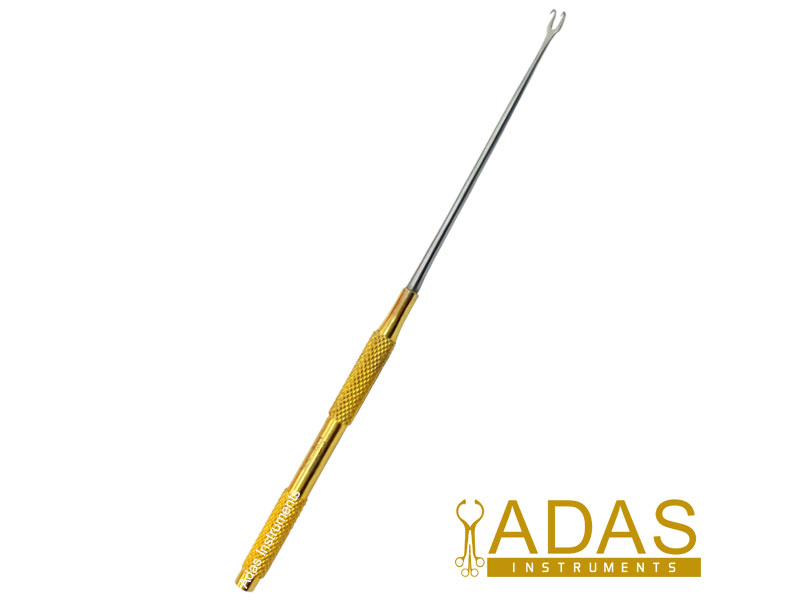
Forceps hold tissue by squeezing it. On skin that will become a visible scar, that squeeze bruises the edge, and a bruised edge heals wider. A hook holds by tension alone. The prong goes into the dermis just under the surface, the surgeon pulls, and the edge lifts without any part of it being crushed.
That is the whole case for the instrument, and it is why a plastic surgery tray often carries more hooks than toothed forceps. It also explains the main rule of use: a hook holds an edge, it does not hold a flap. Ask one fine point to carry the weight of a raised flap and it will tear the dermis it was meant to protect.
Single Hooks: Gillies, Joseph and Micro Dermal
The Gillies skin hook is the pattern most people mean by the word. Named after Sir Harold Gillies, it has one sharp prong bent back on a slim shaft. We make it in 12 cm and 18 cm, with a 2.5 mm or 5 mm hook. The shorter one suits facial and hand work, where the surgeon wants the hand close to the field. The longer one reaches into a deeper wound without the knuckles getting in the way.
The Joseph hook is the other name that comes up again and again, especially in rhinoplasty and eyelid work. It is a straight, fine pattern made with one or two prongs, and many nasal trays carry both.
At the smallest end, the micro dermal single hook has one very fine prong, sharp or blunt, for work where a standard hook is too much instrument: lip borders, small flaps, and the edge of a punch biopsy that has to be lifted so the base can be cut cleanly.
Double Hooks: Guthrie, Swivel Ring and Tenaculum
The Guthrie double skin hook puts two prongs side by side. The pull is shared across two points, so a long or thin edge lies flat instead of tenting at one spot. That is why it is the usual choice for eyelid skin and closure lines on the face. We make it with sharp or blunt prongs.
Two variations solve specific problems. The swivel ring double hook has a finger ring that turns through a full circle, so the direction of pull can change without the prongs leaving the tissue. The nasal tenaculum hook has two sharp prongs at 6, 7 or 9 mm spacing for holding nasal soft tissue under steady traction.
Skin Hook Types at a Glance
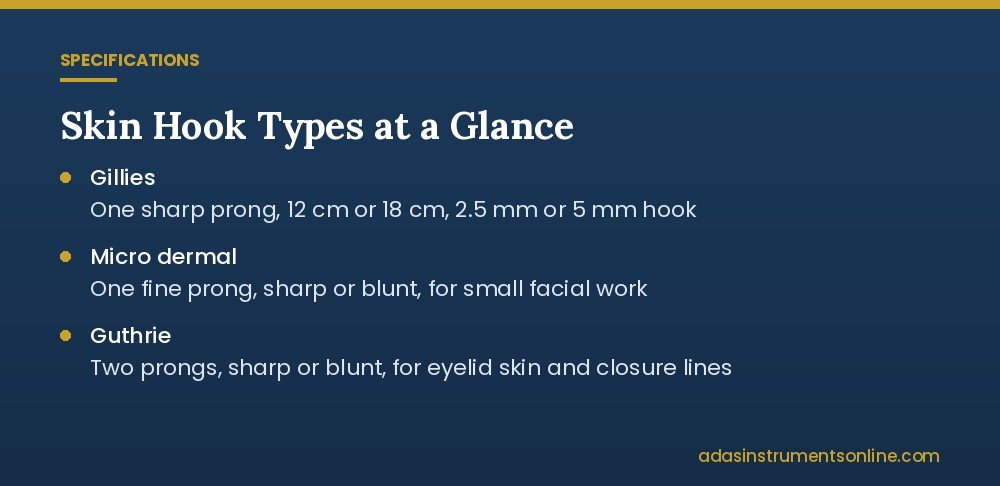
Every row in this table is a pattern we make, with the sizes and tips listed on its product page.
| Pattern | Prongs | Tip | Sizes we list | Typical use |
|---|---|---|---|---|
| Gillies skin hook | 1 | Sharp | 12 cm or 18 cm; 2.5 mm or 5 mm hook | Lifting a wound edge, general plastic surgery |
| Micro dermal (McCoy) | 1 | Sharp or blunt | One size | Fine facial work, small flaps, biopsy edges |
| Guthrie skin hook | 2 | Sharp or blunt | One size | Eyelid skin, facial closure lines |
| Swivel ring double hook | 2 | Sharp | Rotating finger ring | Changing the pull without letting go |
| Nasal tenaculum hook | 2 | Sharp | 6, 7 or 9 mm prong spacing | Holding nasal soft tissue |
| Cottle ball end hook | 1 | Blunt ball | 8 mm or 10 mm | Nasal soft tissue near the septum |
| Millard thumb hook | 1 | Fine | Thumb ring grip | Alar rim traction in rhinoplasty |
Sharp or Blunt: Choosing the Tip
Sharp prongs are for skin edges. They take a small, secure bite of dermis and hold it through closure. Blunt prongs and ball ends are for tissue that must not be punctured: flaps with a thin blood supply, work near nerves, and the inside of the nose. A ball end spreads the load over a rounded face, so it can lean against soft tissue all through a case without marking it.
Our view, from what comes back for replacement: buy sharp hooks for the surgeon and at least one blunt pair for the assistant. Assistants hold traction for longer and with less sight of the tip, and a blunt prong forgives that.
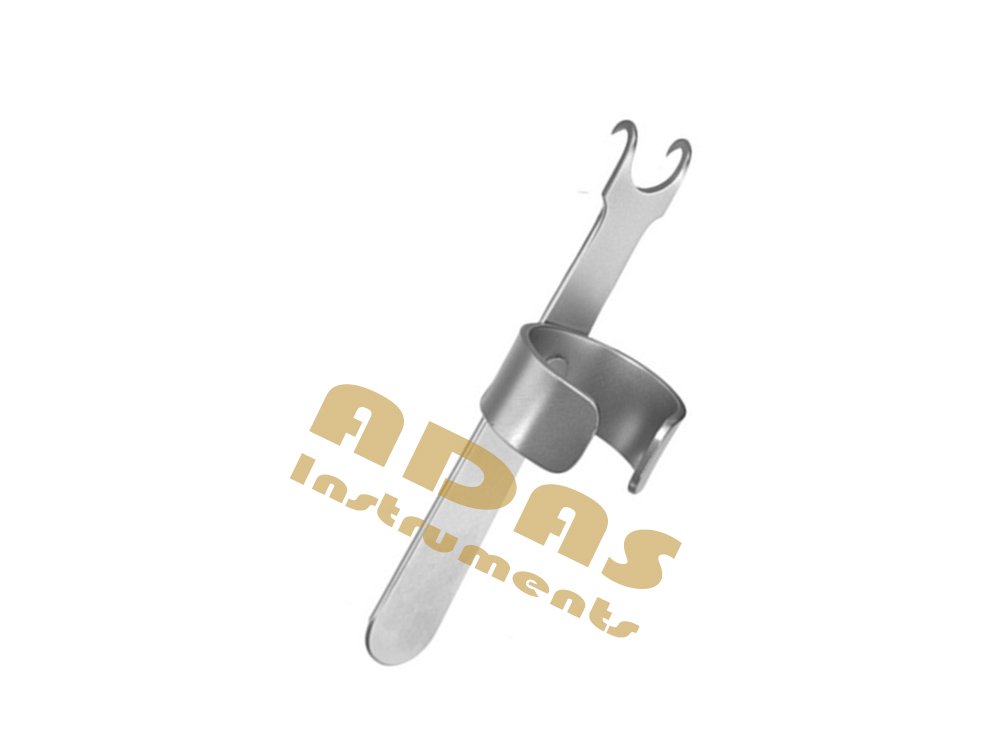
Shop skin hooks direct from the maker
Gillies, Guthrie, micro dermal and swivel ring patterns, made in the Adas Instruments workshop with sharp or blunt prongs. Micro dermal hooks from 16 dollars, Gillies from 18 dollars. Single pieces or tray quantities, plain or laser marked.
Skin Hook Uses by Procedure
| Procedure | Hooks that suit it |
|---|---|
| Facial wound closure and scar revision | Gillies 12 cm, Guthrie, micro dermal |
| Blepharoplasty | Guthrie with fine prongs, micro dermal |
| Rhinoplasty and septoplasty | Joseph single and double, nasal tenaculum, Cottle ball end, Millard thumb hook |
| Facelift skin edges | Guthrie, swivel ring double hook; a flap retractor for the flap itself |
| Dermatology and punch biopsy | Micro dermal or a fine single hook to lift the specimen |
For eyelid trays, the finest patterns are grouped under blepharoplasty instruments; nasal hooks sit with our rhinoplasty instruments. When a whole flap has to be held up rather than an edge, move to a smooth blade such as the Freeman flap retractor; our guide to surgical retractor types covers that wider family.
What Goes Wrong With Skin Hooks
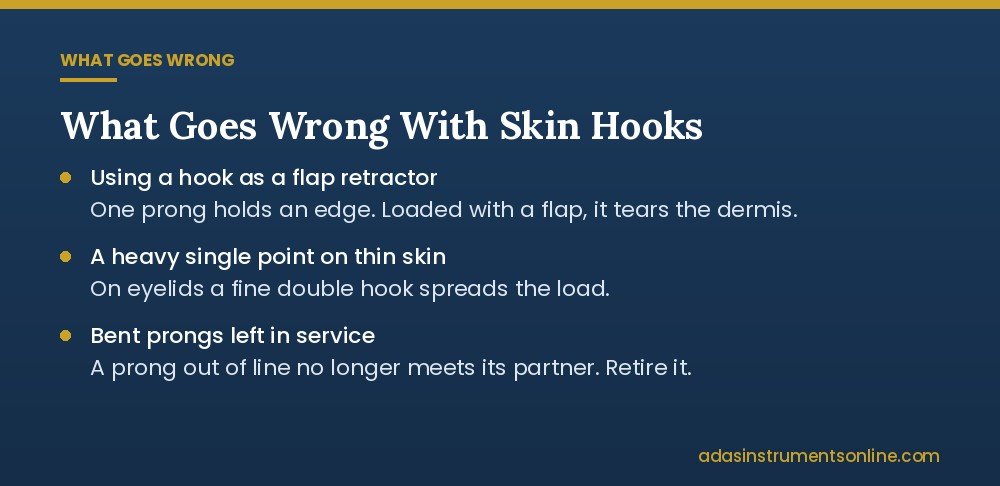
- Using a hook as a flap retractor. One prong holds an edge. Loaded with a flap, it tears the dermis.
- A heavy single point on thin skin. On eyelids a fine double hook spreads the load and leaves no visible entry mark.
- Bent prongs left in service. On a double hook, a prong levered out of line no longer meets its partner. Hold it against the light and retire it.
- Loose hooks in the tray. Unprotected points blunt themselves and scratch the instruments around them. Use tip guards.
Looking After the Points
Skin hooks rarely fail in use. They fail in the cleaning basket, where the points knock against heavier steel. Clean them in a tray that keeps them apart, check each point under magnification during reprocessing, and steam sterilize them with the rest of the set; our autoclaving guide gives the cycle times. A point that has rolled over catches and tears instead of holding. For the clinical side, this NIH paper on skin hook use in skin surgery is a useful read.
Frequently Asked Questions
What is a skin hook used for?
A skin hook lifts and holds the edge of a wound or a small flap under tension so the surgeon can see underneath and place sutures. It holds by tension instead of squeezing, so the skin edge is not crushed and heals with a finer scar.
What is the difference between a single and a double skin hook?
A single hook, such as the Gillies, pulls on one point for precise lifting. A double hook, such as the Guthrie, shares the pull between two prongs, which keeps a longer or thinner edge flat and tears it less.
Are blunt skin hooks better than sharp ones?
Neither is better in every case. Sharp prongs hold a dermal edge securely during closure. Blunt prongs and ball ends are chosen beside nerves and fragile flaps, and inside the nose, where a sharp point could puncture tissue.
What length of Gillies skin hook should I buy?
The 12 cm Gillies hook suits facial and hand work where the hand stays close to the field. The 18 cm version reaches into deeper wounds. Many plastic surgery trays carry both lengths.
How many skin hooks does a plastic surgery tray need?
Four is a practical minimum: a pair for the surgeon and a pair for the assistant. Busy facial practices often carry six to eight across sharp and blunt tips, so a damaged hook can be swapped without stopping the case.
