
Lighted Retractors: How Fiber Optic Blades Work and Which to Choose
Oct
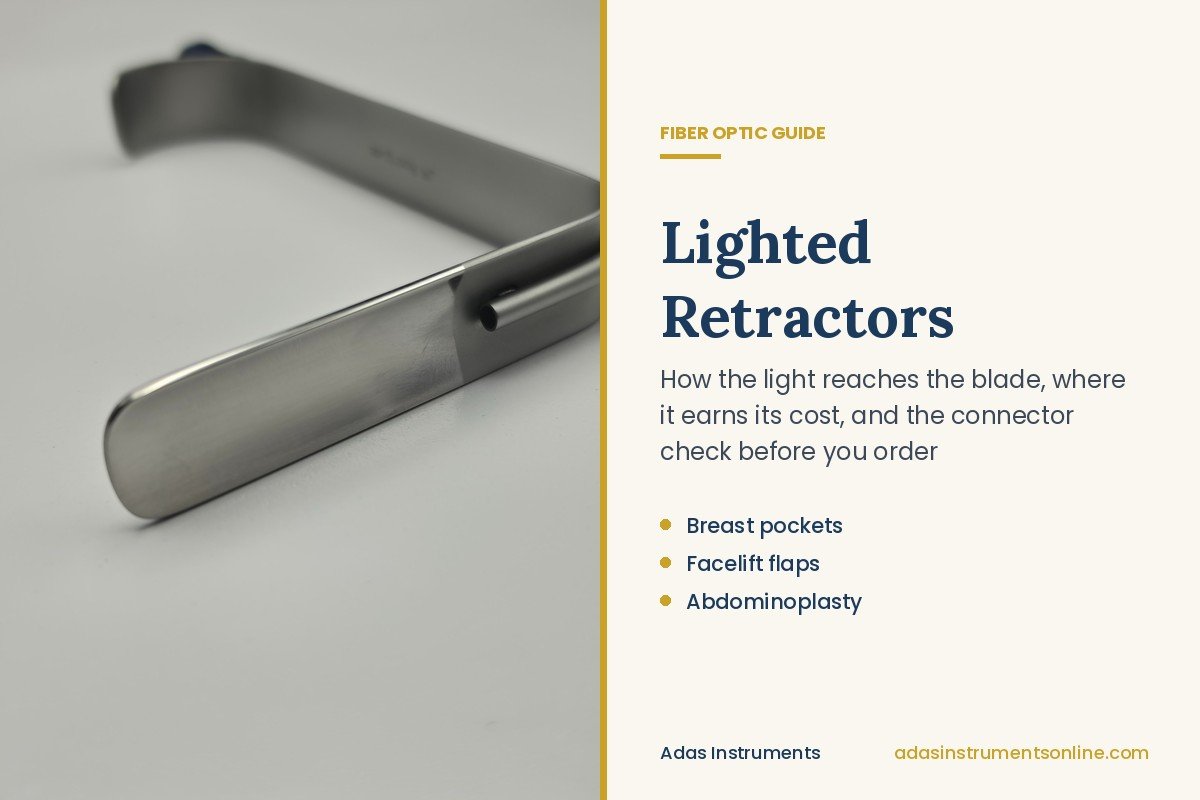
A lighted retractor is a hand held retractor with a fiber optic light carrier built into or along its blade, so light from the theatre light source comes out where the blade is working. Surgeons use them in deep pockets under a flap, mainly in breast augmentation, facelift and abdominoplasty. Adas Instruments makes more than a dozen lighted patterns in high quality medical grade stainless steel, from the 65 mm Engler breast blade to the 19 cm Tebbetts, and most come with or without the light.
Every pattern named in this guide is listed in our fiber optic instruments range. The sections below explain how the light gets to the blade, where it earns its cost, and what to check so the retractor actually connects to the light source in your theatre.
Key takeaways
- The light carrier ends at the blade, so the beam follows the blade into the pocket instead of following the surgeon’s head.
- There is nothing electrical inside a lighted retractor, which is why it goes through the steam autoclave like any other steel instrument.
- Check the connector on your light cable before ordering. A good retractor that will not fit the cable in the room is useless.
- For breast pockets, suction on the same blade clears cautery smoke, which matters as much as the light.
How a Lighted Retractor Works
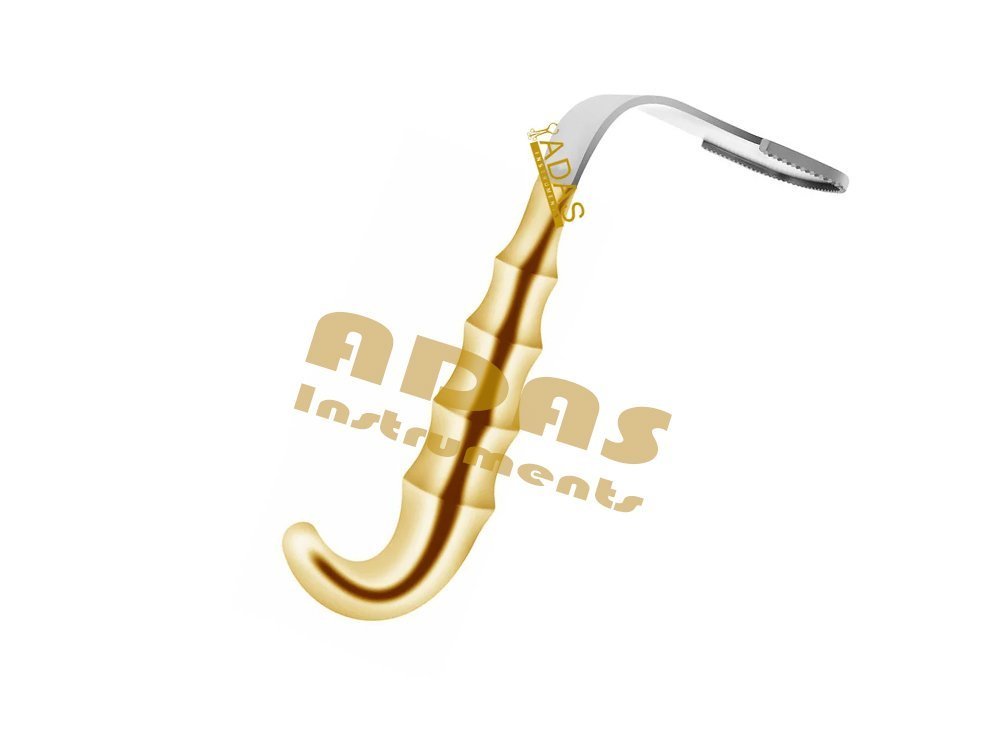
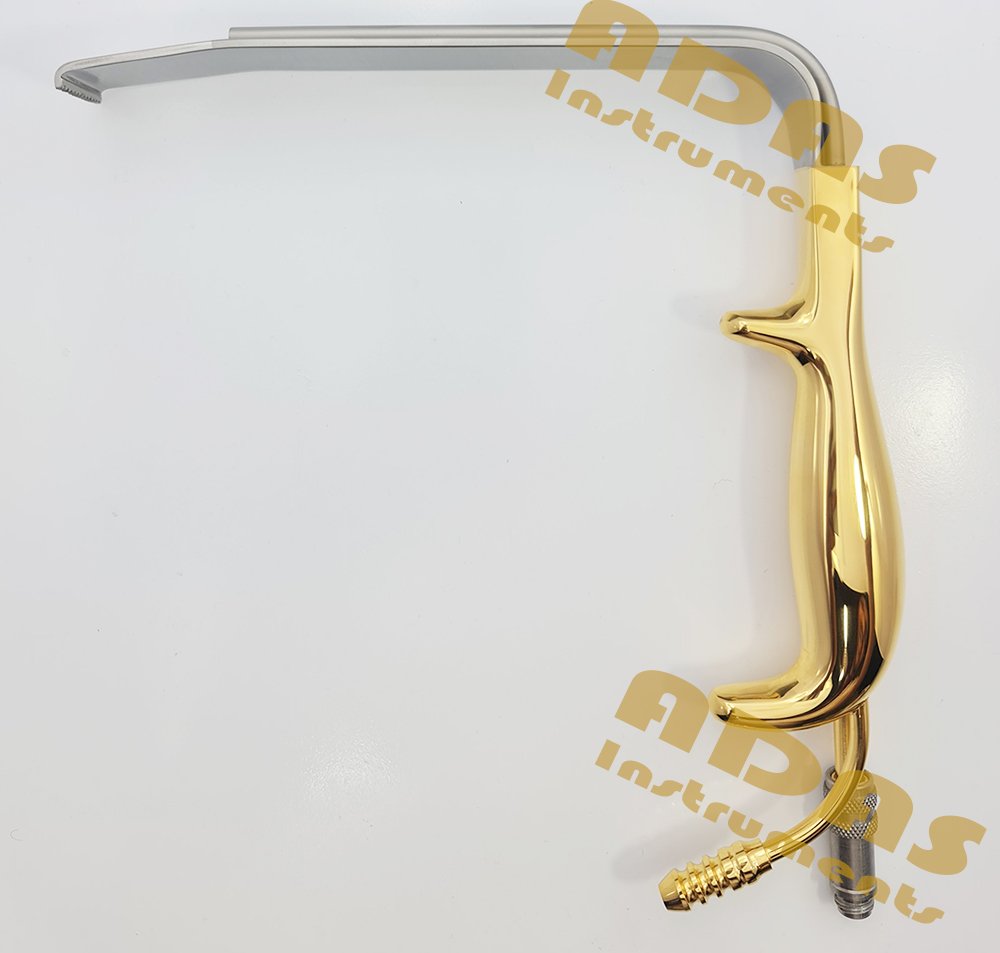
The light starts in a cold light source outside the sterile field. A light cable carries it to a connector post on the retractor handle. From there a fiber optic light carrier, a sealed bundle of glass fibers in a slim tube, runs along the shaft and ends where the blade begins. Plug in the cable and the light points down the blade into whatever it is holding open.
Because the instrument itself carries only glass and steel, it is reprocessed like any other retractor. On our facelift retractor with fiberoptic light carrier, for example, the carrier is fixed along the back of the shaft and the cable screws onto a blue anodized threaded connector, so it stays put while the blade is moved around the flap.
Where the Light Earns Its Cost
A headlight lights whatever the surgeon is facing. Under a raised flap or at the far end of a breast pocket, the flap itself casts the shadow, and the headlight beam stops at the entrance. A lighted blade puts the light past that shadow, at the tip of the dissection. The deeper and narrower the space, the bigger the difference.
That is why lighted blades cluster in three procedures. In breast surgery, the implant pocket is a long tunnel worked through a short incision. In facelift and neck lift work, the plane under the skin flap is exactly where a headlight shadows. In abdominoplasty, the upper flap is lifted over a long distance toward the ribs. Nasal surgery uses the same idea at a smaller size, with the fiber optic Aufricht retractor and the fiber optic Killian speculum.
Lighted Retractor Patterns We Make
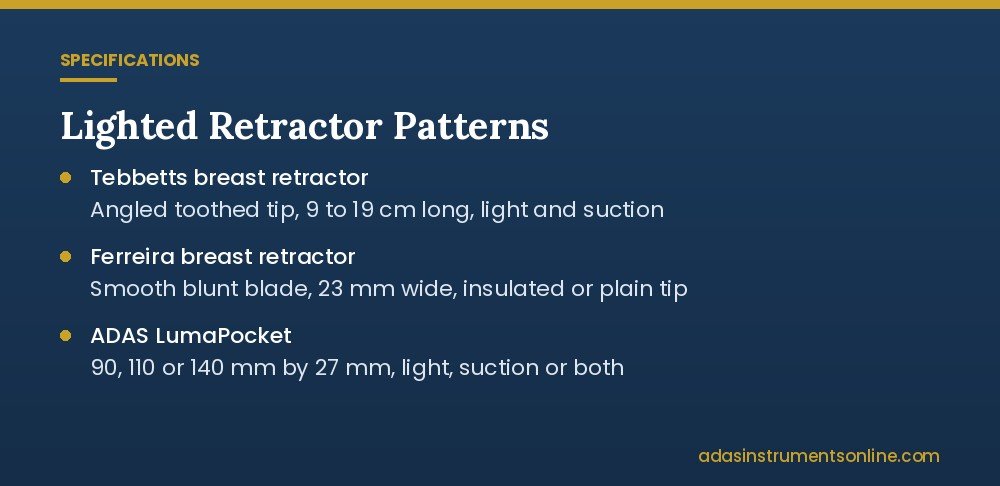
Sizes in this table are the ones listed on each product page.
| Pattern | Blade | Sizes listed | Built in extras |
|---|---|---|---|
| Tebbetts breast retractor | Angled, toothed tip | 9, 15, 17 or 19 cm long | Light and suction |
| Ferreira breast retractor | Smooth, blunt | 23 mm wide, 17 or 19 cm | Light; insulated or plain tip |
| ADAS LumaPocket | Breast pocket blade | 90, 110 or 140 mm by 27 mm | Light, suction, or both |
| Engler breast retractor | Narrow | 65 x 12 mm | Light or suction option |
| C circular breast retractor | Semi circular | 2 in or 4 in blade | Light, suction, or both |
| Facelift retractor | Smooth L shaped | One pattern | Light carrier optional |
| Ferreira face lift retractor | Narrow, smooth | One pattern | Light optional |
| Biggs face lift retractor | Broad, fenestrated | One pattern | Light optional |
| Freeman flap retractor | Smooth, deep set | 13 mm or 24 mm wide | Light optional |
| Saldanha abdominal retractor | Prongs | 4 or 8 prongs | Light option |
| Deaver retractor | Curved | 19, 22 or 25 mm | Light optional |
Light, Suction and Insulation
The light is only one of three add ons, and in breast work it is not always the most important. Pocket dissection is done with an electrocautery pencil inside a closed space, and the smoke fills that space within seconds. A suction channel on the blade clears it, which is why the LumaPocket and the Tebbetts carry both light and suction on one blade.
The third add on is insulation. An insulated blade will not carry current from a cautery pencil that touches it into the tissue it is holding back. If your surgeons cauterize close to the blade, which almost everyone does in a breast pocket, an insulated tip is worth the extra cost. Teeth at the end of the blade, as on the Tebbetts, are a fourth choice: they stop the blade sliding off denser tissue.
Shop lighted retractors direct from the maker
Breast, facelift and abdominoplasty patterns with fiber optic light carriers, many with suction or insulation on the same blade, all made in the Adas Instruments workshop. Engler from 22 dollars, LumaPocket from 80 dollars, Tebbetts from 190 dollars.
Check the Connector Before You Order
The blade end of a lighted retractor is the same everywhere. The cable end is not. Light cables are made with different connector standards, and Storz, Wolf, ACMI and Olympus are the common ones. Before ordering, write down the make of light source in the room and the connector on its cable, and send it with the order. Adaptors exist, but an adaptor that works loose mid case is a problem nobody needs.
Check the light source too. A lighted retractor needs a standard surgical cold light source, the same kind used for endoscopes. If the theatre already runs endoscopy, the source is almost certainly there.
What Shortens the Life of a Lighted Retractor
The steel nearly always outlasts the glass fibers. Four habits account for most dim or patchy light:
- Ultrasonic cleaning. Many makers advise against it for fiber optic parts, because the vibration can crack the fibers. Clean by hand unless the instructions say otherwise.
- Coiling the cable tightly. A cable bent into a tight loop breaks fibers permanently. Coil it loosely.
- Dropping the blade. The polished end of the light carrier is the fragile part. A chipped end scatters the light.
- Running the source at full power. Start low and raise it only as far as needed. Less heat at the tip is kinder to the fibers and to the tissue.
To check an older blade, shine it next to a new one on the same source. Dark spots in the beam mean broken fibers.
Lighted Retractor or Headlight?
Our view: for open, shallow work under good overhead lights, a plain blade and a headlight are enough. For any deep, narrow pocket, the lighted blade wins, because it puts the light where the headlight cannot reach. Most practices end up with both: plain blades from the wider retractor family for routine exposure, and one or two lighted patterns for the cases that need them. For a full breast tray, our breast augmentation instruments guide shows where the lighted blade fits.
Frequently Asked Questions
What is a lighted retractor?
A lighted retractor is a surgical retractor with a fiber optic light carrier built into or along the blade. A light cable from a cold light source connects to the handle, and the light comes out at the blade, inside the space being held open.
Can a lighted retractor be autoclaved?
Yes. A lighted retractor contains no electrical parts, only steel and a sealed glass fiber bundle, so it is steam sterilized with the rest of the set. Follow the maker’s cleaning advice, as many advise against ultrasonic cleaning for fiber optic parts.
Do fiber optic retractors fit any light source?
They work with a standard surgical cold light source, but the cable connector must match. Storz, Wolf, ACMI and Olympus connectors are common. Check the cable in your theatre before ordering, or order the matching adaptor.
Why do some lighted retractors have suction?
In breast pocket dissection the electrocautery pencil makes smoke inside a closed space. A suction channel on the same blade clears the smoke and any blood, so the surgeon keeps a clear view without a separate suction tube.
Is a lighted retractor better than a headlight?
For deep, narrow spaces such as a breast pocket or the plane under a facelift flap, yes, because the light sits at the blade tip. For open, shallow work with good overhead lighting, a headlight and a plain blade are usually enough.
