
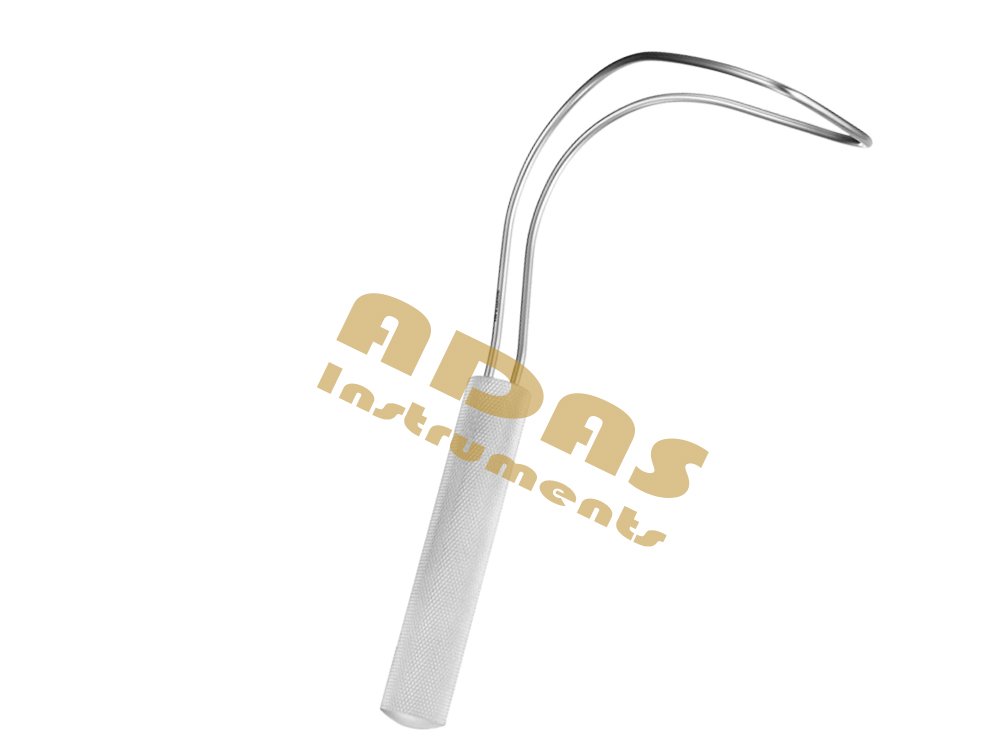
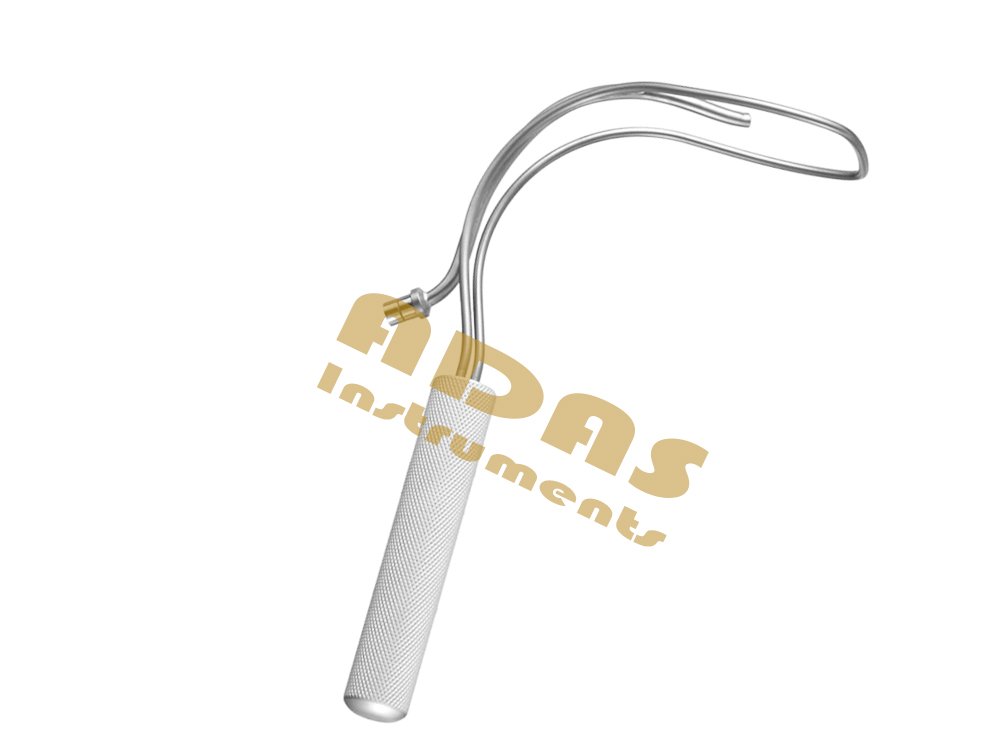
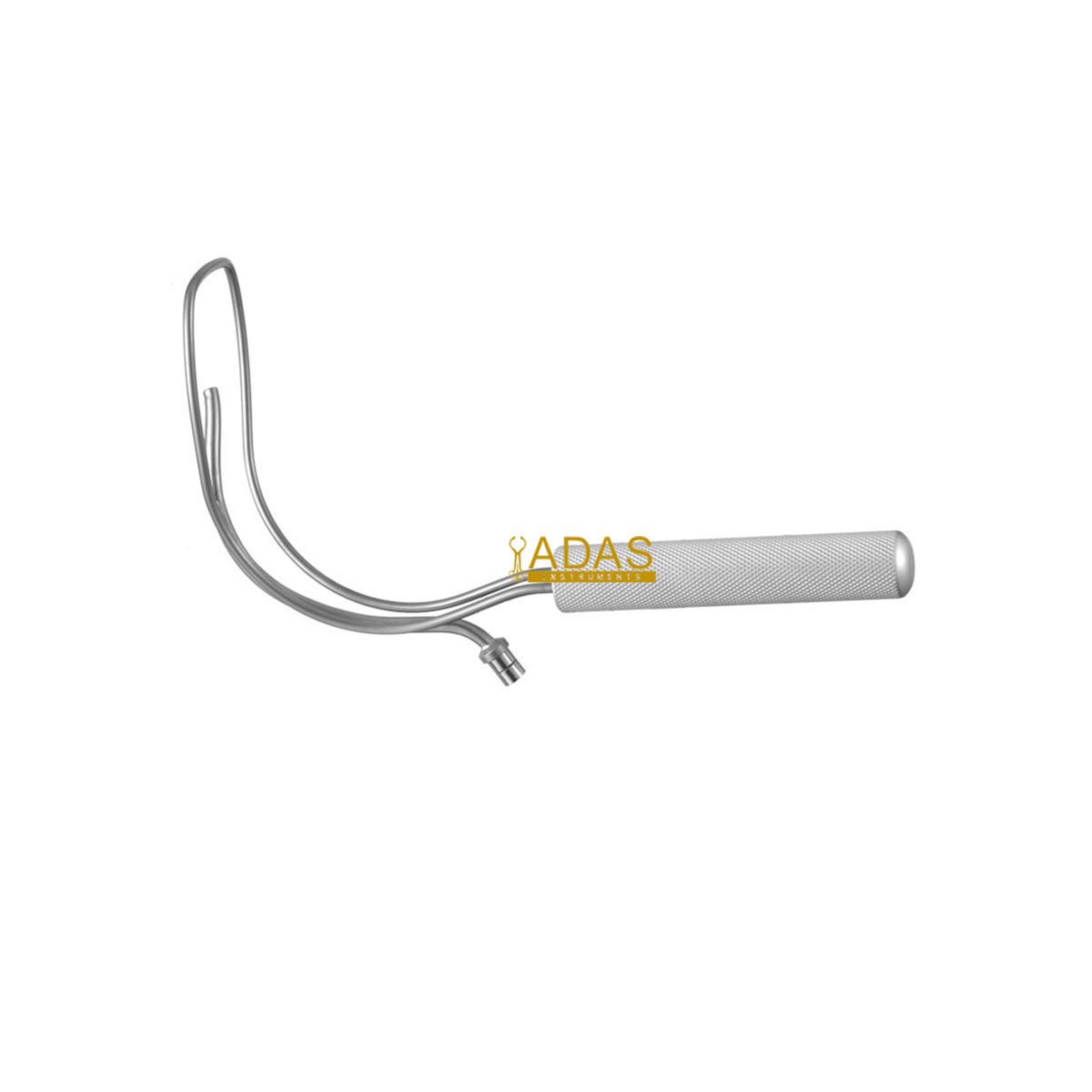
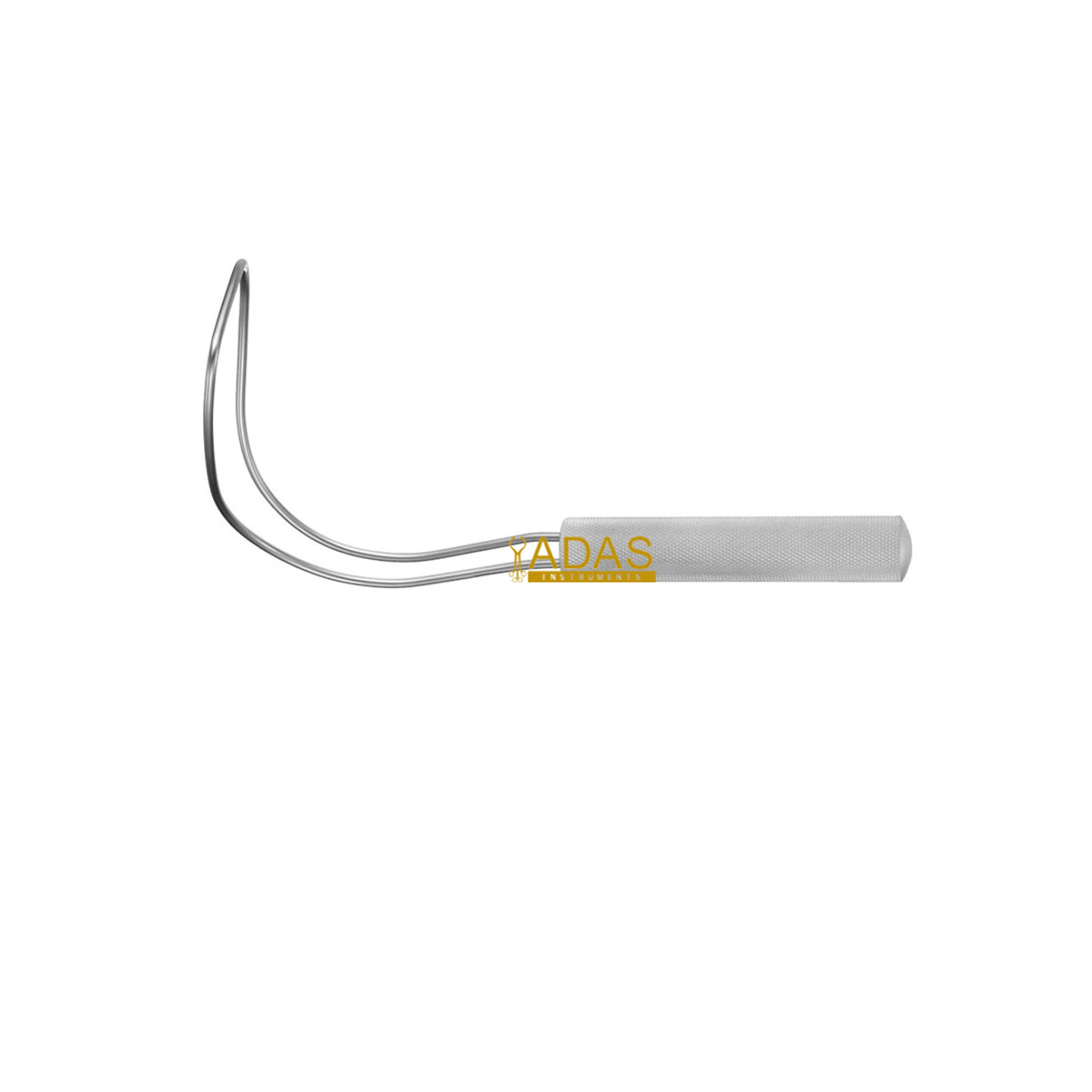
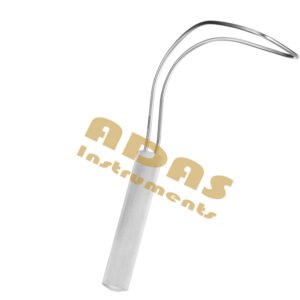
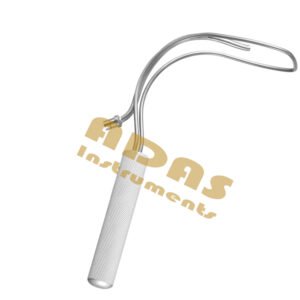


Biggs Face Lift Retractor, Fenestrated Blade, Fiberoptic Option
Price range: $ 32.00 through $ 65.00
Biggs face lift retractors hold deep facial and neck tissue back on a single broad blade with a window cut through it. The window is not decoration: a solid blade 50 mm across slides on wet tissue, and the fenestration gives the tissue something to sit against, so the blade holds its place under steady pull without the surgeon having to press harder. It is used in rhytidectomy, deep plane facelift and cervicofacial dissection, and our own record carries it with or without a fiberoptic light carrier.
Key Features
- A single broad fenestrated blade rather than prongs
- The window stops the blade sliding on wet tissue
- A contoured lip at the tip that spreads the load
- Available with or without a fiberoptic light carrier, from our own record
- Used on deep facial flaps, neck flaps and the SMAS plane
- High quality medical grade stainless steel, autoclavable and made to be used again
- Three year replacement warranty against manufacturing defects

What the biggs face lift retractor is
The biggs face lift retractor holds deep facial and neck tissue back on one broad blade with a window cut through the middle of it. It is the widest instrument in this family and the bluntest.
The window is the part worth understanding. A solid blade of that width, laid against wet tissue and pulled, slides. There is nothing for the tissue to key into, so the only way to stop it sliding is to press harder, which is exactly what a surgeon is trying to avoid on a flap. A fenestration gives the tissue somewhere to sit, and the blade then holds its position under steady, light pull.
There is a lip at the tip as well, contoured rather than square, which spreads the load along the edge instead of concentrating it in a line.
Key design features of this fenestrated facelift retractor
Four features, and the first two are the whole instrument.
- One broad blade. No prongs. Traction spread over a wide face rather than four points.
- A fenestration. The window that stops the blade sliding on wet tissue.
- A contoured lip. At the tip, spreading the load along the edge.
- A fiberoptic option. With or without a light carrier, carried in our own record, which matters on the deep planes this blade is built for.
Biggs face lift retractor size
One line of this table is ours and the rest says so plainly.
| What | Figure | Where it comes from | Item code |
|---|---|---|---|
| Light carrier | With or without fiberoptic | Our own product record | AP-242.03 |
| Blade | One broad fenestrated blade with a contoured lip | Family standard, not an attribute in our record | |
| Blade width | Not carried | Others publish 50 to 52 mm. Not repeated here as ours | |
| Overall length | Not carried | Others publish 20 to 23 cm. Not repeated here as ours | |
| Prongs | None. This pattern has no prongs at all | Family standard |
Our own record carries the fiberoptic option and the item code and nothing else. Other catalogs put the Biggs blade at 50 mm to 52 mm wide on an instrument of 20 cm to 23 cm, and those figures are not repeated here as ours because they have not been measured here. Ask and they will be.
Where a biggs retractor is used
A biggs retractor comes out when the dissection has gone deeper than a skin flap.
| Specialty | What the biggs face lift retractor is used for |
|---|---|
| Rhytidectomy | Broad traction on the deep planes below the skin flap |
| Deep plane facelift | Holding the SMAS layer over a wide face |
| Cervicofacial dissection | Neck planes where width and bluntness both matter |
| Neck lift | Platysma level exposure without piercing anything |
| Facial reconstruction | Deep exposure during rebuilding |
| Submental work | The lit version, where the pocket is deep and narrow at the mouth |
| Revision surgery | Scarred deep planes that will not tolerate points |
What the blade holds, and what it does not
Width and bluntness cut both ways, and the limits belong on the page rather than in a phone call.
| Structure | How the blade takes it |
|---|---|
| Deep facial flaps | Supported across a wide face, nothing pierced |
| Neck flaps | The tissue this width exists for |
| The SMAS layer | Held flat rather than engaged on points |
| Platysma | Broad blunt traction on the muscle |
| Tissue that must not be pierced | Held here, and NOT on any rake in this family |
| A skin flap being raised | A Freeman rake grips that better. A blade supports, it does not grip |
| A small or narrow pocket | NOT this one. The blade is too wide. Use the 13 mm flap retractor |
How the biggs rhytidectomy retractor compares with the rest of the family
Five of the six rows are our own instruments. The biggs rhytidectomy retractor sits at the wide blunt end of a family whose other end is a 22 mm rake.
| Pattern | How it differs | When you reach for it instead |
|---|---|---|
| Freeman flap retractor | A smooth blade too, but 13 or 24 mm and curved | A narrower pocket, or a flap rather than a deep plane |
| Freeman face lift retractor | Four sharp prongs that grip by piercing | Raising and holding the skin flap itself |
| Freeman face lift retractor Adamson model | A wide pronged head on an offset bend | Lifting a large flap in one bite |
| Freeman face lift retractor small | 10 cm, 22 mm prongs, thumb ring | A tight pocket held one handed |
| Ferreira face lift retractor | A narrow right angled blade, often lit | A channel rather than a broad plane |
| Malleable ribbon retractor | A flat strip bent to shape on the table | A shape no fixed blade will make |
Materials and finish
Made from high quality medical grade stainless steel, satin finished, which on a blade this wide is not a detail: a 50 mm polished face under an operating light is a mirror pointed at the surgeon. The steel itself is made to a German specification. The rim of the fenestration is deburred on both faces, because an edge left inside that window will mark tissue that the outside of the blade never touches.
Care and sterilization
Clean with a soft brush under running water, working through the fenestration from both sides where tissue and blood lodge and are easy to miss, and around the light post on the lit version. Rinse in deionized water and dry fully before autoclaving. Store flat so the blade is not carrying the weight of anything else, because a broad blade that has taken a set will no longer sit flush against the tissue it is meant to spread its load across.
Ordering and wholesale
Adas Instruments makes the broad blade face lift retractor patterns to order and supplies hospitals, surgical centers and distributors across the United States, Latin America, Europe and Asia. Item code AP-242.03. State whether you want the fiberoptic version. Bulk and wholesale pricing is available, and instruments held on backorder ship in 10 to 12 working days. Every instrument carries a three year replacement warranty against manufacturing defects. Certifications: CE. Production is controlled under an ISO 13485 quality management system.
Frequently asked questions
What is a biggs face lift retractor used for?
Broad, blunt traction on deep facial and neck tissue during a rhytidectomy. It is the instrument for the part of the operation below the skin flap, on the SMAS and the cervicofacial planes, where a pronged rake would engage structures you would rather it did not.
Why is the biggs face lift retractor blade fenestrated?
To stop it sliding. A wide solid blade on wet tissue has nothing to key into, so it slips, and the only remedy is more pressure. The window gives the tissue something to sit against, which holds the blade in place under a light steady pull. It also lets the surgeon see a little of what is behind the blade.
How wide is the biggs face lift retractor blade?
Our own product record does not carry a width, and that is worth saying rather than hiding. Other catalogs publish 50 mm to 52 mm for this pattern. We measure and confirm the blades we hold before a bulk order ships.
Biggs or a Freeman rake?
Depth and tissue. A Freeman rake grips a skin flap by piercing it and is the right answer while the flap is being raised. The Biggs supports a deep plane over a wide face and pierces nothing. Most facelift sets carry both and change between them as the dissection goes deeper.
Is the fiberoptic version worth it?
On deep neck planes, usually yes. The blade is already at the bottom of the pocket, so a light carrier in it puts light where the surgeon is looking with nothing casting a shadow in front of it. On shallow work under a good overhead light it adds cost for little gain. Both versions are in our record, so it is your call at the order.
Related products and categories
Buyers who order the biggs face lift retractor usually order alongside it the freeman face lift retractor, the freeman face lift retractor small and the freeman face lift retractor adamson model. The whole family sits in hooks and retractors, and this pattern is also listed under facelift and neck lift instruments.
For an L shaped smooth blade with its own light path, see our facelift retractor with fiberoptic light carrier.
| Weight | 0.05 kg |
|---|---|
| Tip options | With Fiberoptic, without fiberoptic |
Be the first to review “Biggs Face Lift Retractor, Fenestrated Blade, Fiberoptic Option”
Shipping & Delivery Policy
Processing Time: In-stock items are dispatched within 24-48 hours. For custom or out-of-stock items, production time is approximately 10-15 days.
Global Delivery Estimates
We partner with world-class couriers (DHL, FedEx) to ensure fast, tracked delivery.
- USA & Canada: 3-5 Business Days
- Europe & UK: 4-6 Business Days
- Rest of World: 5-7 Business Days
*We offer Air Cargo and Sea Freight options for bulk wholesale orders.
Customs & Duties
International buyers are responsible for any customs duties or taxes imposed by their country. Adas Instruments is not responsible for delays caused by customs clearance.
Lost Packages & Insurance
If your package is lost in transit, please contact us immediately. We offer full support and replacements for confirmed lost shipments. Note: You must report non-delivery within 3 weeks to be eligible for an insurance claim.
Related products
Reviews
There are no reviews yet.