
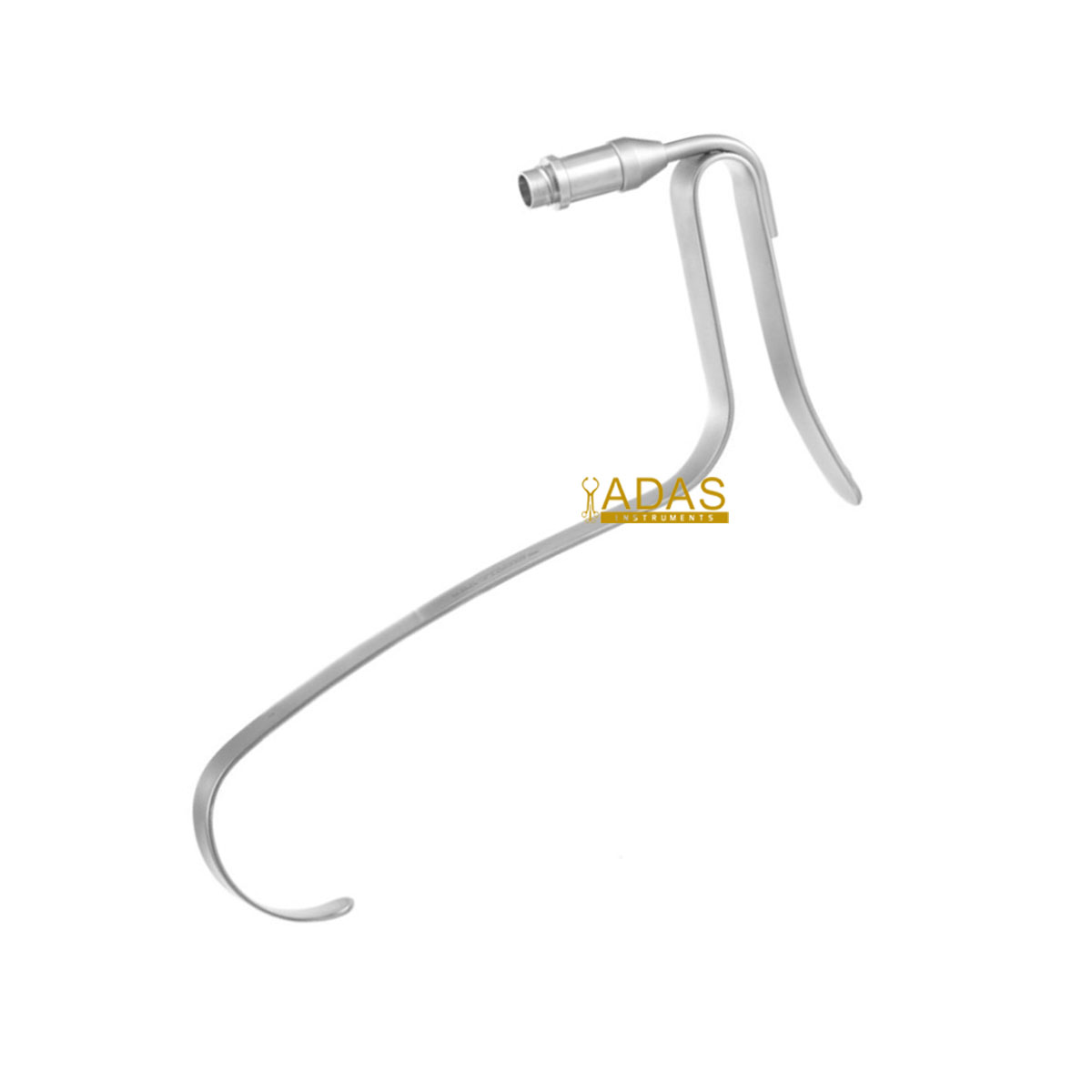
Freeman Flap Retractor, 13 mm and 24 mm, Fiberoptic or Standard
Price range: $ 18.90 through $ 45.00
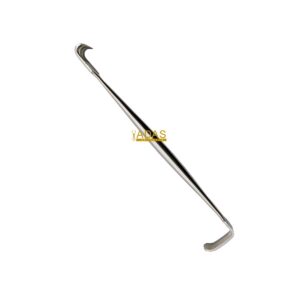
Freeman flap retractors hold an elevated flap back on a smooth blade rather than on prongs, and that single difference is what the instrument is for: nothing pierces the flap, so the skin edge and its blood supply are left alone. The blade is deep set with a slight downward curve, which cradles the flap instead of pressing a hard line across it. Our own record carries it in 13 mm and 24 mm widths, with or without a fiberoptic light carrier, and it is used in facelift, breast surgery and abdominoplasty.
Key Features
- A smooth blade, not prongs, so nothing pierces the flap
- Deep set with a slight downward curve that cradles rather than presses
- 13 mm and 24 mm blade widths, both from our own record
- Available with or without a fiberoptic light carrier
- Used on elevated facial flaps, breast flaps and abdominal flaps
- High quality medical grade stainless steel, autoclavable and made to be used again
- Three year replacement warranty against manufacturing defects

What the freeman flap retractor is
The freeman flap retractor holds an elevated flap back on a smooth blade. There are no prongs anywhere on it, and that absence is the entire design brief.
A rake holds a flap by piercing it, which is fine on tissue that is about to be trimmed and wrong on tissue that has to survive. A blade holds the same flap by supporting it from underneath, so nothing is pierced, the skin edge is untouched and the blood supply running through the flap is not interrupted by four points of tension.
The blade itself is deep set with a slight downward curve at the tip. That curve is what stops it pressing a hard line across the flap: the tissue sits into the hollow of the blade rather than folding over its edge.
Key design features of this flap retractor
Four features, and our own record carries two of them as ordering options.
- A smooth blade. No prongs, no teeth, nothing that pierces.
- A deep set, downward curved tip. Cradles the flap instead of pressing across it.
- Two blade widths. 13 mm and 24 mm, both in our own record.
- A fiberoptic option. With or without a light carrier, also in our own record, which puts light under the flap rather than over it.
Freeman flap retractor sizes and the fiberoptic option
Every line of this table is our own product record.
| Blade width | Light carrier | Where it comes from | Item code |
|---|---|---|---|
| 13 mm | Without fiberoptic | Our own product record | AP-56.130 |
| 13 mm | With fiberoptic | Our own product record | AP-56.130 |
| 24 mm | Without fiberoptic | Our own product record | AP-56.130 |
| 24 mm | With fiberoptic | Our own product record | AP-56.130 |
| Overall length | Not carried | Others publish about 20 cm. Not repeated here as ours |
Four combinations, and all four are real ordering choices rather than a range we have quoted from elsewhere. Our record gives no overall length; other catalogs put this pattern at about 20 cm, which is not repeated here as ours.
Where a flap retractor is used
A flap retractor is not only a facial instrument, and the list below is wider than the category it sits in.
| Specialty | What the freeman flap retractor is used for |
|---|---|
| Rhytidectomy | Holding a facial flap that must not be pierced anywhere |
| Neck lift | Supporting the flap along the mandibular border |
| Breast reconstruction | Holding a raised breast flap without a clamp or a hook |
| Breast augmentation | Pocket exposure, where the lit blade earns its keep |
| Abdominoplasty | Abdominal flap traction over a long dissection |
| Reconstructive flap surgery | Any flap whose blood supply is the thing being protected |
| Endoscopic and small incision work | The lit version, where light has to travel with the blade |
What the blade holds, and what it does not
A smooth blade has the opposite strengths to a rake, and the honest way to put that is side by side.
| Structure | How the blade takes it |
|---|---|
| Elevated facial flaps | Supported from underneath, nothing pierced |
| Breast flaps | Same principle, wider tissue |
| Abdominal flaps | Held over a long dissection without a point of tension |
| Thin or compromised flaps | The reason to pick this over a rake at all |
| Skin that must survive intact | Held here, and NOT on a pronged pattern |
| A flap that keeps sliding off | A rake grips better. A blade supports, it does not hold |
| Deep broad neck planes | The Biggs fenestrated blade holds better at that width |
How the fiber optic flap retractor compares with the rest of the family
Five of the six rows are our own. The row that matters is the first one, because the choice between a fiber optic flap retractor and a pronged rake is made on what the flap has to survive.
| Pattern | How it differs | When you reach for it instead |
|---|---|---|
| Freeman face lift retractor | Four sharp prongs that grip by piercing | A flap that will be trimmed, or one that keeps slipping off a blade |
| Freeman face lift retractor small | 10 cm, 22 mm prongs, thumb ring | A tight pocket held one handed |
| Freeman face lift retractor Adamson model | A wide pronged head on an offset bend | Lifting a large flap in one bite |
| Biggs face lift retractor | One broad fenestrated blade, 50 mm class | Deep neck planes needing a much wider blade |
| Ferreira face lift retractor | A narrow right angled blade | Reaching straight down a channel rather than under a flap |
| Malleable ribbon retractor | A flat strip bent to shape on the table | A shape no fixed blade will make |
Materials and finish
Made from high quality medical grade stainless steel, satin finished, which on a blade instrument matters more than usual: a polished blade under an operating light reflects straight back up into the surgeon eye. The steel itself is made to a German specification. The blade edges are rolled rather than left as cut, because an edge that is square will mark a flap even though it never pierces one.
Care and sterilization
Clean with a soft brush under running water, paying attention to the hollow of the blade and, on the lit version, the light post and the channel behind it. Rinse in deionized water and dry fully before autoclaving. Follow the light cable manufacturer instructions for the cable itself. Check the blade for any new nick along the edge, because a smooth blade that is no longer smooth has lost the one property it was chosen for.
Ordering and wholesale
Adas Instruments makes this pattern to order and supplies hospitals, surgical centers and distributors across the United States, Latin America, Europe and Asia. Item code AP-56.130. State the blade width and whether you want the fiberoptic version. Bulk and wholesale pricing is available, and instruments held on backorder ship in 10 to 12 working days. Every instrument carries a three year replacement warranty against manufacturing defects. Certifications: CE. Production is controlled under an ISO 13485 quality management system.
Frequently asked questions
What is a freeman flap retractor used for?
Holding an elevated flap back without piercing it. It is used in facelift and neck lift surgery, in breast reconstruction and augmentation, and in abdominoplasty, which is why it is the one instrument in this family that turns up on three different sets.
How is a freeman flap retractor different from a freeman face lift retractor?
Prongs against a blade, and they are two different instruments that happen to share a surname. The face lift retractor is a four pronged rake that grips by piercing. The flap retractor is a smooth blade that supports from underneath. Catalogs list both under Freeman, so say blade or say prongs when you order.
What does the fiberoptic version give you?
Light where the retractor already is. An overhead light throws the surgeon own hands as a shadow into the pocket they are trying to see; a light carrier in the blade puts the light under the flap, at the tip, with nothing in front of it. On deep or narrow pockets that is the difference between seeing the plane and feeling for it.
13 mm or 24 mm?
24 mm for an open flap where a wider blade means fewer repositions and lower pressure per square millimeter. 13 mm where the pocket is narrow or the flap is small. Both widths are available with or without the light, so the four combinations in the size table are the whole range.
Can a freeman flap retractor be used on breast flaps?
Yes, and it often is. A raised breast flap and a raised facial flap present the same problem, which is tissue that has to be held out of the way and has to keep its blood supply. The blade and the curve do the same job on both.
Related products and categories
Buyers who order the freeman flap retractor usually order alongside it the biggs face lift retractor, the freeman face lift retractor and the freeman face lift retractor small. The whole family sits in hooks and retractors, and the lit version is also listed under fiber optic instruments.
For an L shaped smooth blade with its own light path, see our facelift retractor with fiberoptic light carrier.
| Weight | 0.05 kg |
|---|---|
| Tip options | With Fiberoptic, without fiberoptic |
| Select Size | 13mm Wide, 24mm Wide |
Be the first to review “Freeman Flap Retractor, 13 mm and 24 mm, Fiberoptic or Standard”
Shipping & Delivery Policy
Processing Time: In-stock items are dispatched within 24-48 hours. For custom or out-of-stock items, production time is approximately 10-15 days.
Global Delivery Estimates
We partner with world-class couriers (DHL, FedEx) to ensure fast, tracked delivery.
- USA & Canada: 3-5 Business Days
- Europe & UK: 4-6 Business Days
- Rest of World: 5-7 Business Days
*We offer Air Cargo and Sea Freight options for bulk wholesale orders.
Customs & Duties
International buyers are responsible for any customs duties or taxes imposed by their country. Adas Instruments is not responsible for delays caused by customs clearance.
Lost Packages & Insurance
If your package is lost in transit, please contact us immediately. We offer full support and replacements for confirmed lost shipments. Note: You must report non-delivery within 3 weeks to be eligible for an insurance claim.
Related products


Reviews
There are no reviews yet.