
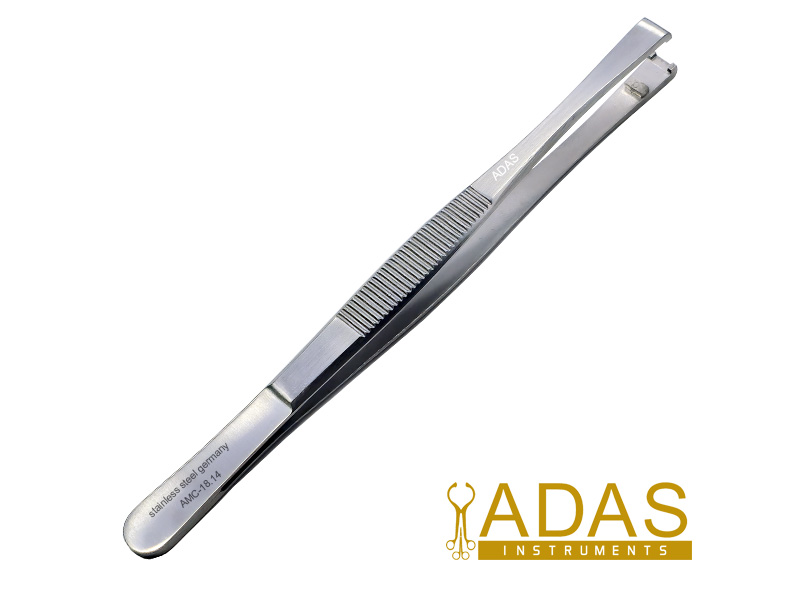
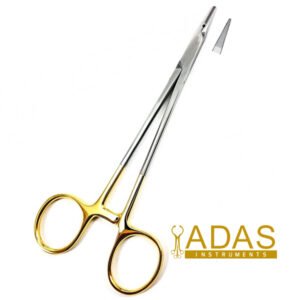
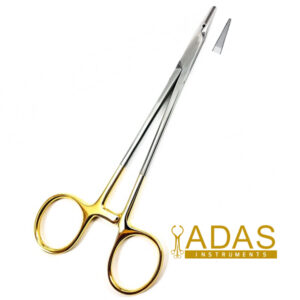
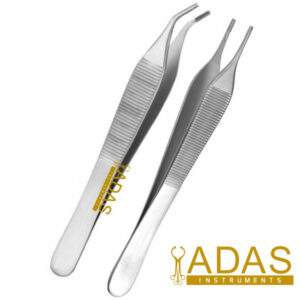
Clamp Applying Forceps, Micro Surgery Clamp Applier
$ 15.50
Clamp applying forceps are a carrier instrument used to grip a small surgical clamp, position it on a vessel and release it exactly where it is wanted. The clamp is held open by the forceps for the whole journey and closes only on release, so the surgeon places occlusion in a field a few millimetres wide without the clamp springing shut early. They are used in microsurgery, in vascular and reconstructive work and in research surgery, wherever bulldog clamps, vessel clips or microvascular clamps are applied by hand.
Key Features
- Jaws shaped to hold a spring clamp open in transit
- Single instrument, no ratchet on the handle
- High quality medical grade stainless steel, passivated and boil tested
- Satin finish, no glare under an operating room lamp
- Reusable and fully autoclavable
- Clamp fit confirmed against your clamp before dispatch
- Item code AMC-17.12
1 in stock (can be backordered)

What clamp applying forceps are
Clamp applying forceps are a carrier, not a clamp. The jaws are shaped to take hold of a small spring clamp, hold it open while it is moved into position, and let it close on release. Nothing stays behind on the patient except the clamp. They are made by Adas Instruments, reusable and fully autoclavable.
Catalogues also list the pattern as clip applying forceps, and that is the same instrument under a different name. The phrase changes with what is being placed: a clip on a small branch, a bulldog clamp on a larger vessel, a microvascular clamp on an artery during an anastomosis. Orders arrive under both names and we build to either.
Search a supplier catalogue for bulldog clamp applying forceps and you will find the same carrier described by the heaviest clamp it takes. The jaw seat is what varies, which is why the clamp matters more than the forceps when an order is placed.
Why the job needs its own instrument
This is the part worth understanding, because it is the question behind most clamp forceps uses searches: why not just use a needle holder.
A spring clamp wants to be closed. That is its entire design. Any instrument carrying it has to fight the spring for the whole journey and then let go of it in a controlled way, at a precise moment, without moving the clamp a millimetre as it lets go.
A ratcheted instrument cannot do that. The ratchet holds at fixed steps, so releasing it is a snap rather than a taper, and the clamp jumps. A plain tissue forceps has no seat for the clamp body, so the clamp pivots between the jaws and lands crooked. Neither failure is dramatic in a large field. In a two millimetre vessel both of them cost the anastomosis.
- Holds the clamp open. Against its own spring, for as long as needed.
- No ratchet on the handle. Release is graded, not stepped.
- A seat for the clamp body. So the clamp cannot rotate in transit.
- Reopens for removal. The same instrument takes the clamp off again.
What it applies
The clamp decides everything about this order. These are the devices a clamp applying forceps carries.
| WHAT IS BEING APPLIED | WHERE IT GOES | WHY A CARRIER IS NEEDED |
|---|---|---|
| Microvascular clamp, small sizes | Artery or vein during an anastomosis | The clamp is smaller than a fingertip and its spring is stiff |
| Microvascular approximator | Two vessel ends held facing each other | Both jaws have to land before either closes |
| Bulldog clamp | A larger vessel needing temporary occlusion | The spring is strong enough to hurt a bare hand |
| Vessel clip | A short branch being taken off | Placement has to be square or the clip slides |
| Scalp clip | A craniotomy edge | Placed repeatedly and quickly along a bleeding margin |
| Research microclamp | A vessel in a laboratory model | Repeat placements with no damage to the clamp |
Tell us the clamp you are working with, or its size, and we confirm the jaw fit before anything ships. A carrier that is close but not right will splay under the spring, and that shows up on the second case rather than the first.
Where these are used
Clamp applying forceps sit wherever a vessel has to be stopped temporarily and then let go again.
| SPECIALTY | WHAT THE APPLIER IS DOING THERE |
|---|---|
| Microsurgery | Carrying microvascular clamps onto vessels under a microscope |
| Plastic and reconstructive surgery | Free flap anastomosis, where both vessel ends are clamped |
| Vascular surgery | Temporary occlusion with bulldog clamps while a repair is made |
| Neurosurgery | Scalp clips along a craniotomy edge, and clips on small vessels |
| Hand surgery | Digital vessel repair, in a field where a hand cannot reach |
| Transplant surgery | Bench work on donor vessels before implantation |
| Research and laboratory | Animal model vessel work with repeat clamp placements |
The common thread is not the specialty. It is the size of the field. Once the vessel is small enough that the clamp is smaller than a fingertip, placing it by hand stops being an option.
The sequence, step by step
Five movements, and a different thing goes wrong at each one without the right carrier.
| STEP | WHAT THE SURGEON DOES | WHAT GOES WRONG WITHOUT AN APPLIER |
|---|---|---|
| Loading | Opens the clamp on the applier jaws | The clamp is squeezed by hand and flies out of the field |
| Carrying | Moves the open clamp to the vessel | A needle holder lets it shut halfway there |
| Positioning | Lines the clamp up square across the vessel | An angled landing crushes one wall and misses the other |
| Releasing | Lets the spring close and withdraws | A partial release drags the clamp along the vessel |
| Removing | Reopens the clamp and lifts it off | Pulling a closed clamp off tears the intima |
| Repeating | Reloads for the second vessel | Each hand placement is a fresh chance to drop it |
Two of those steps are the ones people underestimate. Releasing is not the end of the job, because a partial release drags the clamp sideways along the wall it has just closed on. And removing is a placement in reverse: the clamp has to be reopened before it is lifted, never pulled off closed.
How it compares with the neighbours
These are the instruments reached for instead, usually because the applier is not on the tray.
| INSTRUMENT | WHAT IT IS FOR | WHY NOT USE IT FOR THIS |
|---|---|---|
| Clamp applying forceps | Carrying and placing spring clamps | This is the instrument built for the job |
| Needle holder | Holding a needle in a ratchet | The ratchet is the problem. It grips the clamp, not the clamp spring |
| Micro Adson forceps | Holding tissue | The jaws have no seat for a clamp and it will pivot out |
| Micro jewelers forceps | Fine tissue and suture handling | Tips too fine to hold a stiff spring open |
| Mosquito forceps | Clamping tissue directly | It is a clamp itself, not a carrier for one |
One thing clamp applying forceps will not do is act as a tissue forceps between clamp placements. The jaws are shaped around a clamp body rather than around tissue, so they hold a clamp well and hold tissue badly. That answers the difference between clamp and forceps question from the other direction: the carrier is not a general instrument and was never meant to be.
Materials and finish
Every clamp applying forceps is made in high quality medical grade stainless steel. The steel itself is made to a German specification. Each one is passivated and boil tested before packing, and the finish is satin rather than mirror so there is no glare off the jaws under an operating room lamp.
On a carrier the jaws take the load, not the tips. A clamp spring pushes them apart every time it is loaded, thousands of times across a working life, so the jaw faces are ground and then checked closed against a light. A pair that has been opened by a clamp it was not built for will show daylight at the seat, and from then on it holds that clamp at an angle.
Care and sterilization
Rinse in cool water straight after use, before anything dries in the jaw seat. Clean with a neutral pH enzymatic detergent and an ultrasonic bath, rinse in deionized water, dry fully, then steam autoclave at 134 degrees Celsius.
Inspect the jaws each time rather than the tips. Load the clamp you use, look at whether it sits square, and retire the instrument when it does not. A carrier that has splayed will keep working in the sense that it picks the clamp up, and will keep placing it crooked, which is the failure that is easy to miss.
Ordering and wholesale
Clamp applying forceps are supplied by Adas Instruments to hospitals, surgical distributors, research laboratories and OEM buyers, in single units and in bulk. The item code is AMC-17.12 and it is printed here so a procurement search finds it. Send the clamp or the clamp size with the order so the jaw fit is confirmed first. Backorder items dispatch in 10 to 12 working days, and every instrument carries a three year replacement against manufacturing defects.
For wholesale and OEM orders, instruments ship unpackaged in bulk or individually poly bagged, and laser marking with a distributor code or a hospital asset number is available on the shank. Tell us the clamp, the quantity and the marking, and the quotation comes back with the lead time for that run.
Production is controlled under an ISO 13485 quality management system.
Frequently asked questions
What are clamp applying forceps used for?
Picking up a small clamp, carrying it to the vessel and letting it close where the surgeon wants it. The forceps holds the clamp by its own spring, so the clamp travels open and shuts only when it is released, which is the part a general instrument cannot do reliably in a field a few millimetres across.
What is the difference between a clamp and a forceps?
A clamp stays on the patient and a forceps stays in the hand. The clamp is the thing that occludes the vessel and it is left in place for the length of the anastomosis. The forceps is the carrier that put it there and then came back out. That is why they are two instruments and not one.
Are clip applying forceps the same as clamp applying forceps?
In most catalogues, yes, and orders arrive under both names. Clip applying forceps is the commoner phrase where the thing being placed is a small vessel clip, and clamp applying forceps where it is a bulldog or a microvascular clamp. The instrument in either case is a carrier with jaws shaped to hold a spring device open.
Which clamps will it fit?
That depends on the clamp, and it is worth telling us on the order rather than assuming. Microvascular clamps in the small sizes, single clamps and approximators, and bulldog clamps all differ in how much of a jaw they need. Send the clamp you are using, or its size, and we confirm the fit before anything ships.
Can clamp applying forceps be autoclaved?
Yes, they are fully autoclavable and reusable. Steam at 134 degrees Celsius after an enzymatic clean and an ultrasonic bath. The jaws are the part to inspect afterwards, because a carrier that has been prised open by a clamp it was not built for will never grip that clamp squarely again.
Related products and categories
Buyers usually put clamp applying forceps on the same tray as the micro adson forceps for tissue handling, the micro jewelers forceps for suture work, and the jeweler bipolar forceps for the bleeding points a clamp does not reach. The pattern sits in micro surgery instruments, and it is also listed under dressing and tissue forceps.
| Weight | 0.04 kg |
|---|
Be the first to review “Clamp Applying Forceps, Micro Surgery Clamp Applier”
Shipping & Delivery Policy
Processing Time: In-stock items are dispatched within 24-48 hours. For custom or out-of-stock items, production time is approximately 10-15 days.
Global Delivery Estimates
We partner with world-class couriers (DHL, FedEx) to ensure fast, tracked delivery.
- USA & Canada: 3-5 Business Days
- Europe & UK: 4-6 Business Days
- Rest of World: 5-7 Business Days
*We offer Air Cargo and Sea Freight options for bulk wholesale orders.
Customs & Duties
International buyers are responsible for any customs duties or taxes imposed by their country. Adas Instruments is not responsible for delays caused by customs clearance.
Lost Packages & Insurance
If your package is lost in transit, please contact us immediately. We offer full support and replacements for confirmed lost shipments. Note: You must report non-delivery within 3 weeks to be eligible for an insurance claim.
Related products

Reviews
There are no reviews yet.