


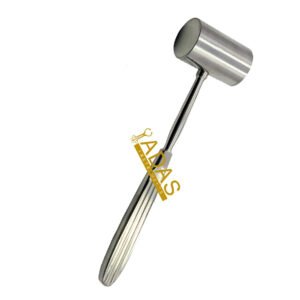
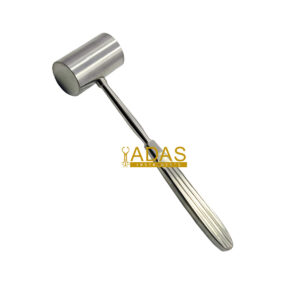
Cottle Nasal Mallet | Solid One Piece Stainless Steel
$ 27.00
The Cottle nasal mallet is one solid piece of stainless steel from the face to the end of the handle. There is no screwed head, no replaceable cap and no filled cavity, which means there is nothing on it that can work loose in an autoclave or come back from sterile processing assembled wrongly. It is the Cottle pattern, which is the one most rhinoplasty tray lists name.
Key Features
- A solid stainless steel mallet, one piece from face to handle
- Nothing to unscrew, replace, lose or reassemble
- The Cottle pattern, which is what most tray lists specify
- Drives osteotomes and chisels, and taps a block cartilage crusher
- Cut from high quality medical grade stainless steel and fully autoclavable
- Three year replacement warranty against manufacturing defects
- Item code AQ-03.45
25 in stock (can be backordered)

What a Cottle nasal mallet is
Cottle’s name is on more rhinoplasty instruments than anybody else’s, and the mallet is the plainest of them. One piece of steel. The pattern has not changed because there is nothing in it to improve: a mallet either delivers a controlled blow or it does not, and the ways a mallet can fail all involve parts.
That is the argument for solid construction and it is a maintenance argument rather than a clinical one. A screwed head loosens. A replaceable cap gets replaced with the wrong one, or not replaced at all. A filled head eventually leaks what is in it. A solid mallet comes back from the autoclave as the same object that went in, every time, for twenty years.
Our own Search Console shows people looking for it by name: “cottle mallet” brings impressions to this site at position 23.0. That is page three, which is where a page of 559 words making two claims we were never entitled to make belongs, and it is why this page has been rewritten from nothing.
It drives osteotomes and chisels through nasal bone, and it taps a block cartilage crusher, because a block crusher is not squeezed, it is tapped with a mallet, which is how the force stays even across the whole graft.
What we do not publish here is a weight. There is no attribute set on this product, and unlike the other two mallets in this family the weight is not in the product name either. Google quotes around 300 grams as typical for a Cottle; that is the market figure and not our measurement, so it does not go on this page. Ask us before ordering if the weight has to be matched, and it is on our own list to put right.
Key design features
One piece, and what that rules out
No joint, no thread, no cap, no cavity. The list of things that can go wrong with this instrument is: the face can wear flat, and the steel can corrode if it is mistreated. That is the whole list, and it is why mallets like this outlive the surgeons who buy them.
The Cottle pattern
Named on more rhinoplasty tray lists than any other mallet, which matters when a theater is ordering to a list rather than to a preference. If the sheet says Cottle, this is the instrument it means.
A plain handle
Round, smooth, uncoated, no grooves and no inlay. A textured handle holds blood in the texture and a coated one eventually chips. Plain steel is easier to clean and a gloved hand on wet round steel is a known quantity.
It rings, and that is the trade
Solid steel struck against steel is loud and it rebounds. If that matters, the nylon faced mallet in this family is the instrument to buy instead, and we would rather point you at it than describe this one as quiet.
Which mallet to order, and what we do not publish
Three mallets and one honest gap on this page.
| Mallet | Face | What we publish | How to decide |
|---|---|---|---|
| Cottle nasal mallet, this page | Solid steel, one piece | The pattern. NOT the weight: there is no attribute on this product | The tray list names the Cottle |
| Nasal mallet | Solid steel | 3/4 lb, around 340 g | You want a published weight and plenty of mass |
| Hayden mallet | Nylon, or nylon and steel | 18.8 cm and 9 oz | The ring, the rebound or the marking matter |
| All three | A choice on the trolley | n/a | A unit doing regular rhinoplasty where the surgeons disagree, which they do |
Where it is used
Anywhere force has to be delivered to something else.
| Procedure | What the mallet drives | Note |
|---|---|---|
| Lateral and medial osteotomy | An osteotome through nasal bone | The main use, and the reason Cottle’s name is on it |
| Hump reduction | A rasp or an osteotome across the dorsum | Taps from the wrist, not blows from the elbow |
| Cartilage graft preparation | A block crusher lid | The other job every rhinoplasty mallet does |
| Septal and maxillofacial work | A chisel or a gouge | The same instrument well beyond the nose |
What it holds back, and what it must not do
Short list, because a solid mallet has very little that can go wrong.
| The task | What this mallet does | What it must not do |
|---|---|---|
| Driving an osteotome | Delivers a controlled blow with nothing to absorb or soften it | It must NOT be swung. A mallet in surgery is tapped from the wrist, and a swung mallet is how an osteotomy goes where nobody planned |
| Tapping a cartilage crusher | Even force on the lid of a block crusher | Tap it. Hammering a crusher turns a graft into mush and there is no way back |
| Working beside a steel instrument | Nothing special. Steel on steel marks both | Where marking matters, use the nylon faced Hayden |
| Being a known weight | We do NOT publish one for this product | Google says around 300 grams is typical for a Cottle. That is the market and not our measurement. Ask us before ordering if the weight has to be matched |
How it compares with the rest of the family
The three mallets and the instrument they are most often used on.
| Instrument | Role | Construction | Buy it when |
|---|---|---|---|
| Cottle nasal mallet, this page | Delivers the force | One solid piece | The tray list names the Cottle pattern |
| Nasal mallet | Delivers the force | Solid, 3/4 lb published | You want the weight on the page |
| Hayden mallet | Delivers the force | Nylon faces in a steel head | The ring and the rebound matter |
| McIndoes bone cutting forceps | Does the cutting the mallet made possible | Double action | Bone has to be removed rather than moved |
Materials and finish
Every Cottle nasal mallet we make is cut from high quality medical grade stainless steel. The steel itself is made to a German specification. We do not publish a grade number. The number on a certificate tells a surgeon nothing about whether a struck face is still flat after a few thousand blows, because a face that has domed slides off an osteotome head instead of driving it square, and the answer to that is in the making rather than in the alloy.
The head is forged rather than cast, and that is not a detail on an instrument whose job is to be hit. A cast head can spall, which means a fragment coming off the edge of the face in an operating room; forged steel deforms before it breaks. The faces are ground flat after forging.
The rim of each face is radiused so it does not bite into an osteotome head, and there is no sharp external edge anywhere on the instrument. The handle is finished smooth rather than mirror polished, because a shine on a wet handle is slippery.
Caring for it
Warm water and a soft brush. There are no joints, no holes and no moving parts, so the only surfaces that matter are the two faces, and they are flat.
Autoclave with the tray. Look at both faces against the light every so often: they should be flat. A domed face does not sit square on an osteotome head and every blow goes slightly sideways, which the surgeon feels as an osteotome that will not stay on its line.
Ordering and wholesale
Every Cottle nasal mallet is made by Adas Instruments in our own workshop and sold direct, which is why the price sits where it does against the catalog houses. Order one for a single tray, or in quantity for a hospital list or a distributor line. We do OEM work under your own brand and your own item numbers. Send us a sample and we will hold a run to your pattern rather than ours. Stock items ship from our own workshop. Backorder items take 10 to 12 working days to make. Every instrument carries a three year replacement warranty against manufacturing defects. Production is controlled under an ISO 13485 quality management system.
Frequently asked questions
What is a Cottle nasal mallet used for?
Driving an osteotome, a chisel or a rasp through nasal bone during rhinoplasty, and tapping a block cartilage crusher. It is the plainest instrument on the tray and the one most tray lists name by pattern.
What does solid mean here?
One piece of stainless steel from the face to the end of the handle. No screwed head, no replaceable cap, no filled cavity. Nothing can work loose in an autoclave and nothing can come back from sterile processing assembled wrongly.
How heavy is it?
We do not publish a weight for this product, because our own record carries no attribute for it and the weight is not in the name either. Google quotes around 300 grams as typical for a Cottle mallet; that is the market figure, not our measurement. Ask us before ordering if it has to be matched.
Cottle or the plain nasal mallet?
Buy the Cottle if your tray list names it, which many do. Buy the plain nasal mallet if you want a published weight on the page: that one is 3/4 lb and the figure is ours.
Will it mark my osteotomes?
Steel on steel marks both, so yes, over time. If that bothers you, the Hayden mallet with nylon faces is the instrument that does not, and plenty of trays carry one of each for exactly that reason.
Related products and categories
For a published weight and more mass, the solid stainless steel nasal mallet at 3/4 lb. For a nylon face that does not mark what it hits, the Hayden mallet. For the bone cutting that follows an osteotomy, the McIndoes bone cutting forceps.
The rest of this family sits under nasal cutting, crusher and septum forceps, and the osteotomes and chisels this mallet is made to drive are under osteotomes, chisels and gouges.
| Weight | 0.28 kg |
|---|
Be the first to review “Cottle Nasal Mallet | Solid One Piece Stainless Steel”
Shipping & Delivery Policy
Processing Time: In-stock items are dispatched within 24-48 hours. For custom or out-of-stock items, production time is approximately 10-15 days.
Global Delivery Estimates
We partner with world-class couriers (DHL, FedEx) to ensure fast, tracked delivery.
- USA & Canada: 3-5 Business Days
- Europe & UK: 4-6 Business Days
- Rest of World: 5-7 Business Days
*We offer Air Cargo and Sea Freight options for bulk wholesale orders.
Customs & Duties
International buyers are responsible for any customs duties or taxes imposed by their country. Adas Instruments is not responsible for delays caused by customs clearance.
Lost Packages & Insurance
If your package is lost in transit, please contact us immediately. We offer full support and replacements for confirmed lost shipments. Note: You must report non-delivery within 3 weeks to be eligible for an insurance claim.
Related products

Reviews
There are no reviews yet.