


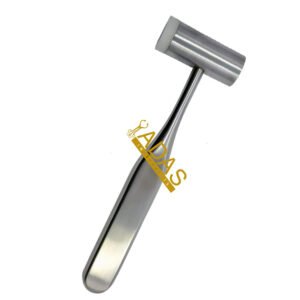


Hayden Mallet | Nylon or Steel Faces, 18.8 cm, 9 oz
$ 29.00
The Hayden mallet has nylon faces, and Google’s description of what a nylon face does is exactly right: it dampens sound, absorbs rebound, and delivers a softer impact that prevents metal on metal degradation. An osteotome driven by a steel mallet rings through the whole room and bounces back at the hand holding it, and driven by this one it does neither. 18.8 cm, 9 oz, and three face combinations.
Key Features
- A nylon head mallet, which dampens the ring and absorbs the rebound
- Three combinations: nylon both sides, one nylon, or one nylon and one steel
- 18.8 cm long and 9 oz, around 255 grams
- No metal on metal, so osteotome heads are not marked
- Cut from high quality medical grade stainless steel and fully autoclavable
- Three year replacement warranty against manufacturing defects
- Item code AQ-03.95

What a Hayden mallet with nylon faces is for
The Hayden mallet answers a problem every rhinoplasty list has. Hit a steel osteotome with a steel mallet and three things happen that nobody wants. The room hears it. The mallet bounces back at the hand holding it, which costs a fraction of control on the next tap. And both faces mark each other, so an osteotome head that started flat ends up peened.
A nylon face fixes all three at once. Google’s own words for it are hard to improve on: the nylon face dampens sound, absorbs rebound, and delivers a softer impact to prevent metal on metal degradation and bone shattering. That last phrase is the clinical one, and it is why some surgeons will not use a steel mallet on a thin nasal bone at all.
The Hayden mallet comes three ways because surgeons disagree about it. Nylon on both sides is the gentle option. One nylon face is the common compromise. One nylon and one steel gives you both tools in one instrument, and it is the version that ends up on most trays, because the steel side is still there for the blow that needs it.
The Hayden mallet is 18.8 cm and 9 oz, which is around 255 grams, and both figures are ours: they are in the product name and they come from our own record. That puts it in the middle of Google’s quoted range of 125 to 400 grams for a surgical mallet, and lighter than the solid steel 3/4 lb mallet in this family. Part of that is the nylon, which weighs less than the steel it replaces.
One thing the search data says about the name: HAYDEN IS A COMMON FIRST NAME, and a hayden mallet is not the only thing a Hayden is. Of 168 keyword ideas on the seed, most are people called Hayden Mallory, Hayden Mallard and Hayden Mallon. The instrument is findable as a “hayden mallet” and our own Search Console has us at position 5.0 for “hayden mallets”, which is page one, but the surname on its own belongs to somebody else entirely.
Key design features
The nylon face, and the three things it does
Dampens the ring, absorbs the rebound, and stops metal marking metal. Those are three separate benefits and the second is the one surgeons feel: a mallet that does not bounce back is a mallet whose next tap starts from where you left it.
Three face combinations
Nylon both sides for the gentlest work. One nylon face for most. One nylon and one steel so the same instrument covers both, which is the version most trays end up carrying because the steel side is still there when a thicker bone needs it.
18.8 cm and 9 oz, both ours
Around 255 grams, which is the middle of the range for a surgical mallet. Lighter than our solid steel 3/4 lb mallet, partly by design and partly because nylon weighs less than the steel it replaces. Both figures come from our own record, which is more than we can say for most instruments in this category.
The faces are replaceable in principle, and we do not publish spares
Said plainly: nylon wears and the rival listings in this class talk about replaceable end caps. Our record does not list a spare face as a stock item, so we are not going to imply you can buy one. Ask us before ordering if that matters to you, and it is on our list.
Which face combination to order
One decision, three answers, and the middle one is the common order.
| Faces | What you get | Usually chosen for |
|---|---|---|
| Both sides nylon | The gentlest mallet we make | Thin nasal bone, and surgeons who never want metal on metal |
| One nylon | A nylon working face | Most general rhinoplasty work. The straightforward choice |
| One nylon and one steel | Both tools in one instrument | The version most trays carry, because the steel side is there for the blow that needs it |
| The steel mallet instead | Mass rather than damping | If the ring and the rebound do not bother you, the solid 3/4 lb mallet is simpler and heavier |
Where it is used
The same jobs as any surgical mallet, with the damping mattering most where the bone is thin.
| Procedure | What the mallet drives | Note |
|---|---|---|
| Lateral and medial osteotomy | An osteotome through nasal bone | The nylon face is chosen here for the softer impact on thin bone |
| Hump reduction | A rasp or an osteotome across the dorsum | Controlled taps, and no ringing in the surgeon’s ear |
| Cartilage graft preparation | A block crusher lid | Nylon on a steel crusher lid is the quietest version of this job |
| Revision rhinoplasty | An osteotome through bone that has already been cut once | Thin, scarred bone is exactly where a softer impact earns its place |
What it holds back, and what it must not do
Nylon is a feature with a wear life and the right hand column is about that.
| The task | What this mallet does | What it must not do |
|---|---|---|
| Driving an osteotome | Delivers the blow with the ring and the rebound damped out | It must NOT be swung. A mallet in surgery is tapped from the wrist whatever its face is made of |
| Protecting the instrument it strikes | No metal on metal, so osteotome heads are not peened | The steel side of the dual face version DOES mark. If that is the point of buying it, use the nylon side for everything else |
| Lasting | Nylon takes the blows instead of the steel | A nylon face that has gone cratered or has split delivers an uneven blow. That is the point to retire the face, and we do not list spares |
| Being a known weight | We publish 18.8 cm and 9 oz, both from our own record | We do not publish a face diameter or a nylon hardness. Ask before ordering if either has to be matched |
How it compares with the rest of the family
Three mallets, and the face is the only thing that separates them.
| Mallet | Face | Weight | Buy it when |
|---|---|---|---|
| Hayden, this page | Nylon, or nylon and steel | 9 oz, around 255 g | The ring, the rebound or the marking matter |
| Nasal mallet | Solid steel | 3/4 lb, around 340 g | You want mass and nothing to wear out |
| Cottle nasal mallet | Solid steel, one piece | Not published by us | The tray names the Cottle pattern |
| The crusher it taps | Not a mallet at all | n/a | Listed here because it is the other thing these mallets are used on |
Materials and finish
Every Hayden mallet we make is cut from high quality medical grade stainless steel. The steel itself is made to a German specification. We do not publish a grade number. The number on a certificate tells a surgeon nothing about whether a nylon face is still flat and whole after a few thousand blows, because a cratered face delivers an uneven blow and a split one delivers half of it, and the answer to that is in the making rather than in the alloy.
The nylon is seated into a steel head rather than bonded onto a flat end, so the steel takes the shear and the nylon takes the impact. A face that is simply glued on eventually lets go at the edge and then peels, which is worse than wearing out.
The handle is plain stainless steel, finished smooth rather than polished to a shine, because a mirror finish on a wet handle is slippery. There is no sharp external edge anywhere on the instrument and the rim of each face is radiused.
Caring for it
Wash it as one piece, warm water and a soft brush. Pay attention to the line where the nylon meets the steel: that seam is the only place on this instrument where anything can collect, and it is also where a face in trouble shows it first.
Autoclave with the tray. Nylon tolerates a normal cycle; if your unit runs something unusual, ask us first, because we do not publish a temperature limit. Look at both faces under good light every so often and retire a face that has cratered, split or gone glassy.
Ordering and wholesale
Every Hayden mallet is made by Adas Instruments in our own workshop and sold direct, which is why the price sits where it does against the catalog houses. Order one for a single tray, or in quantity for a hospital list or a distributor line. We do OEM work under your own brand and your own item numbers. Send us a sample and we will hold a run to your pattern rather than ours. Stock items ship from our own workshop. Backorder items take 10 to 12 working days to make. Every instrument carries a three year replacement warranty against manufacturing defects. Production is controlled under an ISO 13485 quality management system.
Frequently asked questions
What is a Hayden mallet used for?
Driving an osteotome, chisel or rasp during rhinoplasty, and tapping a block cartilage crusher. The nylon face is the reason to choose it: it dampens the sound, absorbs the rebound and stops metal marking metal.
Why a nylon face instead of steel?
Three reasons, and Google puts them well: it dampens sound, absorbs rebound and delivers a softer impact that prevents metal on metal degradation. On thin or previously operated nasal bone the softer impact is the clinical argument, not just a comfort one.
What face combinations can I order?
Three: nylon on both sides, one nylon face, or one nylon and one steel. The last one is the version most trays carry, because the steel side is still available for the blow that needs it.
How heavy is it?
9 oz, which is around 255 grams, on an 18.8 cm handle. Both figures are from our own record. That makes it lighter than our solid steel 3/4 lb mallet, which is partly deliberate and partly because nylon weighs less than the steel it replaces.
Can I buy replacement nylon faces?
Our record does not list a spare face as a stock item, so we will not imply you can order one off the shelf. Ask us before you buy if replaceability matters to you. It is on our list to sort out.
Related products and categories
For mass rather than damping, the solid stainless steel nasal mallet at 3/4 lb. For the Cottle pattern by name, the Cottle nasal mallet. The only pair of scissors in this family is the Gorney turbinate scissors.
The rest of this family sits under nasal cutting, crusher and septum forceps, and the osteotomes and chisels this mallet is made to drive are under osteotomes, chisels and gouges.
| Weight | 0.35 kg |
|---|---|
| More Option | Both Side Nylon Head, One Nylon / One Steel Head |
Be the first to review “Hayden Mallet | Nylon or Steel Faces, 18.8 cm, 9 oz”
Shipping & Delivery Policy
Processing Time: In-stock items are dispatched within 24-48 hours. For custom or out-of-stock items, production time is approximately 10-15 days.
Global Delivery Estimates
We partner with world-class couriers (DHL, FedEx) to ensure fast, tracked delivery.
- USA & Canada: 3-5 Business Days
- Europe & UK: 4-6 Business Days
- Rest of World: 5-7 Business Days
*We offer Air Cargo and Sea Freight options for bulk wholesale orders.
Customs & Duties
International buyers are responsible for any customs duties or taxes imposed by their country. Adas Instruments is not responsible for delays caused by customs clearance.
Lost Packages & Insurance
If your package is lost in transit, please contact us immediately. We offer full support and replacements for confirmed lost shipments. Note: You must report non-delivery within 3 weeks to be eligible for an insurance claim.
Related products

Reviews
There are no reviews yet.