
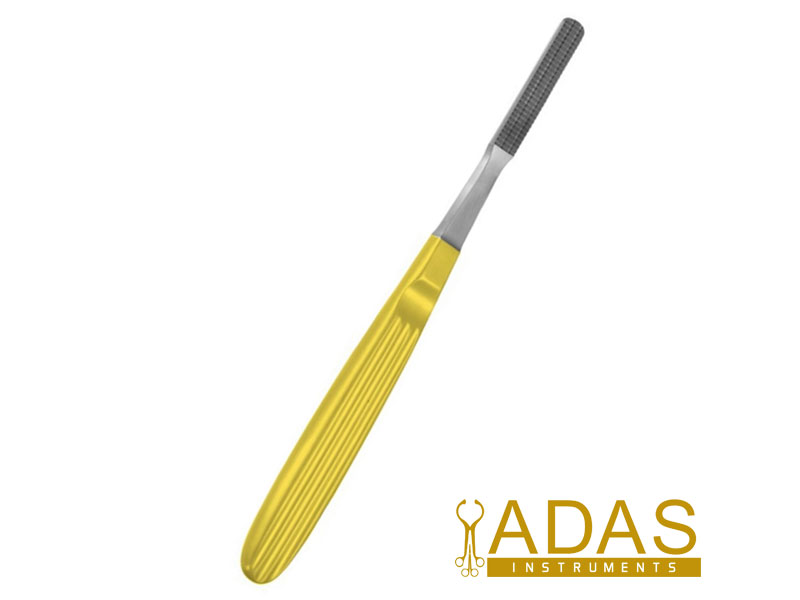
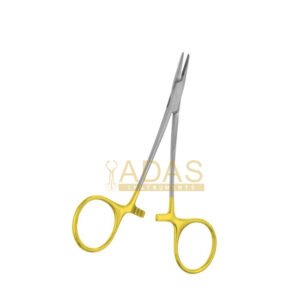
McIndoe Nasal Rasp, Tungsten Carbide, Forward or Reverse Cut
$ 48.00
The McIndoe nasal rasp in tungsten carbide, written TC in most catalogues, is the straight rasp of a rhinoplasty tray with a carbide working face instead of cut steel teeth. It files the flat runs of the nasal dorsum and the dense cartilage beside them, and the carbide is there for one reason: a steel toothed face loses its bite after a few hundred cases and this one does not. It comes forward cutting or reverse cutting, which decides whether bone comes away on the push or on the draw, and that single choice changes how the instrument feels more than any other thing about it.
Key Features
- Two tip options: Forward Cut and Reverse Cut
- Tungsten carbide working face, brazed in rather than coated on
- Straight profile, for the linear surfaces of the nasal dorsum
- Holds its bite through years of autoclave cycles, which is the whole case for carbide
- Satin finish, no glare back into the field
- High quality medical grade stainless steel, fully autoclavable
- Three year replacement warranty against manufacturing defects
- Item code AO-03.17

What a McIndoe nasal rasp in tungsten carbide is
There are two McIndoe nasal rasps on this site and they are the same shape. One has cut steel teeth machined into the face; this one has a tungsten carbide surface brazed into it. Everything a surgeon notices about the instrument follows from that one difference. Catalogues list this one as the McIndoe nasal rasp tungsten carbide, usually shortened to TC, and it is worth being plain about which way it cuts.
The steel one removes bone faster. This one removes bone for longer. On a list where the rasp goes through the autoclave twice a week for ten years, the second thing is worth more than the first, and that is the only honest reason to pay more for carbide.
Key design features
Forward cut or reverse cut
A forward cut face has its teeth leaning back and removes bone on the push, away from the surgeon. A reverse cut face leans them forward and removes on the draw, toward the surgeon. Most teaching sets are built around the reverse cut, because on a draw stroke the force runs back out of the nose rather than up into the root. Order the reverse cut if you are ordering without a preference.
What the carbide actually buys
Not a better cut. A longer one. Carbide is harder than the bone it works on by a wide margin, so the face does not round over the way a steel tooth does, and the instrument you take out of the tray in year five behaves like the one you took out in year one. If an instrument is used twice a year, steel is the sensible purchase and we sell that version too.
The straight profile
The nasal dorsum in its middle third is close to flat, and a straight face loads evenly across it. A curved shank is for reaching over the nostril rim to the root; on the open dorsum it lifts one end of the face off the bone. This is the pattern for the flat part, which is most of the work.
Brazed in, not coated on
The carbide sits in a machined recess and is brazed there. That matters because a sprayed or bonded abrasive can shed, and anything that sheds in a rhinoplasty field ends up under a flap. There is nothing on this face that can come off it.
Which cut direction to order
These two are this product’s own option list. The difference is direction, not coarseness, and neither is the finer instrument.
| Tip option | Which way it removes bone | Who orders it |
|---|---|---|
| Reverse Cut | On the draw, toward the surgeon | The default in most sets, and the stroke a surgeon can stop halfway through. Order this one if you are ordering blind |
| Forward Cut | On the push, away from the surgeon | Surgeons working from the patient’s side who want the cutting force travelling away from them |
| The steel toothed McIndoe, listed separately | Cut steel teeth, both directions available | Bulk removal, and any set where the rasp is used occasionally rather than weekly. It costs less and it removes faster |
Where it is used
It is a general dorsal instrument, so the list runs longer than it does on the specialized patterns.
| Procedure | What the carbide McIndoe does there |
|---|---|
| Dorsal hump reduction | Files the bony hump down and levels the dorsum, usually after an osteotome has taken the bulk |
| Septorhinoplasty | Dresses the bony dorsum once the septal work is finished |
| Lateral osteotomy | Smooths the cut margins so the mobilized bone lies down flat instead of on a ridge |
| Dense cartilage work | Files the thick cartilage at the keystone area, where a toothed face tears rather than cuts |
| Revision rhinoplasty | Takes down callus and residual bone, with the advantage that a carbide face will not catch on an irregular healed surface |
What it abrades, and what it must leave alone
Carbide removes bone more gently than teeth do, which shortens this list but does not change the one rule that matters.
| Tissue | What this rasp does with it |
|---|---|
| Nasal bones and the bony dorsum | Removes, evenly. The working tissue |
| Dense cartilage | Files it. The main thing a carbide face does that a toothed one does badly |
| Bony septum and nasal spine | Removes, in short passes. Thinner than the dorsum and easier to overrun |
| Periosteum | MUST BE LEFT ALONE. Raise the flap first. A loaded carbide face will drag raised tissue with it |
| Skin and the nostril rim | Never. If the rim is being touched the stroke is wrong, not the instrument |
How it compares with the other finishing surfaces
The question buyers actually ask is carbide against steel, so this table answers that first and puts the other two faces in their place.
| Surface | Rate of removal | Where it belongs |
|---|---|---|
| Tungsten carbide, as here | Moderate, and unchanged for years | Any rasp used weekly. Dorsum, dense cartilage, osteotomy margins |
| Cut steel teeth | Fastest, and the first to blunt | Bulk removal, and sets where the instrument is used rarely enough that wear never arrives |
| Diamond coating | Slowest, a few microns a stroke | The finishing pass under thin skin, after this instrument has done the levelling |
| A bone file | Shears along its length rather than across it | Edges and margins only. A file cannot follow the dorsal line |
Materials and finish
Every McIndoe nasal rasp we make is cut from high quality medical grade stainless steel. The steel itself is made to a German specification. We do not publish a grade number, because the number on a certificate tells a surgeon nothing about how an abrasive face holds up after fifty autoclave cycles, and the answer to that is in the finish rather than in the alloy.
The carbide is brazed into a machined recess in the face, so nothing is bonded that can shed and nothing plated that can chip. Carbide does not blunt the way steel does, it polishes: the face goes gradually smoother until it slides instead of biting, and that is the point at which the instrument is finished. On a weekly list that is a matter of years, which is the reason the carbide version exists at all.
Caring for it
Rinse it before the case is cleared, and give the working face more attention than the shank. Bone dust packs into a carbide surface and sets there, and a packed face behaves exactly like a worn one, which is how good instruments get thrown away.
Soft nylon brush along the face, never a wire brush, because wire polishes carbide and polishing is how a carbide face dies. Enzymatic cleaner, ultrasonic cycle, deionized water rinse, dry fully, autoclave at 134 degrees Celsius. Store it so the face is not resting against another instrument.
Ordering and wholesale
The McIndoe nasal rasp in tungsten carbide is made in our own workshop and sold direct, which is why the price sits where it does against the catalogue houses. Order one for a single set, or in quantity for a hospital list or a distributor line; we do OEM work under your own brand and your own item numbers, and we will hold a run to your pattern rather than ours if you send a sample. Stock items ship from our own workshop. Backorder items take 10 to 12 working days to make. Every instrument carries a three year replacement warranty against manufacturing defects. Production is controlled under an ISO 13485 quality management system.
Frequently asked questions
What is a McIndoe nasal rasp used for?
Filing and smoothing the bony dorsum and the dense cartilage beside it in rhinoplasty. It is the straight, general purpose rasp of the tray, used to level the nose after a hump has been reduced and to dress the bone either side of an osteotomy.
What is the difference between a tungsten carbide rasp and a steel one?
How long it lasts, not how well it cuts. Steel teeth remove bone faster and go blunt after a few hundred cases. A carbide face removes a little less per stroke and keeps the same bite for years. If the instrument is used weekly, carbide is the cheaper purchase over its life; if it is used twice a year, steel is.
Should I order the forward cut or the reverse cut McIndoe rasp?
Reverse cut, unless you already know otherwise. It removes bone on the draw stroke, which sends the working force back out of the nose instead of up toward the root, and it is the stroke that can be stopped part way through.
Is a nasal rasp the same thing as a bone file?
No, and the words get swapped constantly. A rasp removes bone with a toothed or abrasive face working across the surface, and it can follow a curve. A file shears along its own length and is for an edge or a margin. This instrument is a rasp, whatever the catalogue heading says.
Can a tungsten carbide nasal rasp be resharpened?
No. There is no edge on a carbide face to restore, and it wears by polishing rather than by rounding over. When it slides instead of biting it is worn out. Brushing it with wire is the fastest way to reach that point early.
Related products and categories
The rest of the carbide and raspatory group: Fomon nasal raspatory, double ended tungsten carbide for two grits on one handle, Fomon rasp, flat and convex double ended where one end has to follow a curve, and Gallaher bone and nasal rasp with finger ring when the stroke needs a finger ring behind it.
The full range is in raspatories and saws, and the tray this belongs to is in rhinoplasty instruments.
| Weight | 0.09 kg |
|---|---|
| Tip options | Forward Cut, Reverse Cut |
Be the first to review “McIndoe Nasal Rasp, Tungsten Carbide, Forward or Reverse Cut”
Shipping & Delivery Policy
Processing Time: In-stock items are dispatched within 24-48 hours. For custom or out-of-stock items, production time is approximately 10-15 days.
Global Delivery Estimates
We partner with world-class couriers (DHL, FedEx) to ensure fast, tracked delivery.
- USA & Canada: 3-5 Business Days
- Europe & UK: 4-6 Business Days
- Rest of World: 5-7 Business Days
*We offer Air Cargo and Sea Freight options for bulk wholesale orders.
Customs & Duties
International buyers are responsible for any customs duties or taxes imposed by their country. Adas Instruments is not responsible for delays caused by customs clearance.
Lost Packages & Insurance
If your package is lost in transit, please contact us immediately. We offer full support and replacements for confirmed lost shipments. Note: You must report non-delivery within 3 weeks to be eligible for an insurance claim.
Related products
Reviews
There are no reviews yet.