
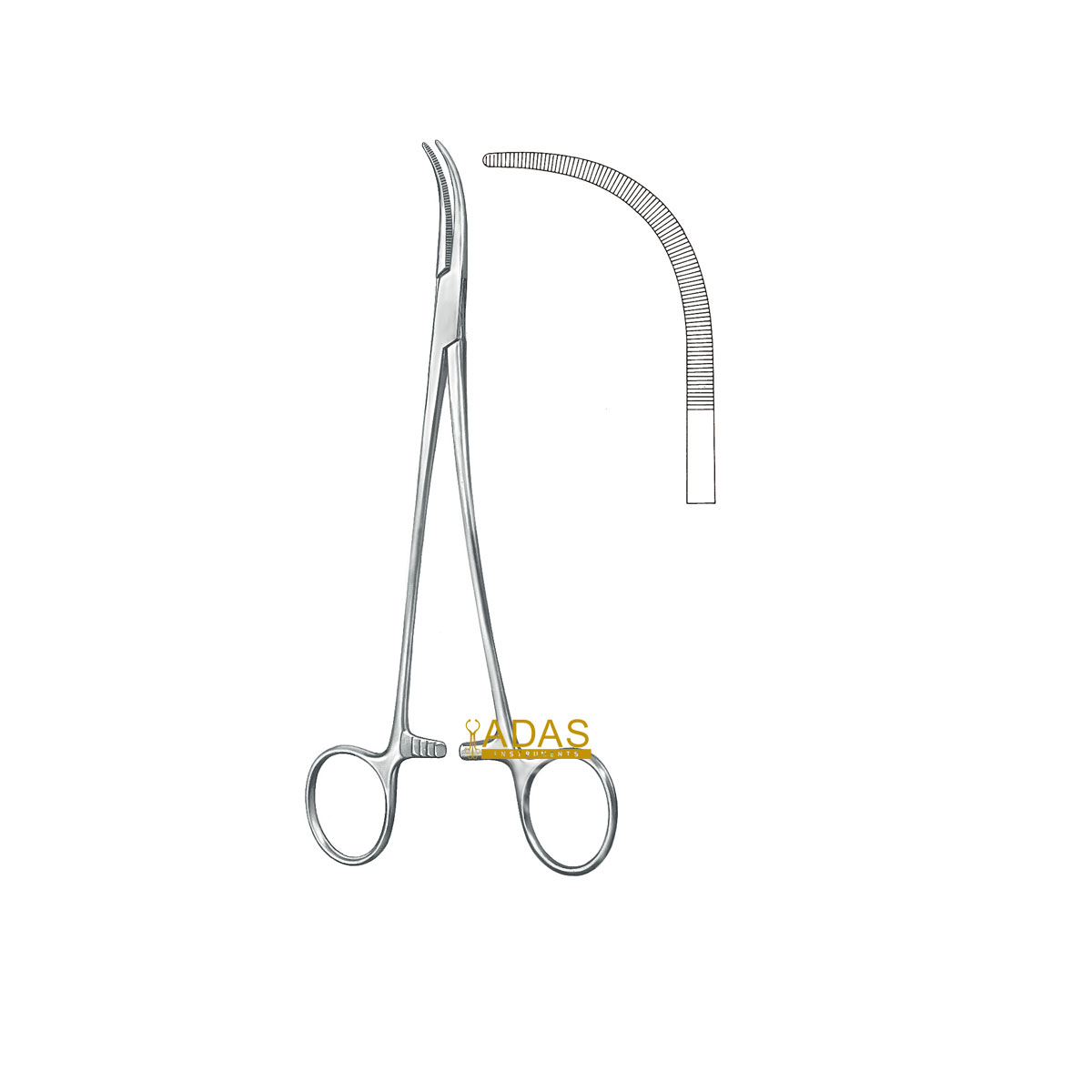
Overholt Forceps, Medium Jaw, Dissecting and Ligature
$ 22.00
Overholt forceps, also listed as Overholt dissecting and ligature forceps and as Overholt-Geissendoerfer, are long ratcheted clamps used in thoracic, cardiovascular and general surgery. The jaws turn away from the shank, so they can be worked in behind a vessel or a duct that a straight instrument cannot reach, and a tie can then be carried round it and drawn through. This is the medium jaw pattern, fine enough for vascular dissection and strong enough to hold while the knot is set.
Key Features
- Turned jaws, for passing a ligature behind a vessel, a duct or a bronchus
- Fine transverse serrations on the inside of the jaws, no teeth
- Ratchet lock above the finger rings, adjustable through its steps
- Medium jaw pattern, between the fine and the heavy
- Used in thoracic, cardiovascular, upper gastrointestinal, hepatobiliary and deep pelvic work
- High quality medical grade stainless steel, autoclavable and made to be used again
- Three year replacement warranty against manufacturing defects
Available on backorder

What the Overholt forceps is
Overholt forceps are long ratcheted clamps used in thoracic, cardiovascular and general surgery to dissect bluntly, to isolate a vessel and to carry a ligature around it. They are also listed as Overholt dissecting and ligature forceps and, in European catalogues, as Overholt-Geissendoerfer.
The jaws turn away from the shank, and that turn is the whole instrument. It lets the tip be worked in behind a vessel, a duct or a bronchus that a straight clamp cannot get behind at all. Once the structure is encircled the jaws open, take the end of a tie, and draw it back round. Surgeons call it passing a tie, and it is the maneuver this pattern exists for.
This page is the medium jaw. It sits between the fine pattern, which is for vascular work where the tip has to be slim, and the heavy pattern, which is for larger pedicles. The medium is the one most general and thoracic sets carry, because it is fine enough for a vessel and strong enough to hold while a knot is set.
Key design features of the Overholt forceps
Four features, and every one of them is about reaching something that is a long way down and behind.
- Turned jaw. The tip leaves the axis of the shank, which is what allows the approach from behind a structure.
- Fine transverse serrations. On the inside of the jaw, along its length, and no teeth anywhere. A tie has to slide when it is pulled, and teeth would hold it.
- Multi step ratchet. At the finger rings, so the jaw can be locked at the pressure wanted and left there.
- Long slender shanks. Less metal between the hand and the field, which is the difference between seeing the vessel and feeling for it.
Overholt forceps patterns and build
Three jaw weights share the body. The medium is what ships from this page.
| Pattern | Jaw | Serration | Ratchet | Item code |
|---|---|---|---|---|
| Medium jaw | Turned tip, slender shank | Fine transverse, no teeth | Multi step, at the finger rings | 0.06 |
| Fine jaw | Narrower tip on the same body | Fine transverse | Multi step | listed separately |
| Heavy jaw | Broader tip for larger pedicles | Fine transverse | Multi step | listed separately |
Lengths are confirmed at the time of order. The trade lists this family across a wide span, and we would rather state the figure for the instrument you are buying than print a range that may not match it.
Overholt forceps uses by specialty
It is a deep field instrument, and the list follows from that.
| Specialty | What it is used for |
|---|---|
| Thoracic surgery | Working around a hilar vessel or a bronchus during lobectomy, which is the operation the pattern was designed for |
| Cardiovascular surgery | Passing a tie behind a vessel that cannot be approached in a straight line |
| Upper gastrointestinal surgery | Isolating a vessel in a deep field before it is divided |
| Hepatobiliary surgery | Dissecting behind a duct during cholecystectomy and carrying a tie around it |
| Deep pelvic surgery | Reaching a structure at the bottom of the pelvis where a straight clamp will not turn |
| Head and neck surgery | Blunt dissection along a plane, opening it rather than cutting it |
What the jaws hold, and what they do not
A serrated jaw with no teeth is a deliberate limit, and the last two rows say where it stops.
| Structure | How the jaw takes it |
|---|---|
| A vessel being isolated | The jaw is worked in behind it, opened, and a tie is carried round and drawn through |
| A duct | Same maneuver. The turned tip is what makes the approach possible at all |
| A bronchus | Held and encircled during lobectomy, which is where the pattern comes from |
| A tissue plane | Opened bluntly by spreading the jaws rather than by cutting |
| A ligature being pulled through | Gripped at the tip and drawn back around the structure |
| Bone or a fibrous band | NOT this instrument. There are no teeth and the jaw will slip |
| Tissue that is being removed | NOT this instrument. A toothed grasper does that work |
How the Overholt forceps compares with the Mixter and the Lahey
This is the comparison buyers actually run, and the honest answer is that the names overlap. Several manufacturers now list a single Overholt-Mixter pattern, which tells you how close the two designs sit.
| Pattern | How it differs | When you reach for it instead |
|---|---|---|
| Baby Mixter artery forceps | The true right angle, in a short delicate body. Many catalogues now sell a combined Overholt-Mixter because the two designs overlap | A shallow field, or where a full right angle is wanted rather than a turn |
| Mixter forceps | The classic right angle at 80 to 90 degrees, made for passing a ligature around a deep structure | Where the approach needs the jaw square to the shank |
| Lahey right angled forceps | A broader heavier jaw, grouped with the right angle artery forceps, and a firmer hold on thick tissue | Larger pedicles and thyroid and neck structures |
| Kocher clamp forceps | One tooth meeting two, and a crushing serrated jaw | Clamping tissue that is coming out, where crushing it does not matter |
| Halsted mosquito forceps | The smallest straight or curved hemostat, for capillaries | A small vessel at the surface, not a deep encirclement |
Overholt forceps materials and finish
Made from high quality medical grade stainless steel, satin finished so the shank does not throw light back at the surgeon in a lit chest. The steel itself is made to a German specification. The serrations are cut into a hardened face and the box joint is finished so the halves move without play, which matters on a long instrument where any looseness at the joint is multiplied at the tip.
Overholt forceps care and sterilization
Release the ratchet before cleaning and before sterilizing, so the joint and the serrations are open and the steel is not held under load at temperature. Clean with a soft brush under running water, working into the turn of the jaw where tissue collects, then rinse in deionized water and dry fully before autoclaving. Store with the ratchet open, and check that the tips still meet cleanly, because a long instrument that has been dropped will usually show it at the tip first.
Ordering Overholt forceps and wholesale
Adas Instruments makes this pattern to order in fine, medium and heavy jaws, and supplies hospitals, surgical centers and distributors across the United States, Latin America, Europe and Asia. Bulk and wholesale pricing is available, and instruments held on backorder ship in 10 to 12 working days. Every instrument carries a three year replacement warranty against manufacturing defects. Certifications: CE. Production is controlled under an ISO 13485 quality management system.
Frequently asked questions
What are Overholt forceps used for?
Blunt dissection in a deep field, isolating a vessel or a duct, and carrying a ligature around it before it is tied. The turned jaw is worked in behind the structure, opened, and used to draw the tie back round. Thoracic and cardiovascular sets carry it, and so do most upper gastrointestinal and hepatobiliary sets.
What is the difference between Overholt and Mixter forceps?
Degree of turn, and not much else. A Mixter is the classic right angle at roughly 80 to 90 degrees. An Overholt is usually described as a more gently turned dissecting and ligature forceps on a longer body. The designs sit so close that several manufacturers now sell a combined Overholt-Mixter pattern, so check the photograph and the jaw angle rather than the name.
Is the Overholt the same as the Overholt-Geissendoerfer?
Yes. Overholt-Geissendoerfer is the full catalogue designation for the same dissecting and ligature forceps, and European lists use it more often than American ones. The instrument does not change with the spelling, and it is also written Overholt-Geissendorfer without the umlaut.
What is the difference between hemostats and forceps?
Forceps is the wide name for any two bladed instrument that holds tissue. A hemostat is the subset with ring handles and a ratchet, made to clamp a vessel and stay clamped. An Overholt is a hemostat by that definition, but it is bought for the dissection and the ligature pass rather than for stopping bleeding.
What does Overholt Klemme mean?
Klemme is the word for a clamp in Germany, so Overholt-Klemme and Overholt-Geissendoerfer-Klemme are what catalogues in that market call the dissecting and ligature forceps on this page. It refers to no separate pattern and to no different jaw. Buyers searching from Europe often type it, which is why it is written here.
Related products and categories
Buyers who order the overholt forceps usually order alongside it the baby mixter artery forceps, the kocher clamp forceps and the halsted mosquito forceps. The whole family sits in hemostats and grasping forceps, and this pattern is also listed under breast surgery instruments.
| Weight | 0.065 kg |
|---|
Be the first to review “Overholt Forceps, Medium Jaw, Dissecting and Ligature”
Shipping & Delivery Policy
Processing Time: In-stock items are dispatched within 24-48 hours. For custom or out-of-stock items, production time is approximately 10-15 days.
Global Delivery Estimates
We partner with world-class couriers (DHL, FedEx) to ensure fast, tracked delivery.
- USA & Canada: 3-5 Business Days
- Europe & UK: 4-6 Business Days
- Rest of World: 5-7 Business Days
*We offer Air Cargo and Sea Freight options for bulk wholesale orders.
Customs & Duties
International buyers are responsible for any customs duties or taxes imposed by their country. Adas Instruments is not responsible for delays caused by customs clearance.
Lost Packages & Insurance
If your package is lost in transit, please contact us immediately. We offer full support and replacements for confirmed lost shipments. Note: You must report non-delivery within 3 weeks to be eligible for an insurance claim.
Related products
Reviews
There are no reviews yet.