
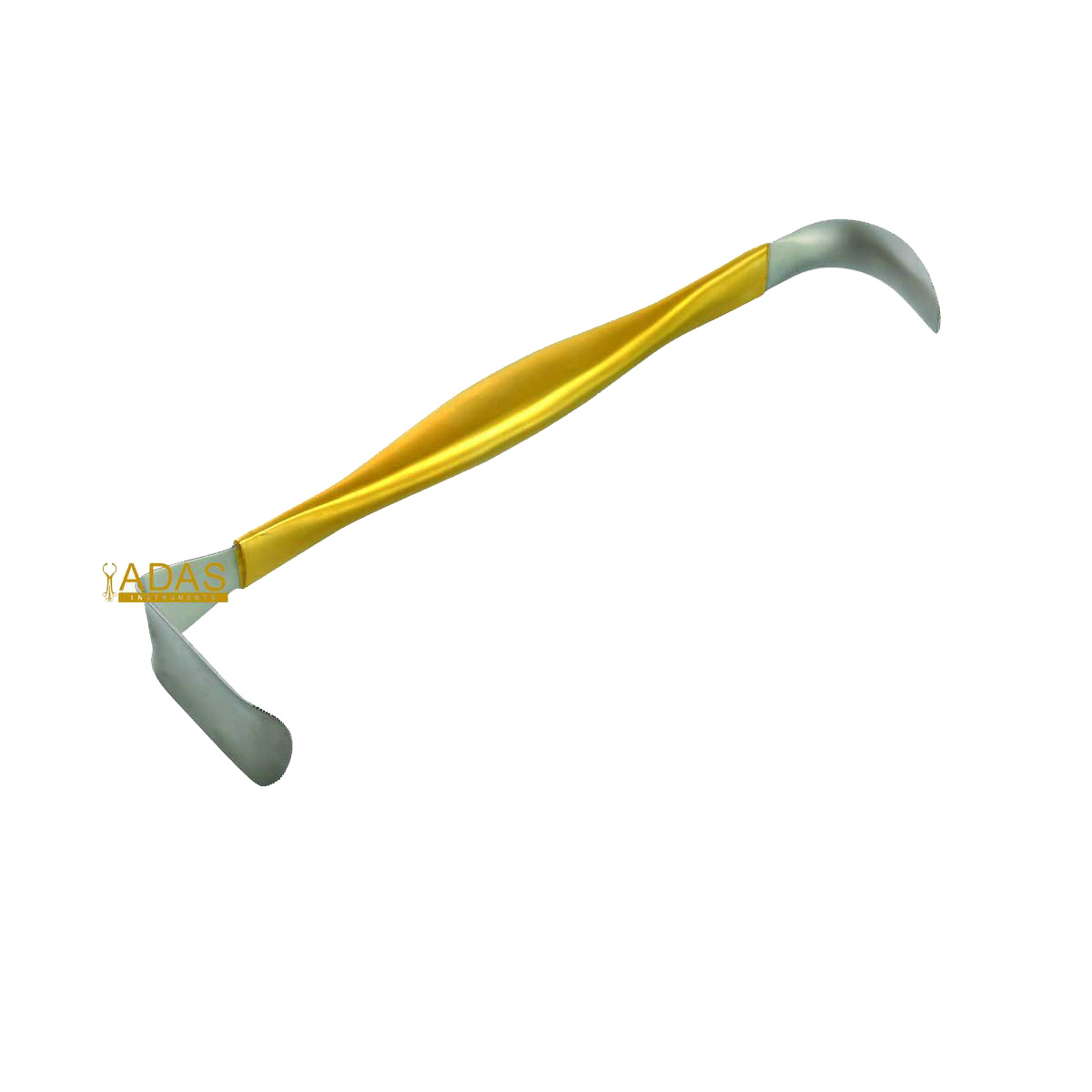
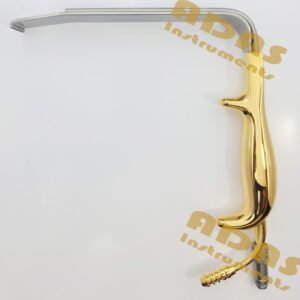
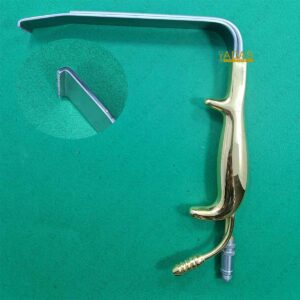
Tebbetts Double End Breast Retractor | Insulated or Standard Tips
Price range: $ 49.00 through $ 85.00
The Tebbetts double end breast retractor carries a working blade at each end of one handle, so a surgeon who needs a second size does not need a second instrument or a second pass from the scrub nurse. Google’s own description of this class names the double ended configuration as one of the three handle types, and the reason it gives is exactly that: it allows alternative sizing during a single procedure. Tips come black insulated, blue insulated or plain steel, and the insulated versions are there because an insulated blade will not carry heat or a stray arc from the cautery pencil into the tissue it is holding.
Key Features
- A working blade at each end of one handle
- Tip options: black insulated, blue insulated, or standard
- No light port and no suction channel, so nothing to flush
- One piece of steel, nothing to loosen
- Cut from high quality medical grade stainless steel and fully autoclavable
- Three year replacement warranty against manufacturing defects
- Item code AD-245-42

What a Tebbetts double end breast retractor is
Halfway through a pocket dissection the blade in the wound stops being the right one. It is a size too long for where the work has moved to, or a size too short for where it is going. The usual answer is to hand it back and ask for another, which costs a pass, a count and a break in whatever rhythm the operation had.
The double end pattern answers that by putting a blade at both ends of the handle. The surgeon turns the instrument round. Google’s own account of Tebbetts handle types lists it as one of the three, and gives the same reason we would: a double ended configuration allows alternative sizing during a single procedure.
Catalogs write the name several ways and they all mean this one instrument: a Tebbetts double ended retractor, a Tebbetts double ended breast retractor, or the double end form our own slug uses. One seller also publishes a Tebbetts spatulated breast retractor, and that is a different thing: a flat bladed spatula rather than a handle with two working ends.
It is also the simplest instrument in this category, and that is a feature rather than a compromise. There is no light port and no suction channel on it, which means there is nothing to flush, nothing to dry, nothing to go cloudy and nothing to block. It is one piece of steel with two ends, and the only decision is whether you want the tips insulated.
At forty nine dollars it is also the cheapest way into this family, and it sits inside the band Google’s own price table gives for a basic retractor with no light, which is 35 to 55 dollars. The lit instruments on the same tray run to 280 or 300 from most sellers.
Key design features
Two blades, one handle
A working end at each end of the shaft. Turning the instrument round is faster than swapping it, and it means one item on the count rather than two. It also means the instrument is never put down between sizes, which is when a retractor ends up under a drape.
Insulated or plain tips
Black insulated, blue insulated, or standard bare steel. The coating is there because an insulated blade will not carry heat or a stray arc from the cautery pencil into the tissue it is holding. The two colors are so that two of these on a tray can be told apart at a glance, which is more useful on a double ended instrument than on a single one, because you cannot tell them apart by their blades.
Nothing plumbed into it
No light guide and no suction channel. On a lit retractor those two features are worth having and they both need flushing and drying before every autoclave cycle. This one needs washing and nothing else, which is why it tends to be the instrument that is always available on a busy list.
One piece of steel
There is no joint anywhere on it, so there is nothing to loosen and no seam for tissue to sit in. A double ended instrument gets handled twice as often as a single ended one and the absence of a joint is what lets it take that.
Which tip to order
One decision, and it is about where the cautery pencil works rather than about the tissue.
| Tip | What it gives you | Usually chosen for |
|---|---|---|
| Black insulated | A barrier at the tip and shaft | Cautery working along the blade. The common choice |
| Blue insulated | The same barrier, second color | A tray carrying two, so they can be told apart |
| Standard | Bare steel, nothing to wear | Cautery working away from the blade, or a tray that already has insulated instruments |
| A pair, one of each color | Two sizes available at once, twice over | A busy list with two surgeons working |
Where it is used
It goes where a single ended retractor goes, and it earns its place on the cases that change size partway through.
| Procedure | Why two ends help | Note |
|---|---|---|
| Breast augmentation | The pocket deepens as it is opened and the useful blade changes with it | The common use |
| Breast reduction | The working depth changes between the pedicle and the lower pole | Insulated tips, because cautery runs constantly |
| Implant exchange | A scarred pocket is not a predictable depth | Insulated tips again |
| A second instrument on a tray | It covers two sizes for the price and the space of one | The reason distributors order it in quantity |
What it holds back, and what it must not do
The simplest instrument in the category still has one thing worth saying about it, and one figure we will not claim.
| The task | What this retractor does | What it must not do |
|---|---|---|
| Holding the flap | Spreads the load across whichever end is in use | It is not a lever and it is not a dissector |
| Changing size | Turn it round | It is not turned round inside the wound. Bring it out, turn it, go back in |
| Working near cautery | On the insulated versions, the coating keeps heat and arcs off the tissue it holds | The standard version is bare steel and should not be the only barrier |
| Being a known size | We do NOT publish a blade figure for this instrument | Nobody should order it expecting a specific blade width from us until we have measured it. It is on our owed list and we say so rather than guessing |
How it compares with the rest of the family
Three Tebbetts retractors, and this is the one with no plumbing and two ends.
| Instrument | Ends | Light | Suction | Insulated |
|---|---|---|---|---|
| Tebbetts double end, this page | Two | No | No | Optional, black or blue |
| Tebbetts breast retractor, toothed | One | Yes | Yes | No |
| Tebbetts breast augmentation retractor | One | Yes | Yes | Yes |
| Ferreira plain | One | No | No | No |
Materials and finish
Every Tebbetts double end breast retractor we make is cut from high quality medical grade stainless steel. The steel itself is made to a German specification. We do not publish a grade number. The number on a certificate tells a surgeon nothing about whether both ends of a double ended instrument are still true to each other after two hundred autoclave cycles, and the answer to that is in the making rather than in the alloy.
Both ends are formed from the same bar, which is the only way to get them to stay in the same plane. An instrument made from two pieces joined at the middle will eventually have one end a degree or two out, and on a double ended retractor that is the fault you notice last and care about most.
The coating, where it is specified, covers the tips and the shaft and stops short of the grip area, because a coated grip under blood is a grip that slides.
Caring for it
Wash it as one piece. There is nothing to flush and no port to dry, which is the whole appeal of this pattern in a sterile processing department: it cannot be put through the cycle wrong.
If the tips are coated, clean them with a soft brush and nothing abrasive, and look at both ends before it goes back on a tray. Retire it when steel shows through. Store it flat and not under anything heavier, because the fault to avoid on this instrument is one end no longer sitting in the same plane as the other.
Ordering and wholesale
The Tebbetts double end breast retractor is made by Adas Instruments in our own workshop and sold direct, which is why the price sits where it does against the catalog houses. Order one for a single tray, or in quantity for a hospital list or a distributor line. We do OEM work under your own brand and your own item numbers. Send us a sample and we will hold a run to your pattern rather than ours. Stock items ship from our own workshop. Backorder items take 10 to 12 working days to make. Every instrument carries a three year replacement warranty against manufacturing defects. Production is controlled under an ISO 13485 quality management system.
Frequently asked questions
What is a double ended breast retractor for?
It gives the surgeon two blade sizes on one handle, so a change of size during a case is a turn of the instrument rather than a swap. Google lists the double ended configuration as one of the three Tebbetts handle types for exactly that reason.
What blade sizes does the Tebbetts double end retractor have?
We do not publish a figure for this one, because our own product record does not carry a blade size for it and we will not print a measurement we have not taken. It is on our list to measure. Ask us before you order if a specific width matters.
Should I order the insulated or the standard tips?
Insulated if the cautery pencil works along the blade, which in practice means reduction, revision and capsulectomy. Standard if it works away from the blade, or if your tray already carries insulated instruments for that job.
Why is there no light on this retractor?
Because this is the simple pattern, and plenty of lists want one. No port means nothing to flush, nothing to dry and nothing to go cloudy, and it is why this instrument tends to be the one that is always ready.
What is the difference between the black and the blue tip?
Only the color. It exists so that two of these on one tray can be told apart, which matters more on a double ended instrument because you cannot tell them apart by their blades.
Related products and categories
For an insulated arc that fits around the breast, the insulated C circular breast retractor. For a flat blade bent by hand, the semi malleable spatula retractor. For the same arc without the insulation, the C circular breast retractors.
The rest of this family sits under breast dissectors and spreaders, and the instruments made to work beside a cautery pencil are under electrosurgery instruments.
| Weight | 0.15 kg |
|---|---|
| Tip options | Black Insulated, Blue Insulated, Standard |
Be the first to review “Tebbetts Double End Breast Retractor | Insulated or Standard Tips”
Shipping & Delivery Policy
Processing Time: In-stock items are dispatched within 24-48 hours. For custom or out-of-stock items, production time is approximately 10-15 days.
Global Delivery Estimates
We partner with world-class couriers (DHL, FedEx) to ensure fast, tracked delivery.
- USA & Canada: 3-5 Business Days
- Europe & UK: 4-6 Business Days
- Rest of World: 5-7 Business Days
*We offer Air Cargo and Sea Freight options for bulk wholesale orders.
Customs & Duties
International buyers are responsible for any customs duties or taxes imposed by their country. Adas Instruments is not responsible for delays caused by customs clearance.
Lost Packages & Insurance
If your package is lost in transit, please contact us immediately. We offer full support and replacements for confirmed lost shipments. Note: You must report non-delivery within 3 weeks to be eligible for an insurance claim.
Related products
Reviews
There are no reviews yet.