


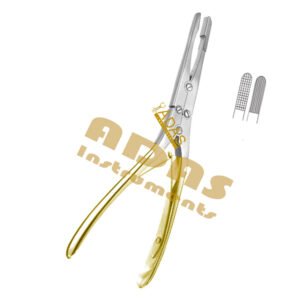
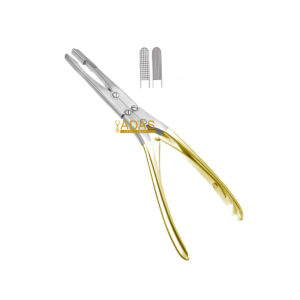
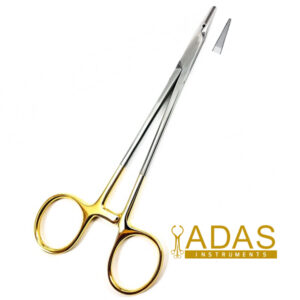
Rubin Septum Straightening Forceps | Tungsten Carbide Inserts
$ 75.00
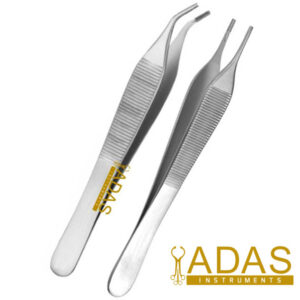
Rubin septum straightening forceps carry tungsten carbide inserts brazed into the jaws, and that is the whole reason to buy this one over a plain steel septum forceps. Carbide keeps its bite on cartilage far longer than steel does, so the instrument that grips a septum the same way on its five hundredth case as on its first is the one with the inserts in it. It is the most expensive septum forceps we make at 75 dollars and it is bought by lists that run this operation every week.
Key Features
- Tungsten carbide inserts brazed into the jaws
- Holds its grip on cartilage long after plain steel has polished smooth
- For straightening a deviated or fractured nasal septum
- No ratchet. The jaws close under finger pressure alone
- Cut from high quality medical grade stainless steel and fully autoclavable
- Three year replacement warranty against manufacturing defects
- Item code AQ-10.59
5 in stock (can be backordered)

What Rubin septum straightening forceps are
Septal cartilage is slippery and a steel jaw gripping it wears in a particular way: it does not break, it polishes. A polished jaw still looks perfect and no longer holds, and the surgeon compensates by squeezing harder, which is exactly what you do not want to be doing to a septum.
Tungsten carbide is the answer to that. Carbide is harder than the steel around it and it is brazed into the jaw as an insert rather than coated onto it, so the gripping face stays rough for the life of the instrument. It is the same reasoning behind every carbide instrument on this site and it is the only reason this one costs twice what the plain patterns do.
One thing has to be said straight, because the alternative is pretending. There is a disagreement in the published record about what a Rubin is. Google and the keyword tools both treat the Rubin pattern as a cartilage MORSELIZER, a pliers style instrument that crushes a graft, and “rubin septal morselizer” is measured at 40 searches a month. Our own catalog lists this product as a septum STRAIGHTENING forceps and carries no attributes for it at all. So this page describes a tungsten carbide septum forceps, which is what our own record supports, and it does NOT claim the instrument crushes or morselizes anything. If you need a morselizer, there is one in this family and it is linked below.
Listed as a Rubin forceps, a tungsten carbide septum forceps, a septum forceps stainless steel in the catalog word order, and a septum straightening clamp. No attributes on file, which means no jaw figure and no length on this page.
Key design features
The carbide inserts, and why they are inserts
Brazed in, not sprayed on. A coating wears through and leaves you with a smooth steel jaw and no warning; an insert is a block of carbide that goes all the way through the gripping face. It is a slower and more expensive thing to make and it is the difference between an instrument that lasts and one that looks like it does.
A grip that does not need more force
The point of the carbide is not that it grips harder on day one. It is that it grips the same on day five hundred. The failure mode of a plain steel septum forceps is a surgeon gradually squeezing harder on cartilage to get the same hold, and that is paid for by the lining.
No ratchet
Finger pressure only. A septum is moved, checked and moved again, and a lock turns one continuous feel into a sequence of settings. There is nothing to release.
What is NOT on it
No gap between the blades, no handing, no coating on the shanks and no light. In particular there is no built in protective gap: that is the Asch, and where the lining is thin that instrument is the better choice regardless of what the jaws are made of.
What to order, and what we do not publish
One pattern, and the honest half of this table is the right hand column.
| Specification | What we publish | Why |
|---|---|---|
| Jaw face | Tungsten carbide inserts | From our own product name. It is the feature the instrument is sold on |
| Jaw size | NOT published by us | There is NO attribute set on this product, which is a real gap on a 75 dollar instrument and it is on our list |
| Overall length | NOT published by us | Same answer |
| Whether it morselizes cartilage | NOT claimed by us | Google and the keyword tools call the Rubin pattern a morselizer. Our record calls this a straightening forceps and carries nothing else, so we claim nothing else |
Where it is used
Septal work on a list that runs often enough for jaw wear to matter.
| Procedure | What this forceps does | Note |
|---|---|---|
| Septoplasty | Grips and repositions a deviated septum | The main use, and the one the carbide is bought for |
| Closed reduction of a nasal fracture | Moves a fractured septum back to the midline | The Asch is the gentler choice where the lining is at risk |
| Septorhinoplasty | Straightens the septum before the bones are addressed | Order of work |
| A high volume ENT list | The same grip, case after case | This is the real argument for carbide and it is about years, not operations |
What it holds back, and what it must not do
A harder jaw is a harder jaw, and that cuts both ways.
| The task | What this forceps does | What it must not do |
|---|---|---|
| Gripping cartilage | Carbide inserts hold a slippery septum without extra squeeze | It is NOT a reason to squeeze harder. A better grip is for using less force, not more |
| Protecting the lining | Nothing in particular. There is no built in gap | Where the mucoperichondrium is thin or scarred, use the Asch, which has the permanent gap between the blades, which is what keeps the mucoperichondrium from being crushed while the cartilage is moved |
| Crushing or softening cartilage | NOT CLAIMED. Our record does not describe this instrument as a morselizer | If a graft has to be softened, use the morselizer or a crusher. Do not use this and hope |
| Holding a position | Holds under finger pressure | It does not lock. There is no ratchet |
How it compares with the rest of the family
Four septum instruments and one question: what is actually wrong with the septum.
| Instrument | Jaw face | The feature that decides it | Buy it when |
|---|---|---|---|
| Rubin, this page | Tungsten carbide inserts | A grip that does not wear out | The list runs this operation every week |
| Asch | Plain steel, angled | A permanent gap that spares the lining | The lining is thin, scarred, or both |
| Cottle Walsham | Plain steel | Reach to the bony base | The base is displaced, not just the cartilage |
| Gorney septal morselizer | Tungsten carbide, double action | It softens cartilage rather than moving it | The septum has to bend, not shift |
Materials and finish
Every Rubin septum straightening forceps we make is cut from high quality medical grade stainless steel. The steel itself is made to a German specification. We do not publish a grade number. The number on a certificate tells a surgeon nothing about whether a carbide insert is still tight in its braze after two hundred autoclave cycles, because that joint is where a carbide instrument fails if it fails at all, and the answer to that is in the making rather than in the alloy.
The insert is brazed into a seat machined for it, and then the whole jaw is finished together so the carbide and the steel sit flush. A proud insert catches tissue and a recessed one does not grip, and getting that flush is the whole skill in making a carbide instrument.
There is no sharp external edge anywhere on the blades. The gold handle ring that marks a carbide instrument on most trays is not something we publish, because our own record does not say this one has it.
Caring for it
Nothing abrasive on the jaws, ever. An abrasive pad takes the roughness off a carbide face the same way it would off steel, and roughness is what you paid for.
Wash the joint open, warm water and a soft brush. Autoclave with the tray. Look at the inserts under good light every so often: a carbide face that has gone shiny, or an insert with a line of corrosion around its edge, is an instrument on its way out and it is the one fault on this pattern that cannot be cleaned off.
Ordering and wholesale
Every Rubin septum straightening forceps is made by Adas Instruments in our own workshop and sold direct, which is why the price sits where it does against the catalog houses. Order one for a single tray, or in quantity for a hospital list or a distributor line. We do OEM work under your own brand and your own item numbers. Send us a sample and we will hold a run to your pattern rather than ours. Stock items ship from our own workshop. Backorder items take 10 to 12 working days to make. Every instrument carries a three year replacement warranty against manufacturing defects. Production is controlled under an ISO 13485 quality management system.
Frequently asked questions
What are Rubin septum straightening forceps used for?
Gripping and repositioning a deviated or fractured nasal septum. The tungsten carbide inserts in the jaws hold slippery cartilage without the surgeon having to squeeze harder as the instrument ages.
What does tungsten carbide actually do here?
It keeps the gripping face rough. Plain steel does not break on cartilage, it polishes, and a polished jaw looks perfect and no longer holds. Carbide is harder than the steel around it, so the face stays as it was made.
Is the Rubin a morselizer or a straightening forceps?
Google and the keyword tools describe the Rubin pattern as a cartilage morselizer. Our own catalog lists this product as a septum straightening forceps and carries no attributes for it. We have written the page on what our record supports and it claims no crushing, and the question is on our own list to settle by looking at the instrument.
What size are the jaws?
We do not publish a figure, because our record carries no attribute for this product at all. On a 75 dollar instrument that is a gap we are not comfortable with and it is on our list to measure. Ask us before ordering if a dimension has to be matched.
Should I buy this or the Asch?
Buy the Asch if the lining is the thing you are worried about: its blades hold a permanent gap that keeps the mucoperichondrium out of the squeeze. Buy the Rubin if the list is busy and you want a jaw that still grips in five years.
Related products and categories
For a protective gap between the blades, the Asch septum straightening forceps. For the bony base, the Cottle Walsham septum straightening forceps. For softening cartilage rather than moving it, the Gorney septal morselizer, which is the instrument in this family that genuinely crushes.
The rest of this family sits under nasal cutting, crusher and septum forceps, and every forceps we make that grips rather than cuts is under hemostats and grasping forceps.
| Weight | 0.1 kg |
|---|
Be the first to review “Rubin Septum Straightening Forceps | Tungsten Carbide Inserts”
Shipping & Delivery Policy
Processing Time: In-stock items are dispatched within 24-48 hours. For custom or out-of-stock items, production time is approximately 10-15 days.
Global Delivery Estimates
We partner with world-class couriers (DHL, FedEx) to ensure fast, tracked delivery.
- USA & Canada: 3-5 Business Days
- Europe & UK: 4-6 Business Days
- Rest of World: 5-7 Business Days
*We offer Air Cargo and Sea Freight options for bulk wholesale orders.
Customs & Duties
International buyers are responsible for any customs duties or taxes imposed by their country. Adas Instruments is not responsible for delays caused by customs clearance.
Lost Packages & Insurance
If your package is lost in transit, please contact us immediately. We offer full support and replacements for confirmed lost shipments. Note: You must report non-delivery within 3 weeks to be eligible for an insurance claim.
Related products
Reviews
There are no reviews yet.