
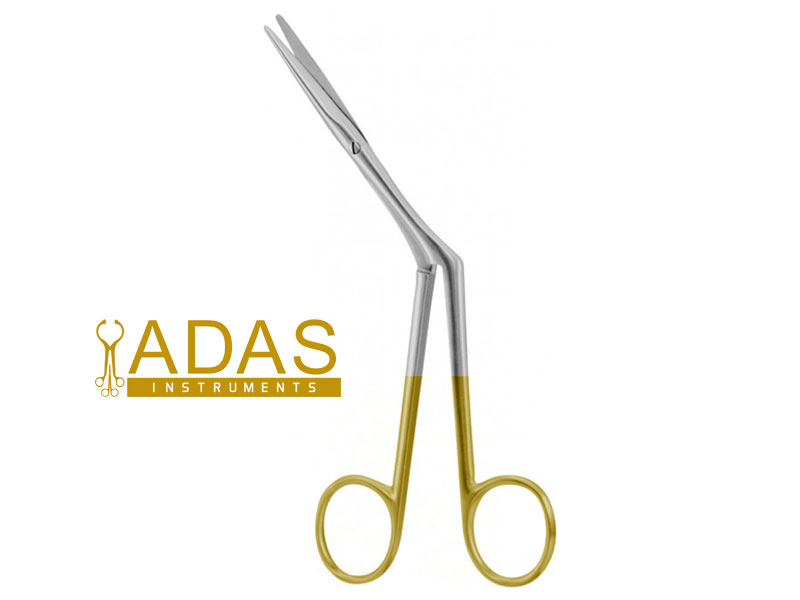
Heymann Nasal Scissors for Turbinectomy, Long Angled Blades, 18 cm
Price range: $ 17.00 through $ 23.00
Heymann nasal scissors are ENT scissors with a knee bent shank and long, blunt tipped blades for cutting and dissecting tissue deep inside the nasal cavity, above all in turbinate reduction. Ours are 18 cm overall with long smooth blades on an angled shank, so the tips reach the back of the inferior turbinate through the nostril while the hand stays out of the line of sight. They are listed at 17 and 23 dollars and made to order.
Key Features
- Knee bent shank, hand below the line of sight
- Long, narrow blades for the posterior nose
- Smooth on both blades
- Blunt tips to spare the mucosa
- 18 cm overall
- Reusable, steam sterilized
- Three year replacement warranty against manufacturing defects
- Item code AD-216.18

What Heymann turbinectomy scissors are
The inferior turbinate sits low on the side wall of the nose and runs a long way back. Trimming it means working at the far end of a narrow tunnel, with the light, the suction and the scissors all sharing the same opening. The Heymann pattern answers that with blades long enough to reach and a bend that keeps the hand out of the way.
Google AI Mode, read on 22 November 2026, describes Heymann turbinectomy scissors as specialized ENT surgical instruments with knee bent, angled shanks and long, blunt tipped blades for cutting and dissecting tissue deep inside the nasal cavity. It names turbinate reduction as the main use, gives 17 to 19 cm as the usual overall length, and lists smooth, micro serrated and carbide edges among the versions made.
Ours are 18 cm with smooth blades and blunt tips. Buyers ask for turbinectomy scissors, for turbinate scissors by the job, or for nasal turbinectomy scissors in full, and each of those names means this pair.
The scissors meet the turbinate after it has been shrunk with a decongestant and, in some cases, after the bone inside it has been outfractured. What is left to cut is soft, vascular tissue on a curved surface. Long blades that close evenly along their length trim that tissue in one stroke, which keeps the field cleaner than a series of short bites.
Key design features
A knee bent shank
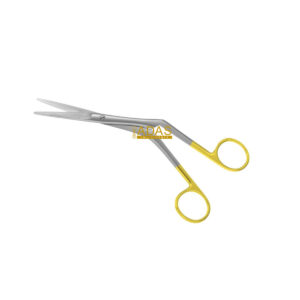
In our photograph the shank runs up from the rings, then bends sharply at the knee before the joint, and the blades rise from there. The bend lowers the hand and the rings below the line of sight, so the eye looks straight down the nostril to the tips.
Long, narrow blades
Our record gives these blades as long, and the photograph shows them narrow and straight beyond the bend. The length is the point of the pattern: it puts the edges at the back of the inferior turbinate while the joint stays near the nostril, where it has room to open.
Smooth blades and blunt tips
Both blades are smooth and both tips are blunt. Blunt tips spare the mucosa of the septum and the floor of the nose, which lie a few millimeters from the turbinate. AI Mode gives blunt tips that same job.
Two listed prices
Our listing carries this pair at 17 dollars and at 23 dollars, and both are made to order. The listing does not yet say what separates the two, so ask us which build you are ordering when you write. The length, shank and blades above are the same on both.
What you are ordering
Every figure below is read off our own listing on 22 November 2026. The pair is made to order.
| Feature | Ours | What it means |
|---|---|---|
| Length | 18 cm | reaches the back of the inferior turbinate |
| Shank | knee bent, angled | hand below the line of sight |
| Blades | long, smooth on both | one even stroke along the turbinate |
| Tips | blunt on both | spares the septal and floor mucosa |
| Price | from 17 dollars | listed at 17 and 23 dollars, made to order |
Where it is used
The first two columns come from the AI Mode answer read on 22 November 2026. The last column is our own guide.
| Job | What AI Mode says | How this pair suits it |
|---|---|---|
| Turbinate reduction | Named first by AI Mode | long blades reach the posterior turbinate |
| Cutting deep in the nasal cavity | The pattern is built for it | the knee bend keeps the view open |
| Dissecting mucosa | Cutting and dissecting tissue | smooth blades, blunt tips |
| Working beside the septum | Blunt tips protect the mucosa | both tips blunt |
| Reaching the back of the nose | 17 to 19 cm overall | ours are 18 cm |
What it is for, and what it is not for
This is a long angled pair for the turbinate. The table names the jobs where another pair of ours suits better.
| Job | Use the Heymann? | What to use instead or beside it |
|---|---|---|
| Trimming the inferior turbinate | Yes | This is the job it is made for |
| Dividing septal cartilage | No | The septal scissors, heavy and serrated |
| Cutting slippery cartilage deep inside | Beside it | The Knight nasal scissors, one serrated edge |
| Fine work at the nasal tip | No | The Converse scissors, 10 cm |
| Turbinate bone | No | A turbinate forceps or bone punch |
How it compares with the rest of the set
Five nasal scissors make up this set. Every cell is read off each listing’s own photograph and order form on 22 November 2026.
| Scissors | Shank and blades, from our photograph | Size and edge on our order form | Job | Price |
|---|---|---|---|---|
| Walter nasal scissors | straight shank, blades bending and curving up near the tips | 14 cm; fine smooth blades, blunt tips | lifting soft tissue off the dorsum | 23 dollars |
| Septal scissors | angled shank, straight heavy blades | 18.5 cm; micro serrated on both edges, blunt tips | dividing septal cartilage and thin bone | 28 dollars |
| Heymann turbinectomy scissors (this page) | knee bent shank, long narrow blades | 18 cm; long smooth blades, blunt tips | trimming the inferior turbinate | from 17 dollars |
| Knight nasal scissors | angled shank, slim straight blades | 18 cm; one serrated edge, blunt tips | cutting mucosa and cartilage deep in the nose | 26 dollars |
| Converse scissors | short pair, blades angled up on the flat | 10 cm; curved or straight, sharp or blunt, four edges | fine dissection at the tip and dorsum | 8.50 to 22 dollars |
Materials and finish
Every Heymann pair we make is formed from high quality medical grade stainless steel, and the steel itself is made to a German specification. The rings are gold colored in our photograph; we make no claim for an insert on this pair. We do not publish a grade number.
The nose is a narrow field, and a straight pair hides its own tips behind the hand. Every scissors in this set moves the hand out of the line of sight in its own way: a curve near the tips, a bend in the shank, or a short body held like a pen.
The five divide the work between them: the Walter lifts soft tissue off the dorsum, the Converse works fine at the tip, the Knight cuts mucosa and cartilage deep inside, the septal scissors take the septum, and the Heymann reaches the inferior turbinate. A tray that carries all five covers the cutting inside the nose from the first cut to the last.
Caring for it
Rinse the Heymann pair as soon as it comes out of use, with the blades open, so no blood or mucus dries in the joint or along the edges. Clean the full length of each blade, because blood dries quickly on the far end where it is hardest to see. Brush the joint and the inside faces of the blades, then dry the pair and steam sterilize it open or unlocked on the normal instrument cycle. Store it closed with the tips protected, so they do not knock against heavier instruments. Before each case, close the blades slowly and look at the tips: they should meet, and a pair that has started to chew rather than cut goes back for sharpening.
Ordering and wholesale
Each pair of Heymann turbinectomy scissors is made by Adas Instruments in our own workshop and sold direct, which is why the price sits where it does against the catalog houses. Order one for a single tray, or in quantity for a hospital list or a distributor line. We do OEM work under your own brand and your own item numbers. Send us a sample and we will hold a run to your pattern rather than ours. Stock items ship from our own workshop. Backorder items take 10 to 12 working days to make. Every instrument carries a three year replacement warranty against manufacturing defects. Production is controlled under an ISO 13485 quality management system.
Frequently asked questions
What are Heymann turbinectomy scissors used for?
They are used for cutting and dissecting tissue deep inside the nasal cavity, above all in turbinate reduction, the use AI Mode names first. The long blades reach the back of the inferior turbinate through the nostril. The case is the surgeon’s call.
Why do turbinectomy scissors have long blades?
Because the inferior turbinate runs a long way back along the side wall of the nose. Long blades put the edges at the far end while the joint stays near the nostril, where there is room for it to open and close.
How long are Heymann scissors?
Ours are 18 cm overall, with long smooth blades and blunt tips on a knee bent shank. AI Mode gives 17 to 19 cm as the usual length for the pattern, so ours sit in the middle of that range.
Are Heymann scissors the same as turbinate scissors?
They are one pattern of turbinate scissors. Turbinate scissors is the name for the job; Heymann is the pattern with the knee bent shank and long blades. Buyers ask for this pair under either name, and for turbinectomy scissors as well.
How is the Heymann different from the Knight nasal scissors?
Both are angled and close to the same length. The Heymann has longer, smooth blades on a sharper knee bend for the inferior turbinate. The Knight has slimmer blades with one serrated edge for mucosa and cartilage deeper in.
Related products and categories
Three more scissors from the same nasal set: Knight nasal scissors, 18 cm, Converse scissors, 10 cm and Walter nasal scissors, 14 cm. The whole range is in rhinoplasty instruments, and the nasal specula, elevators and septum forceps are under ENT instruments.
| Weight | 0.05 kg |
|---|---|
| Select Size | 18 cm / 7" |
| Blade | Long, smooth both blades, blunt tips |
| Shank | Angled |
Be the first to review “Heymann Nasal Scissors for Turbinectomy, Long Angled Blades, 18 cm”
Shipping & Delivery Policy
Processing Time: In-stock items are dispatched within 24-48 hours. For custom or out-of-stock items, production time is approximately 10-15 days.
Global Delivery Estimates
We partner with world-class couriers (DHL, FedEx) to ensure fast, tracked delivery.
- USA & Canada: 3-5 Business Days
- Europe & UK: 4-6 Business Days
- Rest of World: 5-7 Business Days
*We offer Air Cargo and Sea Freight options for bulk wholesale orders.
Customs & Duties
International buyers are responsible for any customs duties or taxes imposed by their country. Adas Instruments is not responsible for delays caused by customs clearance.
Lost Packages & Insurance
If your package is lost in transit, please contact us immediately. We offer full support and replacements for confirmed lost shipments. Note: You must report non-delivery within 3 weeks to be eligible for an insurance claim.
Related products
Reviews
There are no reviews yet.